Boat Title vs. Registration: Key Differences
Boat title and boat registration are two separate but related legal processes. While they are often completed at the same time, they serve fundamentally different purposes. Understanding the distinction is important for every boat owner, especially when buying, selling, or moving a vessel across state lines.
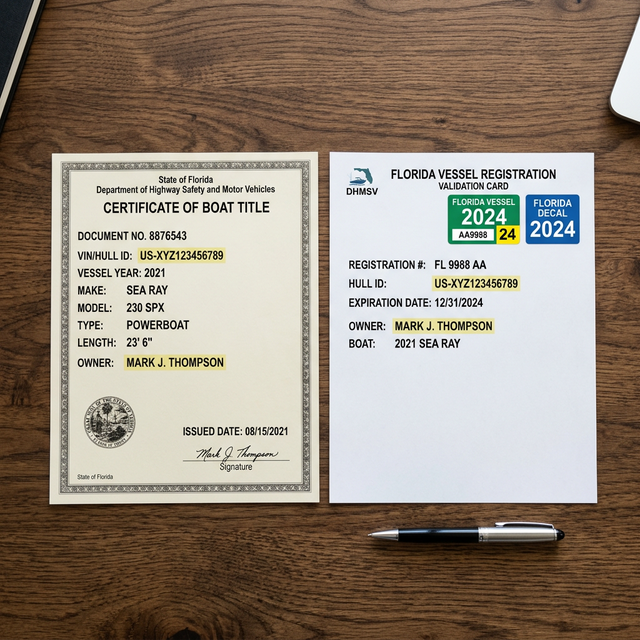
A boat title is a legal document that establishes and proves ownership of a vessel. It functions similarly to a car title and is issued by a state agency. The title contains the owner's name, the vessel's Hull Identification Number (HIN), and details about any liens on the boat.
Boat registration, on the other hand, is the process of recording your vessel with the state and obtaining permission to operate it on public waterways. Registration assigns a unique identification number to your boat and provides a registration certificate that must be carried on board.
Do All States Require Both Title and Registration?
All 50 states require boat registration for most motorized vessels, but not all states require boat titles. Title requirements vary significantly from state to state.
As of 2026, most states do require boat titles for at least some classes of vessels. However, several states have no title requirement at all, while others only require titles for boats above a certain length, value, or model year. Some states have recently introduced titling requirements as part of efforts to combat boat theft and fraud.
States that generally do not require boat titles include Alaska and certain situations in New England states. Large boating states like Florida, Texas, California, and Michigan all require titles for motorized vessels. Use our title requirements checker to quickly determine your state's requirements.
Why Titles Matter for Buyers and Sellers
For buyers, a title provides proof of clean ownership and reveals any outstanding liens. Purchasing a boat without a title in a title-required state can lead to significant problems: you may be unable to register the vessel, transfer ownership later, or obtain insurance.
For sellers, a clear title makes your boat easier to sell and typically commands a higher price. Prospective buyers are wary of boats without titles because it can suggest stolen property, unresolved liens, or ownership disputes.
Even in states that do not require titles, having a bill of sale and any available documentation of the ownership chain is strongly recommended.
USCG Documentation as an Alternative
Vessels that are five net tons or larger and owned by US citizens can be documented with the US Coast Guard instead of (or in addition to) obtaining a state title. USCG documentation is required for vessels operating in international waters or used for commercial purposes.
USCG documentation does not replace state registration in all states. Some states still require documented vessels to have state registration for tax purposes. For more information, see our USCG documentation guide.
How to Get a Boat Title
If you are purchasing a new boat from a dealer, the dealer typically handles the title application as part of the sale. For used boats, the seller signs the title over to you, and you submit a title transfer application to your state's titling agency.
If a boat has never been titled (common for older vessels), you may need to apply for an original title. This usually requires proof of ownership such as a bill of sale, registration history, or an affidavit of ownership. Some states require a physical inspection of the boat and HIN verification.
Title fees typically range from $5 to $55 depending on the state. Most states process titles within 2-6 weeks by mail, or same-day for in-person applications.
When You Need Both
In states that require both title and registration, you must have both documents for your vessel to be legal. The title establishes your ownership, and the registration gives you permission to operate on public waterways.
You can own a titled boat without registration (for example, if it is in storage and not being used), but you cannot legally operate a registered boat without a title in states that require one.
Frequently Confused Terms
Certificate of Number: This is another name for the registration certificate in some states. It is not a title.
USCG Certificate of Documentation (COD): This is a federal proof of ownership for qualifying vessels. It is similar to a title but issued by the Coast Guard rather than a state.
Manufacturer's Certificate of Origin (MCO): This is issued by the boat manufacturer for new vessels and is used to obtain the first title. It is not itself a title.
Frequently Asked Questions
What is the difference between a boat title and registration?
Do I need a boat title in every state?
Can I sell a boat without a title?
What should I do if I lost my boat title?
Sources
- National Association of State Boating Law Administrators — NASBLA (https://www.nasbla.org/)
- U.S. Coast Guard — Vessel Documentation Center (https://www.dco.uscg.mil/nvdc/)
This information is provided for reference purposes only. While we strive to keep data accurate and up-to-date, registration requirements, fees, and regulations may change without notice. Always contact your state's official registration agency for the most current and authoritative information before making any decisions.