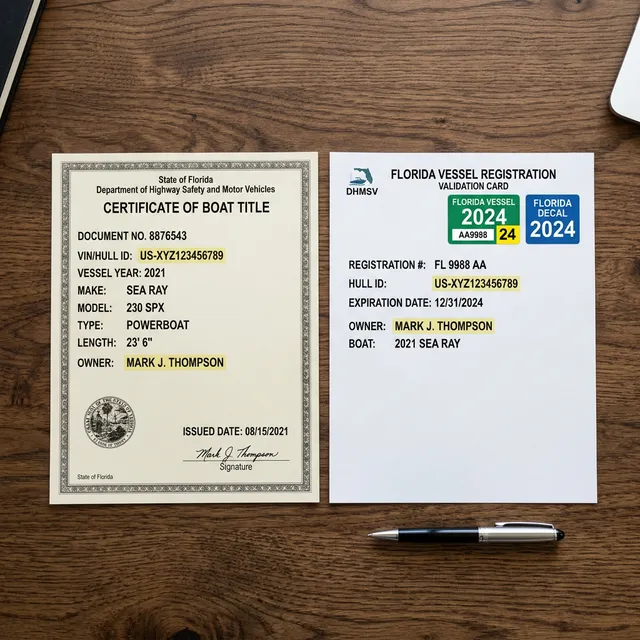
Boat Title vs. Registration: Key Differences
Boat title and boat registration are two separate but related legal documents. While they are often processed at the same time, they serve fundamentally different purposes — and confusing them can cause serious problems when buying, selling, or relocating a vessel.
Boat title is a legal document that establishes and proves ownership of a vessel. It functions like a car title: it records the owner's name, the vessel's Hull Identification Number (HIN), and any liens (outstanding loans) against the boat. A title transfers with the boat when it is sold.
Boat registration is the process of recording your vessel with the state and obtaining permission to operate it on public waterways. Registration assigns a unique identification number (registration number) displayed on the hull, and provides a registration certificate that must be carried on board while operating.
Think of it this way: the title is a deed (proves you own it), and registration is a license plate (proves you're authorized to use it on public waters).
| Document | What it does | When it matters most |
|---|---|---|
| Boat title | Shows ownership and liens | Buying, selling, financing, inheritance, and title-required transfers |
| Boat registration | Authorizes operation and assigns hull numbers | Operating on public waterways and renewing state credentials |
| Bill of sale | Documents the transaction terms | Private sales, tax calculation, and ownership-chain support |
| USCG documentation | Creates a federal vessel record for qualifying vessels | Eligible vessels, documented-vessel financing, and certain commercial uses |
Which States Require a Boat Title?
Most states require registration for motorized vessels, but title rules are more uneven. Some states title nearly all motorized vessels; others title only vessels above a length, horsepower, model-year, or lien threshold; and some states rely on registration records, bills of sale, or prior ownership documents instead of issuing a separate boat title.
Title-required transactions: If the boat has an existing state title, a lien, a qualifying outboard motor, or a size category that your state titles, expect the agency to ask for the signed title or a formal replacement path.
Registration-only transactions: If the state does not issue boat titles for that vessel category, the registration certificate, bill of sale, manufacturer statement, or prior-state paperwork becomes more important. Keep the full ownership chain, not only the current registration card.
Use our title requirements checker to instantly find your state's specific rules, or read the comprehensive states that require boat titles guide.
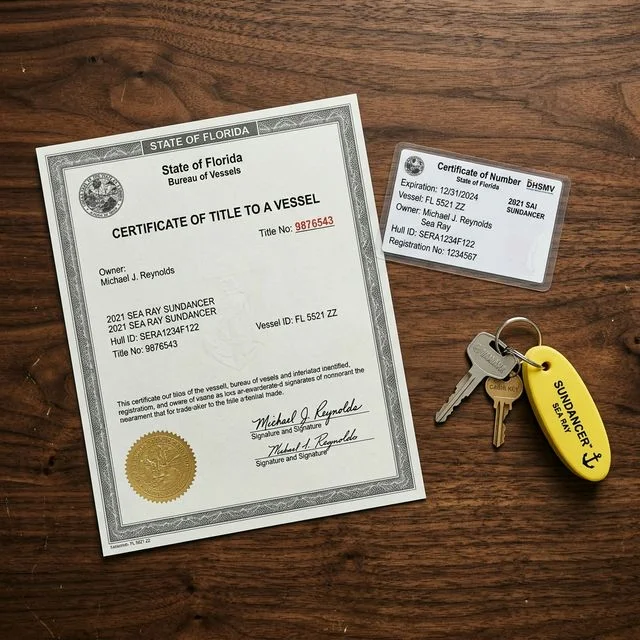
Why Titles Matter for Buyers
For anyone buying a used boat, the title is your single most important safeguard. Here's what it protects you from:
Stolen vessels: A valid title creates a verifiable chain of ownership. Without one, you have no way to confirm the seller legally owns the boat. Law enforcement routinely checks title records during stolen vessel investigations — and if you're holding a stolen boat, you lose it regardless of whether you paid for it.
Hidden liens: Outstanding loans are recorded directly on the title document. If a boat has a $20,000 loan against it and you buy it without checking the title, the lender can legally repossess the vessel from you. The title is the fastest way to discover any financial encumbrances.
Future resale problems: Buying a boat without a title in a title-required state means you may be unable to register it, insure it, or sell it later. You could end up with a boat that's essentially unusable on public waterways.
Why Titles Matter for Sellers
For sellers, a clear title makes your boat significantly easier to sell and typically commands a higher price. Experienced buyers and marine finance companies will not proceed without a title in states that require one.
If you've lost your title, apply for a duplicate through your state's titling agency before listing the boat for sale. The fee, form, and processing time vary, but starting before the listing removes the single biggest barrier to a clean sale.
Even in registration-only states, having a documented ownership chain (bill of sale from prior transfers, registration history, lien releases, and seller ID) gives buyers more confidence and can speed up the transaction.
What Happens If You Buy a Boat Without a Title?
In a title-required transaction, buying a boat without a title creates a serious problem. You may be unable to complete a standard registration, insure the vessel, or resell it without first clearing the ownership path. Your options are limited and often expensive:
Option 1 — Bonded title: Some title-required states offer a bonded title process for boats without titles. The state may require an ownership review, assessed value, surety bond, bonded-title fee, and a waiting period before the bonded notation can be removed. The bond amount and premium are state- and provider-specific.
Option 2 — Court order: Some owners must petition a court for a judicial determination of ownership. This can involve filing a petition, publishing notice, and presenting evidence to a judge. Costs and timing vary widely.
Option 3 — Contact the previous owner: If you can locate the previous titled owner, they can apply for a duplicate title and then sign it over to you. This is the cheapest and simplest option when possible.
The bottom line: never buy a boat without a title in a title-required state unless you fully understand and accept the cost and hassle of obtaining one afterward. For more details, see our used boat registration guide.
USCG Documentation as an Alternative
Vessels measuring five net tons or larger — roughly 25+ feet for recreational boats — that are owned by U.S. citizens can be documented with the U.S. Coast Guard. USCG documentation serves as a federal proof of ownership, similar to a title but issued at the federal level rather than state level.
When USCG documentation is required: Certain eligible vessels used in coastwise trade, commercial fishing, or other documented trades must be documented. Recreational boat owners may voluntarily document eligible vessels, but documentation is not available for every boat.
Important limitation: USCG documentation does not automatically replace state registration, decal, or tax requirements. Documented vessels generally use federal identification instead of state bow numbers, but many states still require a state record, validation decals, or local tax paperwork.
For the full process, see our USCG documentation guide.
How to Get a Boat Title
New boat from a dealer: The dealer may handle the title application using the Manufacturer's Certificate of Origin (MCO), but confirm what the dealer files and what you must sign.
Used boat from a private seller: The seller signs the title over to you when the vessel is titled. You submit the assigned title with the title transfer application, fee, and any required tax paperwork to your state's agency.
Boat never titled before: Older vessels that predate state titling requirements may need an original title application. This requires proof of ownership (bill of sale, registration history, or affidavit), a physical HIN inspection, and sometimes an ownership search. Contact your state's agency for specific requirements.
Processing time depends on the agency, office channel, missing documents, liens, and whether an ownership review is required. For a full walkthrough and state-by-state fees, see our boat title transfer guide.
When You Need Both Title and Registration
When your state requires both documents, the title establishes ownership and the registration authorizes operation.
Title without registration: Often possible for a boat in storage, dry dock, or private waters, but you generally cannot operate it on public waterways until registration is current.
Registration without title: In a title-required transaction, registration without a clean ownership path can create resale, insurance, or enforcement problems.
Registration-only state or vessel category: Registration and supporting ownership documents may be the primary evidence. Keep the bill of sale and prior registration records with the same care you would give a title.
Common Terminology Explained
Certificate of Number: Another name for the registration certificate used in some states. This is not a title — it's the document you carry on board while operating.
USCG Certificate of Documentation (COD): A federal proof of ownership and nationality for qualifying vessels (5+ net tons, U.S. citizen owners). It functions like a federal ownership record but does not automatically satisfy state registration, decal, or tax rules.
Manufacturer's Certificate of Origin (MCO): Issued by the boat manufacturer for new vessels. This document is used to obtain the first title and is not itself a title. Once the title is issued, the MCO is absorbed into the state's records.
Hull Identification Number (HIN): The 12-character unique identifier on every boat built after November 1972. The HIN appears on both the title and registration and is essential for verifying that documents belong to the correct vessel.
Frequently Asked Questions
What is the difference between a boat title and registration?
Do I need a boat title in every state?
Can I sell a boat without a title?
What should I do if I lost my boat title?
Why do boat title counts vary by source?
Can I operate a titled boat in a state that doesn't require titles?
Does USCG documentation replace a state title?
Sources
- National Association of State Boating Law Administrators — NASBLA (https://www.nasbla.org/)
- U.S. Coast Guard — National Vessel Documentation Center (https://www.dco.uscg.mil/nvdc/)
- Florida DHSMV — Vessel Titles (https://www.flhsmv.gov/motor-vehicles-tags-titles/vessels/)
- California DMV — Vessel Registration (https://www.dmv.ca.gov/portal/vehicle-registration/vessel-registration/)
This information is provided for reference purposes only. While we strive to keep data accurate and up-to-date, registration requirements, fees, and regulations may change without notice. Always contact your state's official registration agency for the most current and authoritative information before making any decisions.