
Quick Answer: How Do You Renew Boat Registration?
To renew a boat registration, use your state agency's online renewal portal, mail the renewal notice, or visit the DMV, DNR, county tax collector, or registration agent listed on your current certificate. You usually need the registration number, owner information, payment method, and any updated address or vessel details.
| Renewal question | Short answer | Next step |
|---|---|---|
| Can I renew online? | Many states support online renewal for eligible existing records | Start with your state registration page |
| How often do I renew? | Usually 1, 2, or 3 years depending on state | Check the expiration date on your certificate |
| What if it expired? | Do not operate until renewed | Renew immediately or re-register if long lapsed |
| What does it cost? | Often the same class fee as registration, plus decals or late fees where applicable | Use the fee calculator for an estimate |
Renewal rules are state-specific. For high-demand renewal pages, see Utah renewal, Connecticut renewal, Arkansas renewal, Delaware renewal, and SCDNR boat registration renewal.
Why Boat Registration Renewal Matters
Boat registrations are not permanent. Every state requires vessel owners to renew their registration periodically — whether annually, biennially, or on a three-year cycle — to maintain legal operating status on public waterways. Operating a boat with an expired registration can result in fines ranging from $25 to over $500 depending on the state, and in some jurisdictions, law enforcement may impound the vessel until it is properly registered.
Renewal also ensures your vessel information stays current in state databases, which is critical for safety, law enforcement, and search-and-rescue operations. Timely renewal is a fundamental responsibility of boat ownership, and most states make the process straightforward through online services.
SCDNR Boat Registration Renewal: What to Check
South Carolina is a good example of why renewal pages need state-specific handling. In current site data, South Carolina boat registration renewal is annual and tied to county property tax processing. SCDNR lists a $10 renewal fee, while county property taxes and late fees can affect the final renewal path.
| SCDNR renewal item | Current planning note |
|---|---|
| Renewal cycle | 1 year, generally renewed with county property taxes |
| SCDNR renewal fee | $10.00 in current site data |
| Late timing | Late fee applies on the 31st day after expiration; a larger late fee applies on the 61st day |
| Next page | South Carolina boat registration guide |
If your search is specifically for "SCDNR boat registration renewal," start with the South Carolina state guide, then verify the current renewal notice, county tax status, and SCDNR instructions before operating with expired decals.
Renewal Periods by State
Renewal cycles vary significantly across the 50 states. Below is a breakdown of the most common renewal periods based on each state's current regulations.
Annual renewal (1-year cycle): Connecticut, Indiana, New Jersey, South Dakota, Arizona, Hawaii, Utah, Washington, Kentucky (expires April 30), Idaho and Nevada (expire December 31), South Carolina (renewed with county property taxes), and Alabama (October 1 – September 30 fiscal year). Colorado and Maine follow a January 1 – December 31 calendar year.
Biennial renewal (2-year cycle): California, Maryland, Massachusetts, Pennsylvania, Texas, and Rhode Island (March 1 to last day of February). Oregon expires December 31 of the second year. Florida offers either 1-year or 2-year registration options. Vermont allows 1 or 2 years.
Triennial renewal (3-year cycle): Alaska, Arkansas, Georgia, Illinois, Kansas, Louisiana, Mississippi, Missouri, Nebraska, New Mexico, New York, Virginia, and Wisconsin. Michigan and Ohio registrations expire on March 31 and March 1 of the third year, respectively. Iowa runs May 1 to April 30 cycles. North Dakota uses a fixed 2026-2028 cycle. Delaware, North Carolina, Oklahoma, Wyoming, and Tennessee offer multi-year options up to 3 years.
Permanent registration: Montana is the only state offering a one-time permanent registration fee with no renewal required. Starting in 2025, validation decals are no longer needed for Montana-registered vessels.
Your registration certificate will clearly indicate the expiration date. Most states mail renewal notices 30-60 days before expiration, but it is ultimately your responsibility to renew on time.
How to Renew Your Boat Registration
Most states offer more than one renewal method, but online eligibility is not universal. A state may allow online renewal for an existing record while requiring mail, an office visit, county processing, property-tax clearance, or original documents for transfers, lapsed records, or corrections.
Online Renewal
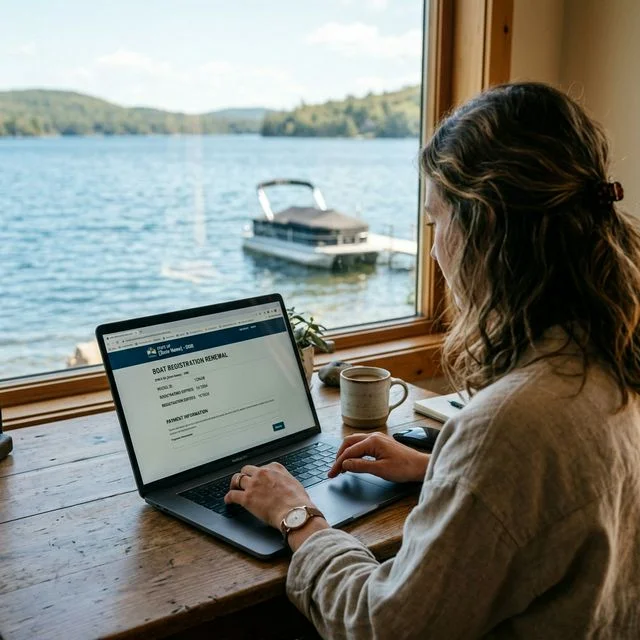
Online renewal is the fastest and most convenient method. You will typically need your existing registration number, the owner's date of birth or identification number, and a credit or debit card for payment. After completing the online process, many states allow you to print a temporary registration immediately while your permanent stickers and card are mailed.
Some state online renewal portals include Florida Virtual Office, California DMV Vessel Portal, Arizona Game & Fish, and Georgia Wildlife Resources. For your state's specific renewal portal, visit your state registration page.
In-Person Renewal
Visit your local DMV, county tax collector, DNR office, or other authorized agent. Bring your current registration certificate and a valid photo ID. This method is ideal if you need to update your address, correct information, or handle special situations such as adding a co-owner.
In-person processing is typically same-day. In Florida, you can renew at any county tax collector's office. In Texas, your local county Tax Assessor-Collector office handles renewals. In New York, any participating DMV office can process boat registration renewals.
Mail-in Renewal
Many states mail a renewal notice before expiration. Return the completed form with payment and any required updates. Mail timing varies by state, season, and whether your record needs correction, so do not wait until the expiration date if you plan to operate.
Keep a copy of your renewal form and payment receipt. If you have not received your new registration in the agency's expected window, contact your state boating agency to check the status.
Renewal Fees: What to Expect
Renewal fees are often the same base class fee as the original registration, but some states add decal, waterway, county, property-tax, aquatic invasive species, or agent fees. Fees are typically based on vessel length, type, horsepower, registration period, or local rules.
Plan for the full renewal cost: base renewal fee + decals or stickers + local/agent fees + late fee if expired + any required tax or property-tax clearance.
Use current state examples carefully: Texas lists $32-$150 for two-year vessel registration, Michigan lists three-year watercraft fees from $14 to $448, and New Hampshire combines length-based registration fees with decal, public water use, Fish and Game, and agent fees. Always confirm the final amount with the official state agency.
Beyond the base registration fee, many states charge additional fees for aquatic invasive species prevention, waterway access improvement, or boater education programs. Use our fee calculator to estimate your renewal cost, or check the state-by-state comparison for specific fee schedules.
Late Renewal and Penalties
If you fail to renew by the expiration date, most states impose late fees or penalties. The severity varies:
Grace period states: Some states allow a short grace period after expiration during which you can renew without penalty, while others treat operation after expiration as a violation immediately. Confirm your state rule before launching.
Flat late fees: Many states charge a fixed late fee. Florida adds a $10 late fee. Alabama charges a $5 late penalty. These are added on top of the regular renewal fee.
Percentage-based penalties: A few states calculate late fees as a percentage of the registration fee, which can add up quickly for larger vessels.
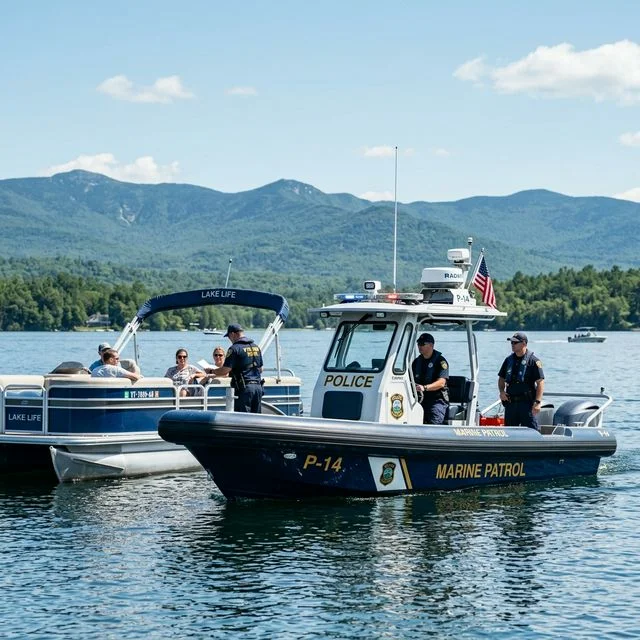
Operating a vessel with an expired registration is a citable offense in all 50 states. Law enforcement officers conducting safety checks on the water routinely verify registration validity. Repeated violations can result in increased fines and court appearances. Use our penalty calculator to estimate potential late fees in your state.
What if My Registration Has Lapsed for Over a Year?
If your registration has been expired for an extended period (usually more than one year), you may need to re-register the vessel rather than simply renew. This process is similar to an initial registration and typically requires proof of ownership (title or bill of sale), a hull identification number (HIN) verification, and in some states, a physical inspection of the vessel.
Some states charge back fees for the years the registration was lapsed. For example, if your 3-year registration in New York lapsed 2 years ago, you may owe the full 3-year fee plus penalties for the lapsed period. Contact your state's boating agency directly to understand the specific requirements and costs for re-registering a lapsed vessel.
For more information on handling an expired registration, see our expired boat registration guide.
Keeping Your Information Current
Renewal is an excellent time to update your information. If you have moved, changed your name, or made significant modifications to your vessel (such as repowering with a new engine), update this information during the renewal process.
Most states require you to notify the boating agency of address changes within 15-30 days — even outside of renewal — to ensure you receive future renewal notices and safety notifications. Failure to update your address can cause you to miss renewal notices, leading to unintentional lapses.
States with the Best Renewal Processes
For boat owners who value convenience, some states stand out for their renewal experience:
Montana offers permanent registration — pay once, and you never need to renew. This makes Montana the most owner-friendly state for registration.
Florida allows online renewal through its Virtual Office portal with instant temporary registration printing. The state also offers both 1-year and 2-year registration options.
California provides a user-friendly DMV vessel portal with biennial (2-year) renewal cycles, reducing the frequency of renewals.
3-year renewal states like Michigan, New York, Wisconsin, and Virginia require attention only once every three years, saving both time and effort.
Frequently Asked Questions
How often do I need to renew my boat registration?
Can I renew my boat registration online?
What happens if I let my boat registration expire?
Do I get a reminder when my boat registration is due?
Which states have the longest renewal period?
Is the renewal fee the same as the initial registration fee?
Can I renew my boat registration early?
Sources
- National Association of State Boating Law Administrators — NASBLA (https://www.nasbla.org/)
- Florida DHSMV — Vessel Registration & Titling (https://www.flhsmv.gov/motor-vehicles-tags-titles/vessels/)
- California DMV — Vessel Registration (https://www.dmv.ca.gov/portal/vehicle-registration/vessel-registration/)
- Michigan DNR — Watercraft Registration (https://www.michigan.gov/sos/vehicle/boat)
- New York DMV — Register a Boat (https://dmv.ny.gov/boat/register-boat)
- South Carolina Department of Natural Resources — Boating Titling and Registration (https://www.dnr.sc.gov/boating/Titling_and_Registration/)
This information is provided for reference purposes only. While we strive to keep data accurate and up-to-date, registration requirements, fees, and regulations may change without notice. Always contact your state's official registration agency for the most current and authoritative information before making any decisions.