Can You Sell a Boat Without a Title?
In a title-required state, do not treat a bill of sale as a substitute for a missing boat title unless the state agency says that specific transaction qualifies for a bonded title, duplicate title, court order, or other missing-title process. The safer seller path is to obtain a duplicate or corrected title before completing the sale.
In a registration-only or no-separate-title state, the agency may rely on registration records, a bill of sale, prior ownership paperwork, or other documents instead of a vessel title. That does not mean paperwork is optional. Buyers should still verify the HIN, check for liens where available, and confirm the filing path with the state agency before paying.
| Situation | Seller move | Buyer risk |
|---|---|---|
| State requires a boat title and title is missing | Seller should request a duplicate or corrected title before sale | Registration can be blocked, and liens or ownership defects may be hidden |
| State has a bonded/missing-title process | Confirm the exact agency process before taking payment | Extra time, bond cost, inspection, or rejection risk |
| Registration-only state | Provide bill of sale, prior registration, HIN, and ownership chain | Buyer still needs agency confirmation before operating |
For state-specific checks, use the title requirements checker, compare states that require boat titles, and read the boat bill of sale template before writing a private-sale receipt.
Why Registering a Used Boat Is Different
Registering a used boat involves additional steps compared to a new boat from a dealer. When you buy new, the dealership typically handles title application, registration paperwork, and sales tax collection as part of the sale. With a used boat — especially from a private seller — the entire burden falls on you as the buyer.
You are responsible for verifying the seller's legal ownership, confirming the vessel has no outstanding liens or theft history, completing the title transfer, paying applicable sales or use tax, and filing the registration application. Skipping any of these steps can result in an unregisterable boat, financial loss, or legal liability.
This guide walks through the entire process from pre-purchase verification to final registration, with specific advice for private sales, out-of-state purchases, and common pitfalls.
Private Sale vs. Dealer Purchase: Key Differences
Before diving into the process, understand that how you buy the boat significantly affects your registration experience:
Dealer purchase: Licensed marine dealers handle most paperwork. They will apply for the title transfer, collect sales tax, and often submit registration on your behalf. Timing varies by state agency, dealer process, and whether the paperwork is complete. The dealer must provide a valid title or Manufacturer's Certificate of Origin (MCO) for new boats. This is the simpler path, but you pay retail prices.
Private sale: You handle everything yourself. The seller signs over the title, you create a bill of sale, and you personally visit the DMV/DNR or submit applications by mail. You are responsible for verifying ownership, checking for liens, and paying sales tax directly. This path saves money on purchase price but requires diligence. The remainder of this guide focuses primarily on private sale transactions since they carry the most risk.
Before You Buy: Pre-Purchase Verification
Before exchanging any money, complete these critical verification steps. Discovering a problem after you've paid is significantly harder to resolve.
Verify the Hull Identification Number (HIN)
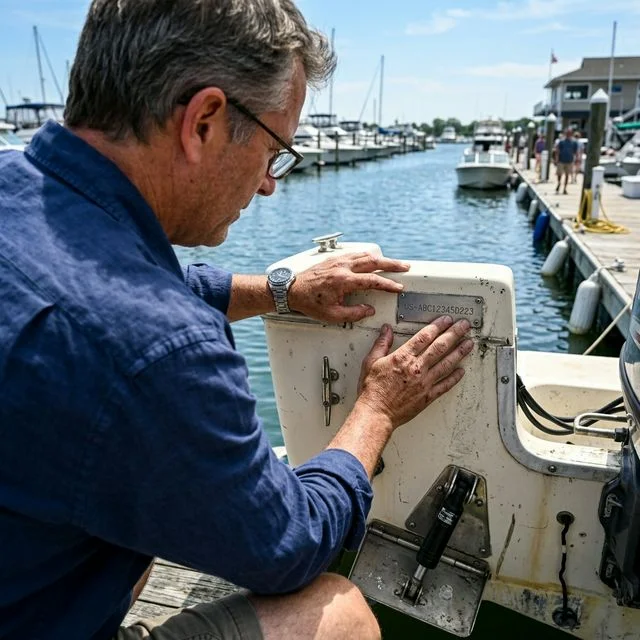
Every boat manufactured after November 1, 1972, has a unique 12-character Hull Identification Number (HIN) permanently affixed to the starboard (right) side of the transom. A second HIN is hidden in an unexposed location inside the hull. The HIN format includes the manufacturer's code (3 characters), serial number (5 characters), and date of manufacture (4 characters).
What to verify: The HIN on the physical boat must exactly match the HIN on the title, registration certificate, and bill of sale. Check both the primary (transom) and secondary (hidden) HIN — they should be identical. Look for signs of tampering: ground-off characters, re-stamped numbers, mismatched plates, or fresh paint/adhesive covering the HIN area.
If the HIN is missing, damaged, or doesn't match the paperwork, do not proceed with the purchase. A mismatched HIN is one of the strongest indicators of a stolen vessel or identity fraud. You can verify a HIN through the NICB VINCheck service for free.
Check for Liens and Encumbrances
A lien is a legal claim on the boat by a creditor — usually from an unpaid boat loan, marina storage fees, or mechanic's work. If you buy a boat with an existing lien, the creditor retains the right to repossess the vessel regardless of your purchase. You would lose both the boat and your money.
How to check: Contact your state's titling agency and request a lien search using the HIN. In title-required states, liens are often recorded on the title document itself — look for entries in the "Liens" or "Security Interest" section. In registration-only or no-separate-title states, ask the registration agency whether liens are tracked through registration records, UCC filings, or another state process.
If a lien exists, the seller must obtain a lien release from the creditor before the sale can proceed. Never accept a seller's verbal assurance that a loan has been paid off. For more details, see our boat lien check guide.
Verify the Seller's Identity and Ownership
Confirm that the person selling the boat is the actual owner listed on the title. Request to see their government-issued photo ID and compare the name, address, and signature to the title document.
Red flags: The seller's name doesn't match the title, the seller claims to be selling "for a friend" or "for an estate" without proper documentation, the seller is unwilling to meet at their home or the boat's storage location, or the seller pressures you to skip the title transfer and "just use a bill of sale."
If the seller is not the titled owner, they must provide legal documentation authorizing the sale — such as a power of attorney, letters testamentary (for estates), or a court order. Do not accept excuses for missing documentation.
Red Flags: When to Walk Away
Years of buying and selling boats reveal consistent warning signs. If you encounter any of these, proceed with extreme caution or walk away entirely:
1. No title available: In states that require boat titles, a seller who "can't find" or "never received" the title is a major risk. While duplicate titles are obtainable, the seller should apply for the duplicate before the sale — not you.
2. Price far below comparable listings: A price that is well below similar boats is a reason to verify the HIN, lien status, ownership documents, and condition before paying. It is not proof of a problem by itself, but it should slow the transaction down.
3. HIN tampering: Any signs of ground-off numbers, re-stamped characters, or plates attached with non-original fasteners.
4. Seller refuses to allow inspection: A legitimate seller has no reason to prevent a marine survey or mechanical inspection.
5. Cash-only, no paperwork: A seller who insists on cash payment and resists creating a bill of sale or meeting at a registration office is likely trying to avoid a paper trail.
6. Multiple title transfers in a short period: A title showing 3-4 owners in 1-2 years is unusual and may indicate the boat is being "flipped" due to undisclosed problems.
7. Reluctance to meet at a registration office: Offering to complete the title transfer together at the local DMV/DNR is the safest approach. A seller who refuses this arrangement should raise concerns.
Required Documents for Used Boat Registration
When registering a used boat, you will need the following documents. Requirements vary by state, so use our document checklist generator to get a personalized list for your state.
Common documents to prepare: A signed title when the state requires one, a bill of sale with purchase price, date, and vessel details, the hull identification number (HIN), the state registration/title application, valid photo identification when required, and proof of sales tax payment or exemption when applicable.
Additional documents (state-specific): Some states require notarized signatures, a state bill of sale, an HIN inspection, an engine or outboard motor application, a vessel condition report, or proof of insurance. Some states do not require a separate boat title for every vessel class, so check our title requirements checker before assuming the signed title is or is not required.
The Title Transfer Process
Title transfer is the legal process of changing boat ownership from the seller to you. In title-required states, this step is usually mandatory and must be completed before or simultaneously with registration. The process involves three core steps.
Step 1: Complete the Title Assignment
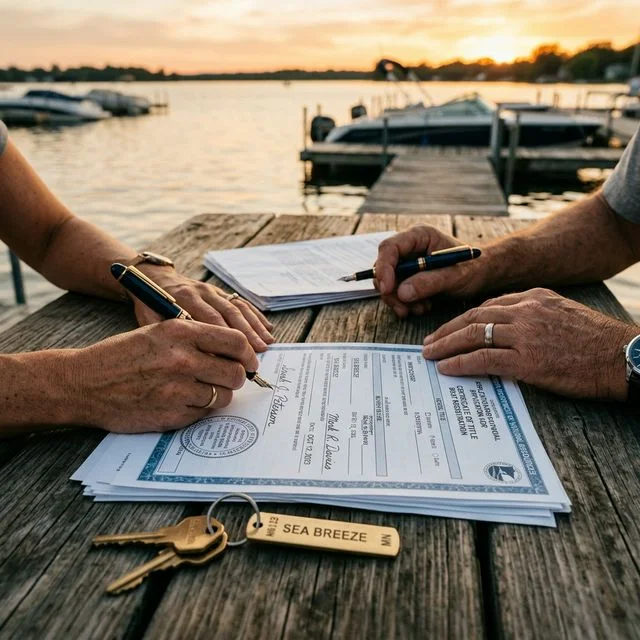
The seller signs the back of the title in the "seller" or "assignment" section, including their printed name, signature, and date. You (the buyer) fill in your information in the "buyer" section. Signatures, bills of sale, or supporting affidavits may need to be notarized depending on the state and transaction type.
Critical detail: Ensure all fields are filled in completely. Any blank fields, corrections made with correction fluid, or mismatched information can cause the title to be rejected. If mistakes are made, it is safer to have the seller apply for a duplicate title than to attempt corrections on the original.
Step 2: Create a Bill of Sale
A bill of sale is a written agreement documenting the transaction. While oral agreements may be technically valid in some states, a written bill of sale protects both parties and is required for registration in most states.
Include these elements: Full legal names and addresses of both buyer and seller, date of sale, purchase price (this determines your sales tax), complete vessel description (year, make, model, length, hull material, HIN), engine details (make, horsepower, serial number, fuel type), trailer details if included, statement that the vessel is free of liens (or disclosure of existing liens), and signatures of both parties.
The purchase price stated on the bill of sale is used to calculate sales tax. Be aware that some states (including California and Florida) may assess tax based on fair market value rather than stated price if the amount seems significantly below market. For a detailed template, see our boat bill of sale template guide.
Step 3: Submit the Title and Registration Application
Submit the signed title, bill of sale, and completed applications to your state's titling and registration agency. In many states, you can complete both title transfer and registration in a single transaction at the same office — this is the most efficient approach.
Title transfer and registration fees vary by state and vessel class. Florida lists a $5.25 vessel title fee, Texas lists a $27 vessel/outboard motor title transfer fee, and Michigan title fees depend on the watercraft transaction. Some offices can issue paperwork quickly when documents are complete, while mail or exception cases can take weeks.
For a comprehensive overview of the title transfer process and fees by state, visit our boat title transfer guide or the title fees comparison.
Sales Tax on Used Boats
Most states charge sales or use tax on private boat purchases. Unlike dealer sales where tax is collected at the point of sale, private transactions require you to pay the tax directly when registering.
Tax rates and rules: Sales or use tax, caps, credits, exemptions, and filing deadlines vary by state. Some states do not have a general sales tax, while others apply a state rate plus local or vessel-specific rules. Use the state guide and sales-tax calculator for a planning estimate, then confirm the amount with the agency handling the transfer.
If you purchase a boat in one state but register it in another, your home state will typically charge a "use tax" at its standard rate. Some states offer credits for sales tax already paid in the selling state. For detailed state-by-state information, see our boat sales tax guide or use the sales tax calculator.
Buying from Out of State
Purchasing a used boat from another state adds complexity. You must register the boat in your home state (where it will be primarily used), not the state where you purchased it. Key considerations:
Title transfer: Many states accept out-of-state titles, but some require the seller's state to issue a "release" or the title to be in a specific format. Contact your home state's agency before purchasing to confirm they will accept the seller's state title.
Inspection requirements: Some states require a physical inspection of out-of-state vessels before registration. This may include HIN verification, safety equipment checks, and emissions compliance.
Tax implications: You will owe your home state's use tax on the purchase. If you paid sales tax in the seller's state, your home state may offer a credit. However, if the seller's state has a lower tax rate, you'll owe the difference.
For more information, visit our out-of-state boat registration guide.
Frequently Asked Questions
Can I register a used boat without a title?
How do I register a used boat bought from a private seller?
Do I have to pay sales tax on a used boat?
How long do I have to register a used boat after purchase?
What does a used boat registration cost?
Is it safe to buy a boat without a title?
Should I complete the title transfer at the registration office with the seller?
Sources
- U.S. Coast Guard — Hull Identification Number Requirements (https://www.ecfr.gov/current/title-33/chapter-I/subchapter-S/part-181)
- National Association of State Boating Law Administrators — NASBLA (https://www.nasbla.org/)
- National Insurance Crime Bureau — Free VINCheck (https://www.nicb.org/vincheck)
- Florida DHSMV — Title Transfers for Vessels (https://www.flhsmv.gov/motor-vehicles-tags-titles/vessels/)
- Texas Parks and Wildlife Department — Boat Forms and Fee Chart (https://tpwd.texas.gov/fishboat/boat/forms/)
This information is provided for reference purposes only. While we strive to keep data accurate and up-to-date, registration requirements, fees, and regulations may change without notice. Always contact your state's official registration agency for the most current and authoritative information before making any decisions.