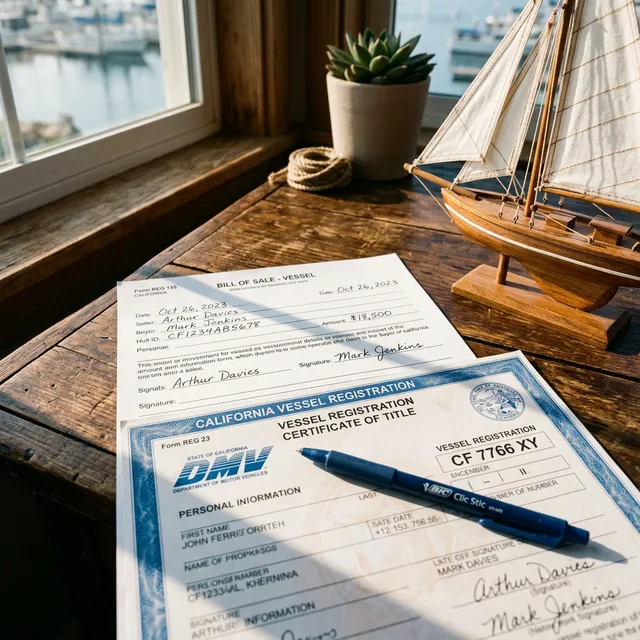
Understanding Boat Ownership in California's No-Title System
California is one of several states that does not issue titles for boats and other vessels. This means there is no single "Certificate of Title" document that definitively proves you own a boat — unlike states such as Florida, Texas, or Michigan where a title is the gold standard of ownership proof.
Instead, California establishes boat ownership through a combination of DMV registration records (Certificate of Number) and supporting documents such as a Bill of Sale. For most transactions — buying from a dealer, purchasing from a private seller with proper paperwork — this system works smoothly. But what happens when the standard documents are missing?
This guide addresses a common and frustrating scenario: you have a boat, but you lack the typical paperwork to prove it is yours. Whether you inherited a vessel from a relative, purchased a boat years ago without keeping records, found an abandoned vessel, or bought a boat from someone who could not provide a registration card, California's DMV has processes to help you establish ownership — though the path requires patience and the right documentation strategy.
How California Establishes Boat Ownership
In a no-title state like California, ownership is typically proven through these documents, listed from strongest to weakest evidence:
| Document | Strength | How to Obtain |
|---|---|---|
| Certificate of Number (Registration Card) | Strongest — linked to DMV database | Issued by CA DMV upon registration |
| Bill of Sale (REG 135 or equivalent) | Strong — records purchase transaction | Created at time of sale by buyer/seller |
| Previous Owner's Endorsement on Registration | Strong — shows chain of ownership | Seller signs over registration |
| Insurance Policy in Your Name | Moderate — supporting evidence | From your insurance provider |
| Marina Slip Lease in Your Name | Moderate — supporting evidence | From marina management |
| Maintenance/Repair Receipts | Weak — circumstantial evidence | From service providers |
When one or more of the primary documents (registration card, Bill of Sale) are missing, you will need to work with the DMV using alternative documentation and specific forms to establish your ownership claim.
Scenario 1: You Have the Boat but Lost the Registration
If you are the registered owner of a vessel but have lost or damaged your Certificate of Number (registration card), the solution is straightforward. Complete form REG 227 (Application for Replacement or Transfer of Title) to request a duplicate registration card from the DMV.
You will need to provide your name, address, the CF number of the vessel, and a valid photo ID. The DMV will look up your vessel in their database and issue a replacement. If the boat was previously registered in your name, this process is typically quick and requires only the replacement fee.
If you also do not remember or cannot find the CF number, contact the DMV directly. Providing the boat's Hull Identification Number (HIN), make, model, and year may allow them to locate the registration in their system.
Scenario 2: You Bought a Boat Without a Bill of Sale
Purchasing a boat without obtaining a Bill of Sale is one of the most common mistakes in private vessel transactions. If you find yourself in this situation, the DMV provides a path forward through form REG 256 (Statement of Facts).
The REG 256 allows you to make a written declaration, under penalty of perjury, explaining how you acquired the vessel and why you do not have a Bill of Sale. Your statement should include: the approximate date of acquisition, the name and contact information of the person you acquired it from (if known), the purchase price or estimated value, and the circumstances of the transaction.
The DMV will review your REG 256 along with any other supporting evidence you can provide — photographs, text messages or emails about the sale, witness statements, canceled checks or payment records, or any other documentation showing the transaction occurred. The more evidence you can gather, the stronger your case.
If the DMV accepts your REG 256, you can proceed with registration using the standard BOAT 101 application. If the DMV is not satisfied with the evidence, they may require a surety bond (described below).
Scenario 3: You Inherited or Were Gifted a Boat
Vessels received as gifts or through inheritance require specific documentation to transfer ownership in California:
Gift Transfer: The person giving you the boat should provide a signed Bill of Sale (indicating the gift and a "$0" or "gift" purchase price), the current Certificate of Number (registration card), and a completed REG 262 (Vehicle/Vessel Transfer and Reassignment Form). A REG 256 (Statement of Facts) should also be completed to claim the family use tax exemption if the donor is a qualifying family member.
Inheritance: If the registered owner has passed away, you will need the death certificate, legal documentation establishing your right to the estate (such as a will, trust documents, or letters of administration from probate court), the vessel's current registration card (if available), and a REG 256 explaining the circumstances. The DMV may also require additional probate documentation depending on the estate's complexity.
Scenario 4: The Surety Bond Process
When the DMV determines that standard documentation is insufficient to establish ownership, they may require a surety bond. This is most common for vessels valued at $2,000 or more where the ownership history cannot be adequately documented through other means.
A surety bond is essentially an insurance policy that protects against competing ownership claims. If someone later proves they are the rightful owner, the bond covers their losses. Here is how the process works:
Step 1: Determine the bond amount — The bond must typically equal 1.5 times the vessel's fair market value. For a boat appraised at $10,000, you would need a $15,000 bond.
Step 2: Purchase the bond — Contact a surety bond company. The cost of the bond (the premium you pay) is usually 1% to 5% of the bond amount, depending on the vessel value and your credit history. For a $15,000 bond, expect to pay $150 to $750.
Step 3: Submit to the DMV — File the surety bond along with your BOAT 101 application, REG 256 (Statement of Facts), the HIN verification (if required), and all other supporting documentation.
Step 4: Bond period — The bond remains in effect for 3 years. After 3 years with no competing ownership claim, the bond is released, and your ownership is considered clear.
The Hull Identification Number (HIN): Your Best Friend
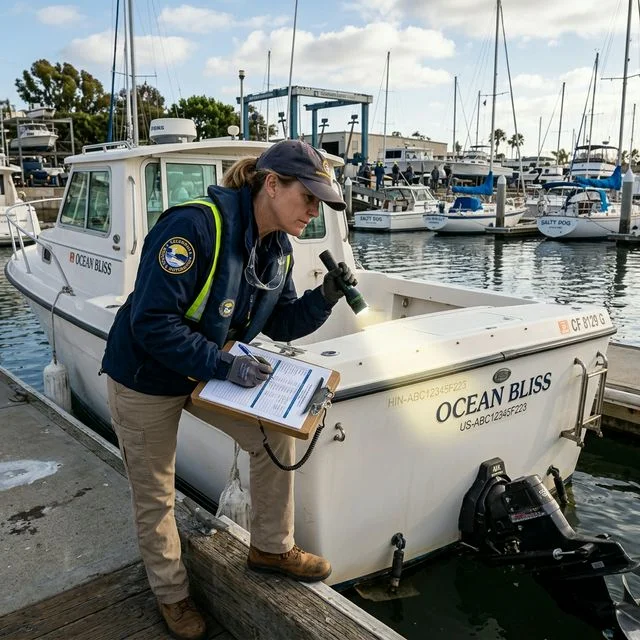
The Hull Identification Number (HIN) is a 12-character serial number permanently affixed to every vessel manufactured after November 1, 1972. It is the "VIN" equivalent for boats and is your most powerful tool when establishing ownership of a vessel with missing paperwork.
The HIN is typically located on the upper right corner of the transom (the flat back of the boat). A duplicate HIN is also placed in a hidden location on the vessel for fraud prevention purposes. The HIN encodes the manufacturer, serial number, production date, and model year.
Why the HIN matters for ownership disputes: the DMV can use the HIN to search their database and determine the vessel's registration history, including previous owners, outstanding liens, and whether the vessel has been reported stolen. If the HIN matches a vessel that was properly registered to a previous owner, the DMV can help trace the ownership chain. If no HIN is present or it has been defaced, the DMV can assign a new HIN after an investigation — but this raises red flags and triggers additional scrutiny.
Before purchasing any used boat, especially in a private sale, always verify the HIN on the physical vessel matches the HIN on the registration documents. Discrepancies may indicate a stolen vessel, registration fraud, or a simple clerical error that needs correction before the sale.
What to Do with an Abandoned Boat
Finding or acquiring an apparently abandoned vessel is another common scenario in California. However, registering an abandoned boat is one of the most complex ownership situations because California law has specific procedures for abandoned property.
Under California Harbors and Navigation Code, a vessel may be deemed abandoned if it has been left unattended on public waterways, public property, or private property without the property owner's permission for a specified period. Simply finding an abandoned-looking boat does not automatically grant you ownership rights.
The general process involves: documenting the vessel's condition and location (photographs with timestamps), contacting local law enforcement or the harbor master to report the vessel as potentially abandoned, allowing law enforcement to attempt to locate the registered owner through the HIN and DMV records, and waiting for the applicable notice period to expire. If no owner is found or responds after proper notice, you may be able to claim the vessel through the legal process — but this often requires involvement of local authorities and potentially court proceedings.
Attempting to register an abandoned vessel without following proper legal procedures can result in criminal charges for receiving stolen property. Always work through official channels.
Protecting Your Ownership Going Forward
Once you have established ownership and registered your vessel with the California DMV, take these steps to protect yourself in the future:
Keep your registration current: California vessel registration is valid for 2 years. Set a reminder to renew before expiration. A lapsed registration weakens your ownership evidence.
Maintain copies of all documents: Store digital copies of your Certificate of Number, Bill of Sale, and any REG 256 or bond documentation in a secure location separate from the originals. Cloud storage ensures these records survive even if physical copies are lost in a fire or flood.
Use a Bill of Sale for every transaction: Whether buying, selling, or gifting a vessel, always create a detailed Bill of Sale that includes the date, both parties' names and addresses, vessel description (make, model, year, HIN, CF number), and purchase price. Both parties should sign and each keep a copy.
File REG 138 immediately when selling: If you sell your vessel, file the Notice of Transfer and Release of Liability (REG 138) with the DMV within 5 days. This protects you from liability and creates an official record of the ownership change. For details, see our California boat title transfer guide.
Keep insurance documentation: Boat insurance records serve as additional evidence of ownership. Even if California does not require boat insurance, maintaining a policy provides both financial protection and ownership documentation. Learn more in our boat insurance requirements guide.
California vs. Title States: Pros and Cons
California's no-title system has both advantages and disadvantages compared to title states:
| Aspect | California (No Title) | Title States (e.g., FL, TX, MI) |
|---|---|---|
| Primary Ownership Proof | Registration + Bill of Sale | Certificate of Title |
| Title Fee | $0 (no title issued) | $5 – $77 depending on state |
| Transfer Complexity | Moderate — multiple forms | Simpler — endorse and transfer title |
| Lien Recording | Through registration only | Liens recorded on title document |
| Lost Document Recovery | REG 227 for registration duplicate | Apply for duplicate title |
| Ownership Disputes | Harder to resolve without title | Title provides clearer evidence |
| Moving to Another State | Must apply for title in new state | Title accepted in most states |
If you plan to move your boat to a title state in the future, obtain your California registration card, a certified Bill of Sale, and any other ownership documentation before leaving. The receiving state will use these documents to issue you a title under their system. For more on how California's registration compares to title systems, see our Boat Title vs. Registration guide.
Frequently Asked Questions
Does California issue boat titles?
How do I prove I own a boat in California?
What if I bought a boat without getting a Bill of Sale?
How much does a surety bond cost for a boat in California?
Can I register an abandoned boat I found in California?
How do I move a California-registered boat to a title state?
Sources
- California DMV — Vessel Registration (https://www.dmv.ca.gov/portal/vehicle-registration/vessel-registration/)
- California DMV — REG 256 Statement of Facts (https://www.dmv.ca.gov/portal/handbook/vehicle-industry-registration-procedures-manual/statement-of-facts-reg-256/)
- California DMV — Bonded Vessels (https://www.dmv.ca.gov/portal/vehicle-registration/vessel-registration/)
- California Harbors and Navigation Code — Abandoned Vessels
This information is provided for reference purposes only. While we strive to keep data accurate and up-to-date, registration requirements, fees, and regulations may change without notice. Always contact your state's official registration agency for the most current and authoritative information before making any decisions.