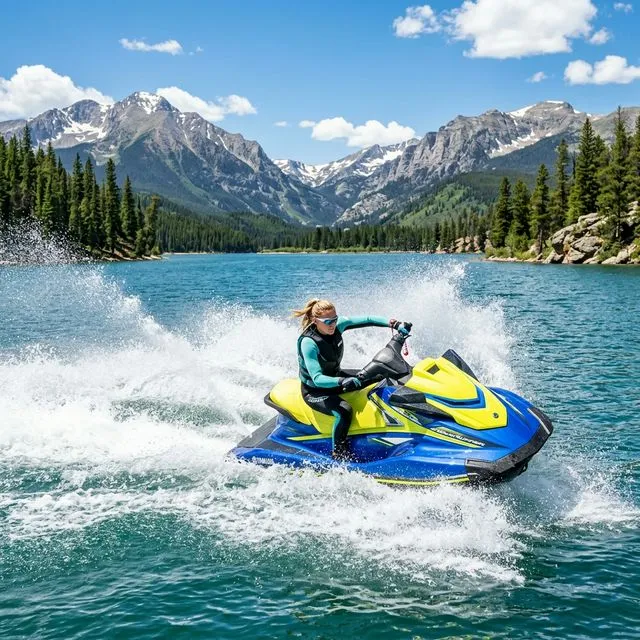
Colorado Jet Ski and PWC Laws: Complete Overview
Personal watercraft (PWC) — including Jet Skis, WaveRunners, and Sea-Doos — are classified as motorboats under Colorado law. This means they are subject to all the same registration, ANS stamp, and AIS inspection requirements as any motorized vessel, plus additional age and operating restrictions specific to PWC.
Colorado updated its PWC and boating age laws effective June 1, 2024, replacing older regulations with stricter age minimums and mandatory safety education. If you are operating on rules you learned before 2024, this guide will bring you up to date.
The key points: no one under 14 may operate a PWC in Colorado; ages 14 to 17 must complete a CPW-approved boating safety course; 18 and older do not need a course but CPW strongly recommends one. All PWC must be registered with CPW, carry an ANS stamp, and pass an AIS inspection before launching.
This guide covers every aspect of Colorado PWC law: age requirements, safety course details, registration fees, operating restrictions, safety equipment, and how Colorado compares to neighboring states. For general boat registration, see our Colorado Boat Registration Guide.
Age Requirements and Safety Course (Updated June 2024)
Colorado's age requirements for PWC operation were updated effective June 1, 2024. Here are the current rules:
Under 14: Absolute Prohibition
No person under the age of 14 may operate any motorboat — including personal watercraft — on Colorado public waters. This is an absolute prohibition with no exceptions. Adult supervision does not change the rule; a 12-year-old cannot operate a Jet Ski even with a parent sitting directly behind them.
Children under 14 may ride as passengers on a PWC operated by a person who meets the age and education requirements. However, they must wear a properly fitted USCG-approved life jacket at all times.
Ages 14 to 17: Safety Course Required
Persons aged 14 through 17 may operate a PWC if they have completed a CPW-approved boating safety course and carry the certificate of completion while operating. The certificate must be presented on demand to any law enforcement officer.
Approved courses include those offered by NASBLA-approved providers. Most courses can be completed online in 4 to 6 hours and cost between $0 and $50 depending on the provider. Popular options include the BoatUS Foundation (free online course) and the National Association of State Boating Law Administrators (NASBLA) approved providers.
Colorado also accepts boating safety certificates from other states, provided the issuing state's requirements are not less restrictive than Colorado's.
18 and Older: No Course Required
Adults aged 18 and older do not need to complete a boating safety course to operate a PWC in Colorado. However, CPW strongly recommends that all boaters take a course, especially those new to personal watercraft. PWC-related incidents represent a significant portion of Colorado boating accidents each year.
Free courses are available from the BoatUS Foundation and other NASBLA-approved providers. Completing a safety course may also qualify you for a boat insurance discount — many insurers offer 5% to 15% off for certified boaters.
PWC Registration and Fees
Personal watercraft are registered through CPW using the same process as any motorboat. Here are the costs:
| Fee Type | Resident | Non-Resident |
|---|---|---|
| Annual Registration (under 20 ft) | $35.25 | $35.25 |
| ANS Stamp | $25.00 | $50.00 |
| Total Annual Cost | $60.25 | $85.25 |
Most PWC fall under the "less than 20 feet" registration category. The registration is valid from January 1 through December 31 and must be renewed annually. Additionally, all PWC must stop at an AIS inspection station before launching and carry proof of ANS stamp purchase on board.
For details on sales tax implications, see our Colorado Boat Sales Tax guide. Use our Boat Registration Fee Calculator to estimate your total costs.
PWC Operating Rules in Colorado
Beyond registration and age requirements, Colorado imposes specific operating rules for personal watercraft:
| Rule | Requirement |
|---|---|
| Operating hours | PWC may only be operated between sunrise and sunset. No nighttime PWC operation is permitted. |
| Life jacket (PFD) | All PWC riders — operator and passengers — must wear a properly fitted USCG-approved Type I, II, III, or V PFD at all times. |
| Engine cutoff lanyard | The engine cutoff lanyard (kill switch) must be attached to the operator's person while the PWC is in operation. |
| Reckless operation | Jumping wakes within 100 feet of another vessel, weaving through congested traffic, and operating at excessive speed in restricted zones are prohibited. |
| Wakeless zones | PWC must observe all posted wakeless/no-wake zones. Most boat ramp areas, marinas, and shoreline zones are designated wakeless. |
| Passenger capacity | Never exceed the maximum capacity listed on the PWC's capacity plate. |
| BUI (Boating Under Influence) | BAC limit of 0.08%. Penalties include fines, license suspension, and criminal charges — same as DUI. |
| Sound levels | PWC must not exceed 86 dB(A) at 50 feet. Factory-stock exhaust systems generally comply. |
Required Safety Equipment for PWC
Every personal watercraft on Colorado waters must carry the following equipment:
Life jackets: A properly fitted USCG-approved PFD for every person on board. Unlike larger boats where PFDs can be stored on board, all PWC riders must actually wear the PFD at all times while on the water.
Engine cutoff lanyard: Must be attached to the operator's person (wrist, PFD, or arm) during operation. This ensures the PWC stops if the rider falls off.
Fire extinguisher: A USCG-approved B-1 type fire extinguisher is required on PWC with enclosed engine compartments (most modern PWC have enclosed compartments).
Sound-producing device: A whistle, horn, or other sound-producing device must be on board for signaling in emergency situations.
Registration certificate: The original CPW registration certificate (or a copy) must be carried on the vessel.
ANS stamp proof: Electronic receipt or printed copy of the ANS stamp purchase.
Safety course certificate: Required for operators ages 14 to 17.
Where You Can and Cannot Ride in Colorado
While your CPW registration allows operation on all public waters, individual lakes and reservoirs may have additional restrictions:
PWC-permitted reservoirs: Most major reservoirs allow PWC, including Blue Mesa, Pueblo, Chatfield, Cherry Creek, Horsetooth, and Lake Granby. Check specific lake regulations for any seasonal or area restrictions.
Wakeless-only lakes: Some smaller lakes and reservoirs are designated as wakeless only, meaning PWC may operate but only at no-wake speed. At this speed, PWC are less enjoyable as they are designed for planing operation.
No-motorboat lakes: A handful of Colorado lakes prohibit all motorized vessels, including PWC. These tend to be smaller, mountain-fed natural lakes managed for fishing or wildlife.
Municipal reservoirs: Some reservoirs that serve as drinking water sources (e.g., Dillon Reservoir) have unique restrictions. Check with the managing authority before visiting.
Always check the specific lake's regulations on the CPW website or at the park entrance before launching your PWC.
How Colorado Compares to Neighboring States
Colorado's PWC laws are moderately strict compared to its neighbors. Here is a comparison:
| State | Minimum Age | Safety Course | Nighttime Operation |
|---|---|---|---|
| Colorado | 14 | 14–17 only | Prohibited |
| Wyoming | 16 | Under 18 | Prohibited |
| Utah | 12 (with adult) | 12–17 | Prohibited |
| Arizona | 12 (with adult) | Under 16 | Prohibited |
| Kansas | 12 (with adult) | 12–20 | Prohibited |
| Nebraska | 14 | Under 18 | Prohibited |
| Oklahoma | 12 (with adult) | Under 16 | Prohibited |
| New Mexico | 13 | Under 18 | Prohibited |
Colorado's 14-year minimum is one of the higher thresholds in the region. Compare this to neighboring Arizona, Kansas, Oklahoma, and Utah — all of which allow children as young as 12 to operate a PWC with adult supervision. The tradeoff is that Colorado's approach prioritizes safety by ensuring operators have reached a minimum level of physical and cognitive maturity.
For a broader comparison across all 50 states, see our Boater Education Requirements guide and the state-by-state registration cost comparison.
Common Violations and Penalties
CPW officers actively patrol Colorado's busiest reservoirs during peak season. Here are the most commonly cited PWC violations:
Operating without registration or ANS stamp: Citations range from $50 to $100+. Officers regularly check at boat ramps and on the water.
Underage operation: A minor operating a PWC without meeting age and education requirements results in a citation for the minor and potentially for the supervising adult.
No life jacket: Failure to wear a PFD on a PWC is one of the most common citations. All riders must wear PFDs at all times — not just carry them.
Reckless operation: Jumping wakes near other vessels, excessive speed in no-wake zones, and operating under the influence carry significant fines and can result in criminal charges.
Bypassing AIS inspection: Launching without a valid inspection can result in a citation and being denied access to the water body.
BUI (Boating Under the Influence): Same BAC threshold as DUI (0.08%). Penalties include fines from $200 to $1,000+, potential jail time, and loss of boating privileges.
Frequently Asked Questions
How old do you have to be to drive a jet ski in Colorado?
Do you need to register a jet ski in Colorado?
Can you ride a jet ski at night in Colorado?
Do you need to wear a life jacket on a jet ski in Colorado?
Is a boating safety course required for jet ski riders in Colorado?
What is the penalty for underage jet ski operation in Colorado?
Sources
- Colorado Parks and Wildlife — Boating Safety Laws (https://cpw.state.co.us/thingstodo/Pages/BoatingSafety.aspx)
- CPW — Boating Registration (https://cpw.state.co.us/thingstodo/Pages/Boating.aspx)
- Colorado Revised Statutes — Boating and Watercraft (https://leg.colorado.gov/)
- NASBLA — Boating Safety Course Information (https://www.nasbla.org/)
This information is provided for reference purposes only. While we strive to keep data accurate and up-to-date, registration requirements, fees, and regulations may change without notice. Always contact your state's official registration agency for the most current and authoritative information before making any decisions.