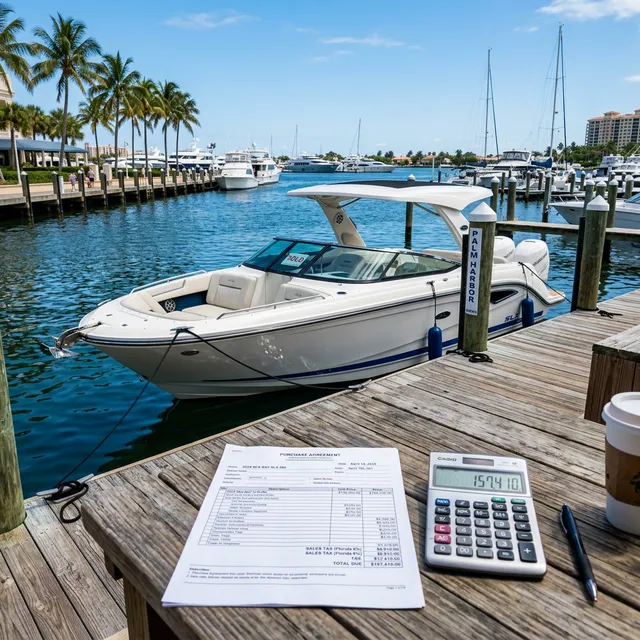
Florida's Boat Sales Tax: Why the $18,000 Cap Matters
Florida is one of the most boat-friendly states in the country when it comes to sales tax. Since July 1, 2010, Florida has capped the total sales tax collected on any single boat purchase at $18,000 — regardless of the vessel's price. This means whether you buy a $300,000 sport yacht or a $2 million mega-yacht, you'll never pay more than $18,000 in total state and county sales tax.
This tax cap has made Florida a magnet for large-boat buyers from across the United States. Combined with year-round boating weather and no state income tax, it's one of the key reasons Florida leads the nation in boat registrations. For a full overview of Florida's registration system, see our Florida Boat Registration guide.
How Florida Boat Sales Tax Is Calculated
Florida applies two types of sales tax to boat purchases, but both are subject to the $18,000 overall cap:
| Tax Type | Rate | Applies To | Notes |
|---|---|---|---|
| State Sales Tax | 6% | Full purchase price | Subject to $18,000 cap |
| County Discretionary Surtax | 0.5%–2.5% | First $5,000 only | Varies by county; included in cap |
The county discretionary surtax is an additional tax imposed by individual counties, but it only applies to the first $5,000 of the purchase price. This means the maximum county surtax on any boat purchase is $125 (2.5% × $5,000). Both the state tax and county surtax combined are subject to the $18,000 total cap.
Tax Calculation Examples by Boat Price
The following SVG chart illustrates how the $18,000 cap dramatically reduces the effective tax rate as boat prices increase:
As you can see, boats priced at or below $300,000 pay the full 6% rate (the cap equals $18,000 at $300,000). For anything above $300,000, the effective rate drops dramatically.
Here is the detailed breakdown with actual tax amounts:
| Boat Price | State Tax (6%) | County Surtax* | Total Tax | Effective Rate | Savings vs 6% |
|---|---|---|---|---|---|
| $25,000 | $1,500 | $50 | $1,550 | 6.2% | — |
| $50,000 | $3,000 | $50 | $3,050 | 6.1% | — |
| $100,000 | $6,000 | $50 | $6,050 | 6.05% | — |
| $300,000 | $18,000 | — | $18,000 | 6.0% | Cap reached |
| $500,000 | $18,000 | — | $18,000 | 3.6% | $12,000 |
| $1,000,000 | $18,000 | — | $18,000 | 1.8% | $42,000 |
| $2,000,000 | $18,000 | — | $18,000 | 0.9% | $102,000 |
| * County surtax estimated at 1% on first $5,000. Actual rate varies by county (0.5%–2.5%). | |||||
County Discretionary Surtax: What You Need to Know
Each Florida county may impose an additional discretionary sales surtax that applies to the first $5,000 of the purchase price. The rate varies by county and typically ranges from 0.5% to 2.5%. New surtax rates take effect on January 1st each year.
Here are surtax rates for some of the most popular boating counties in Florida:
| County | Surtax Rate | Max Surtax on Boat |
|---|---|---|
| Broward (Fort Lauderdale) | 1% | $50 |
| Miami-Dade | 2% | $100 |
| Palm Beach | 1% | $50 |
| Hillsborough (Tampa) | 1.5% | $75 |
| Lee (Fort Myers) | 0.5% | $25 |
| Pinellas (St. Petersburg) | 1% | $50 |
| Monroe (Keys) | 1.5% | $75 |
You can find the current surtax rate for every Florida county on the Florida Department of Revenue website.
The Use Tax Trap: Buying a Boat Outside Florida
One of the most common and expensive mistakes Florida boat buyers make is purchasing a vessel in another state and then bringing it to Florida without paying the appropriate tax. Florida imposes a Use Tax that catches this exact scenario.
If you purchase a boat outside Florida and bring it into the state within 6 months, you owe Florida use tax on the full purchase price (6%, capped at $18,000). If you already paid sales tax in the state of purchase, Florida will give you a credit for the amount paid — but only up to 6%. If the other state's tax was lower, you owe the difference.
How the Use Tax Credit Works
Here's a practical example illustrating the credit system:
If Florida's tax ($12,000 in this example) exceeds the $18,000 cap before the credit, you still only owe up to the cap minus your credit. Always keep your proof of sales tax payment from the purchase state.
Tax Exemptions and Reductions
Florida provides several sales tax exemptions for boat purchases. If any of these apply to you, make sure to claim them at the time of the transaction — retroactive claims are more difficult:
Family Gift Exemption: Boats transferred as gifts between immediate family members (parents, children, siblings, spouses) are exempt from sales tax. A gift affidavit must be completed.
Trade-In Credit: If you trade in your old boat when purchasing a new one, you only pay sales tax on the net difference between the purchase price and the trade-in value.
Commercial Vessel Exemption: Vessels used exclusively for commercial fishing or other commercial marine operations may qualify for sales tax exemption under Florida Statute §212.08.
Non-Resident Purchaser: Non-residents who purchase a boat in Florida but intend to use it outside the state may qualify for a sales tax exemption if the vessel is removed from Florida within 90 days and not returned for 6 months.
How Florida Compares to Neighboring States
Florida's $18,000 cap makes it significantly more affordable for large-boat purchases compared to most neighboring states:
| State | Tax Rate | Cap? | Tax on $500K Boat |
|---|---|---|---|
| Florida | 6% | $18,000 cap | $18,000 |
| Georgia | 4% + local | No cap | ~$35,000 |
| Alabama | 4% + local | $15,000 cap | $15,000 |
| South Carolina | 5% | $500 cap | $500 |
| Texas | 6.25% + local | No cap | ~$41,250 |
For a full side-by-side comparison of boat taxes across all 50 states, see our Boat Registration Cost by State comparison page. Use our Fee Calculator to estimate your total costs.
When and Where You Pay
Sales tax on boat purchases in Florida is collected at different points depending on how you buy:
Dealer Purchase: The dealer collects sales tax at the time of sale and remits it to the Florida Department of Revenue.
Private Sale: Sales tax is collected by the County Tax Collector's office when you apply for title transfer. You cannot title or register the vessel without paying the tax.
Out-of-State Purchase: Use tax is collected at the county office when you bring the vessel into Florida and apply for a Florida title and registration.
Common Sales Tax Mistakes
1. Forgetting the county surtax: Many buyers budget for 6% and are surprised by the additional county surtax. While it only applies to the first $5,000, it's still an unexpected cost in some counties.
2. Not keeping out-of-state tax receipts: If you purchased the boat elsewhere, Florida will credit your previous tax payment — but only with proof. Without a receipt, you pay the full Florida tax.
3. Assuming the $18,000 cap includes registration fees: The cap applies to sales/use tax only. Registration fees ($11.25–$195.50) and title fees ($5.25–$11.00) are separate.
4. Underreporting the purchase price: Florida audits boat sales, especially high-value transactions. If the reported price is significantly below fair market value, the Department of Revenue may challenge it and assess tax based on comparable sales.
Frequently Asked Questions
What is the sales tax cap on boats in Florida?
Do I have to pay Florida sales tax if I bought my boat in another state?
Is there a county tax on boats in Florida?
Are there any sales tax exemptions for boats in Florida?
How does Florida's boat sales tax compare to other states?
Sources
- Florida Department of Revenue — Sales and Use Tax on Boats (https://floridarevenue.com/taxes/taxesfees/Pages/boat_tax.aspx)
- Florida Statute §212.05(1)(a)2 — Sales Tax Cap on Boats (http://www.leg.state.fl.us/statutes/index.cfm?App_mode=Display_Statute&URL=0200-0299/0212/Sections/0212.05.html)
- Florida Department of Revenue — Discretionary Sales Surtax Rates (https://floridarevenue.com/taxes/taxesfees/Pages/discretionary.aspx)
This information is provided for reference purposes only. While we strive to keep data accurate and up-to-date, registration requirements, fees, and regulations may change without notice. Always contact your state's official registration agency for the most current and authoritative information before making any decisions.