Do You Need to Register a Kayak in Florida?
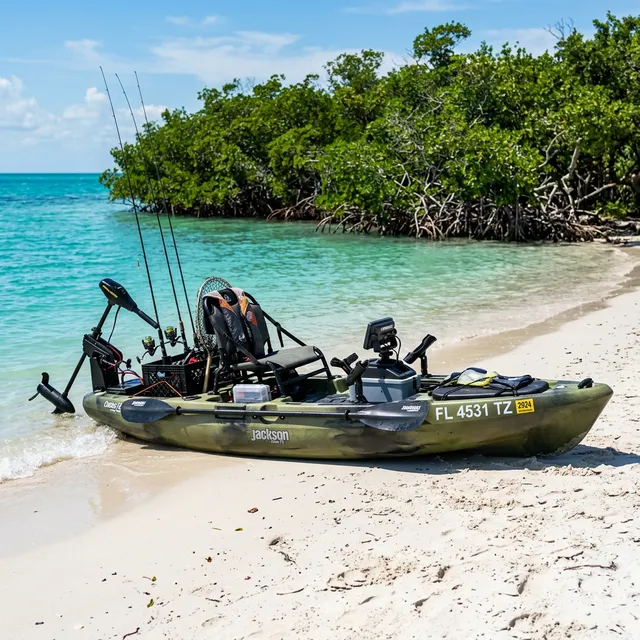
The short answer: it depends on whether your kayak has a motor. Florida exempts most human-powered vessels from registration, but the moment you attach any type of motor — including a small electric trolling motor — your kayak becomes a motorized vessel subject to full title and registration requirements.
This single rule catches thousands of Florida kayak anglers by surprise every year. Here is the complete breakdown. For a general overview of Florida registration, see our Florida Boat Registration guide.
The Motor Line: Exempt vs Required
Florida law draws a clear line based on propulsion type:
What Counts as a "Motor"?
Any propulsion device that is not human-powered counts as a motor under Florida law. This includes:
| Motor Type | Registration Required? | Notes |
|---|---|---|
| Electric trolling motor | Yes | Even a 30 lb thrust motor triggers registration |
| Pedal-driven propeller (Hobie MirageDrive) | No | Human-powered; treated as paddle craft |
| Gas outboard (any size) | Yes | Full title + registration |
| Electric jet drive (Bixpy, etc.) | Yes | Any electric propulsion = motorized vessel |
| Sail (only) | Depends | Non-motorized sailboats 16 ft+ must register |
The key takeaway: pedal-powered propulsion is exempt, but any form of electric or gas propulsion requires registration — there is no minimum horsepower or thrust threshold.
Registration for Motorized Kayaks
If your kayak has a motor, registration is straightforward and inexpensive:
| Item | Cost | Notes |
|---|---|---|
| Registration (Class A-1, < 12 ft) | $5.50 | Most motorized kayaks fall in this class |
| Registration (Class A-2, 12-16 ft) | $16.25 | Longer fishing kayaks |
| Title (e-Title) | $5.25 | Required for all motorized vessels |
| Sales tax | 6% | On purchase price (capped at $18,000) |
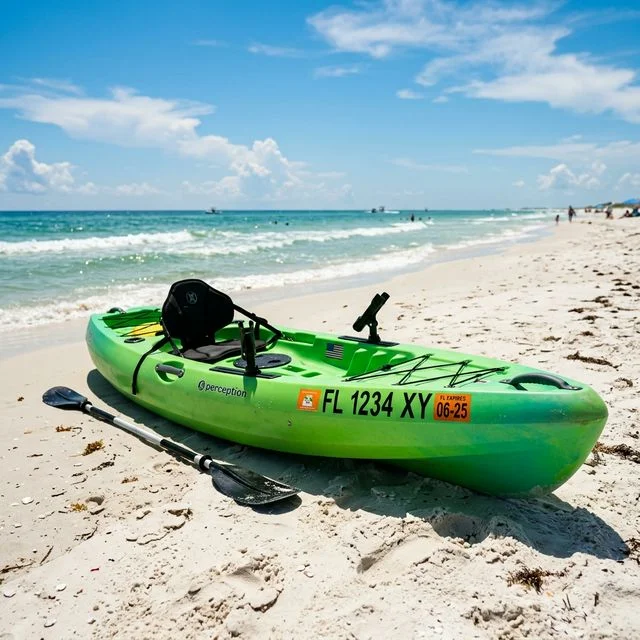
Register at your local County Tax Collector within 30 days of purchase. You will receive registration numbers that must be displayed on both sides of the bow in block letters at least 3 inches high. The validation decal goes within 6 inches of the registration number on the port (left) side.
Safety Requirements: All Kayaks (Motor or Not)
Whether or not your kayak requires registration, Florida law and federal regulations require specific safety equipment. The requirements differ based on motorization and length:
| Equipment | Non-Motorized Kayak | Motorized Kayak |
|---|---|---|
| USCG-approved PFD (life jacket) | Required — 1 per person | Required — 1 per person |
| Sound-producing device (whistle) | Required | Required |
| Fire extinguisher | Not required | Required if enclosed spaces |
| Navigation lights | If used after sunset | Required (red/green bow, white stern) |
| Registration certificate on board | N/A | Required |
| Boater Safety ID Card | Not required | Required if born after 1/1/1988 & 10+ HP |
| Children under 6 — PFD worn | Required | Required |
Note: SUPs (stand-up paddleboards) are classified as vessels by the U.S. Coast Guard and must carry a PFD and whistle — unless you are in a designated swimming, surfing, or bathing area.
The Freedom Boater Safety Inspection Decal (2025)
Starting in 2025, FLHSMV introduced the Florida Freedom Boater Safety Inspection Decal program. Under this voluntary program, even exempt non-motorized kayaks can obtain a safety inspection decal by submitting a Vessel Safety Equipment Attestation (Form HSMV 87191).
The attestation confirms your vessel carries all required safety equipment. While completely optional for non-motorized kayaks, having the decal signals to FWC officers that your vessel has been checked — potentially resulting in fewer stops on the water.
Standup Paddleboard (SUP) Rules
Paddleboards occupy a unique space in Florida boating law:
Registration: Not required (non-motorized, regardless of length).
PFD: Required. You must carry a USCG-approved wearable life jacket at all times — except when in a designated swimming, surfing, or bathing area.
Whistle: Required when outside swimming areas.
Navigation lights: Required if using the SUP after sunset.
Adding an electric motor to a SUP (like the popular Bixpy jet) converts it to a motorized vessel requiring full registration.
Canoe Registration Rules
Canoes follow the same rules as kayaks:
Non-motorized canoe of any length: Exempt from registration. Must carry PFDs and whistle.
Canoe with any motor attached: Must be titled and registered. Even a small trolling motor triggers the requirement. Most motorized canoes under 12 feet pay $5.50/year in registration fees.
Non-motorized canoe 16 feet or longer: Still exempt from registration in Florida (unlike some other vessel types, canoes receive a specific exemption regardless of length).
Common Kayak Registration Mistakes
1. "My trolling motor is only 30 lbs thrust, so I don't need to register": Wrong. There is no minimum thrust, horsepower, or motor size threshold. Any motor = registration required.
2. "I only use the motor sometimes": If the motor is attached to the kayak, the vessel is considered motorized — even if you're paddling at the time of a stop. Remove the motor completely when not in use if you want to avoid registration.
3. "Kayaks don't need PFDs": All vessels in Florida must carry USCG-approved PFDs — one per person aboard. Children under 6 must wear theirs at all times.
4. "I bought it in another state so I don't need FL registration": If you operate a motorized kayak on Florida waters beyond the 90-day non-resident exemption, you must register in Florida.
Frequently Asked Questions
Do you need to register a kayak in Florida?
How much does it cost to register a motorized kayak in Florida?
Does a kayak with an electric trolling motor need to be registered in Florida?
Do paddleboards need registration in Florida?
What safety equipment do I need on a kayak in Florida?
If I carry (but don't mount) an electric motor on my kayak, does it still need registration?
Sources
- FLHSMV — Vessel Registration Requirements (https://www.flhsmv.gov/motor-vehicles-tags-titles/vessels/)
- FWC — Boating Safety Equipment (https://myfwc.com/boating/safety-equipment/)
- FWC — Vessel Registration FAQ (https://myfwc.com/boating/regulations/)
- U.S. Coast Guard — SUP as Vessel Classification
This information is provided for reference purposes only. While we strive to keep data accurate and up-to-date, registration requirements, fees, and regulations may change without notice. Always contact your state's official registration agency for the most current and authoritative information before making any decisions.