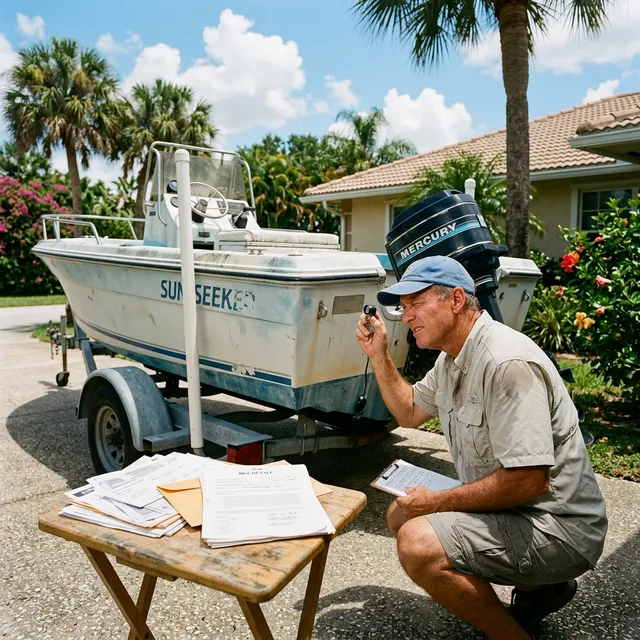
Can You Register a Boat Without a Title in Florida?
Yes — but it's significantly more complex than a standard title transfer. If you've purchased, inherited, or found an older boat without a title, Florida law still provides a path to legal ownership. You'll need to prove ownership through alternative documentation and may need a physical vessel inspection.
One critical fact to understand upfront: Florida does NOT offer bonded titles (surety bond titles) for boats. Unlike some states that allow you to purchase a surety bond to establish ownership, Florida's bonded title process applies only to motor vehicles, mobile homes, and motorcycles — not vessels. This means you must use other methods to prove your claim to the boat.
Why Boats End Up Without Titles
Before diving into the solution, it helps to understand how boats lose their paperwork. Each scenario has a slightly different resolution path:
| Scenario | How It Happens | Difficulty Level |
|---|---|---|
| Previous owner lost the title | Misplaced over years of ownership | Easiest — seller gets duplicate |
| Boat was never titled | Older boats predating FL title requirements | Moderate — requires ownership chain |
| Bought with Bill of Sale only | Private sale without proper paperwork | Moderate — additional docs needed |
| Inherited without paperwork | Estate settlement, no title found | Moderate — probate docs help |
| Abandoned vessel | Left on property, no known owner | Most difficult — law enforcement involved |
| Homemade boat | Built by the owner | Special process — Vessel Statement of Builder |
Step-by-Step: Establishing Ownership Without a Title
The following flowchart shows the decision path for registering a boat without a title in Florida:
Step 1: Gather All Available Documentation
The more evidence of ownership you can provide, the smoother the process. Florida's DHSMV evaluates your claim based on the totality of evidence — no single document is absolutely required, but more is always better.
| Document | Weight | How to Obtain |
|---|---|---|
| Notarized Bill of Sale | High | Have seller sign; include HIN, price, date, addresses |
| Notarized Affidavit of Ownership | High | Write sworn statement of how you acquired boat |
| Previous registration records | High | Any state's registration, even expired |
| Photos of the vessel | Medium | Include HIN close-up, hull, transom, overall views |
| Repair/maintenance receipts | Medium | Shows continuous possession/spending on vessel |
| Marina/storage records | Medium | Proves you've been paying for storage |
| Insurance records | Medium | Shows you insured the vessel in your name |
Step 2: HIN Verification and Vessel Inspection
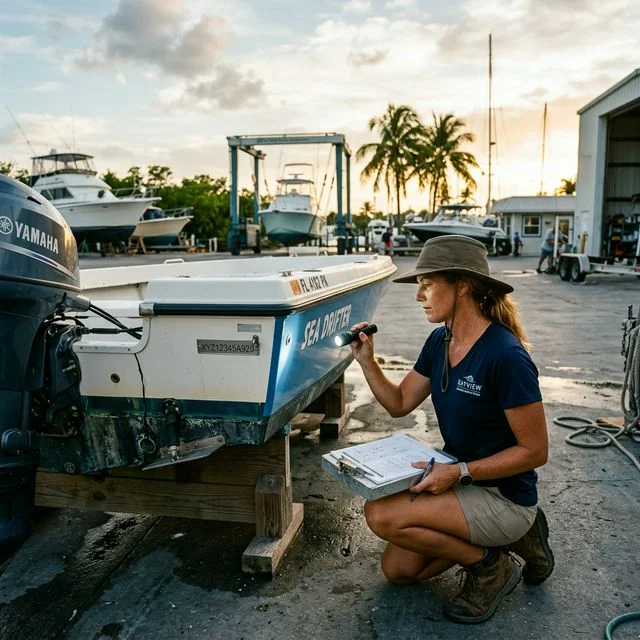
Florida typically requires a physical inspection of the vessel when no title exists. A DHSMV or FWC officer will verify the Hull Identification Number (HIN) stamped on the transom and compare it against national stolen vessel databases.
The HIN is a 12-character alphanumeric code found on the starboard (right) side of the transom. If the HIN is missing, damaged, or altered, the process becomes significantly more complex — the vessel may need to be assigned a new HIN by the state, and a law enforcement investigation may be required.
Contact your local County Tax Collector's office to schedule an inspection. Some counties have inspectors on-site; others coordinate with FWC for field inspections.
Step 3: Submit to the County Tax Collector
Bring all your documentation and the vessel inspection report to the County Tax Collector's office. You'll complete Form HSMV 82040 (the same form used for standard title transfers). The Tax Collector will forward your package to DHSMV for review.
DHSMV evaluates the entire submission and either issues an original Florida title or requests additional documentation. Processing time is typically 4–8 weeks for these more complex cases, compared to same-day for standard transfers.
Special Case: Homemade (Home-Built) Boats
If you built the boat yourself, you follow a different process. Florida requires you to complete a Vessel Statement of Builder form, which serves as the equivalent of a Manufacturer's Certificate of Origin for commercially built boats.
You'll also need an FWC inspection to have an official HIN assigned to your homemade vessel. Once you have the Statement of Builder and the assigned HIN, you can apply for an original Florida title and registration at the County Tax Collector's office. The standard title fee ($5.25 e-Title) and registration fees apply.
Special Case: Abandoned Vessels
Finding an abandoned boat on your property or at a marina does not automatically make you the owner. Florida has a specific legal process for abandoned vessels:
1. Report the abandoned vessel to local law enforcement, who will initiate an investigation to locate the owner.
2. Law enforcement runs the HIN through NCIC (National Crime Information Center) to check for theft records.
3. If the owner cannot be found after the statutory waiting period, the investigating agency may authorize a transfer of ownership.
4. With the authorization letter from law enforcement, you can then apply for an original title at the County Tax Collector's office.
Be aware that under proposed 2025 legislation, failure to obtain proper Florida registration may become additional criteria for a vessel being declared derelict — which carries its own penalties and removal costs.
Why Florida Doesn't Offer Bonded Titles for Boats
Many buyers come to Florida expecting to use the bonded title process — a popular method in other states where you purchase a surety bond (typically 1.5x the vessel's value) to back your ownership claim. However, Florida's bonded title program is limited to motor vehicles, mobile homes, and motorcycles that meet specific age requirements (generally 10–25 years old).
This limitation means that if you buy a boat without a title in Florida, your only path is the evidence-based process described above. This is one reason why we strongly recommend never purchasing a boat without a clear title in Florida unless you're prepared for the additional time and effort required to establish ownership.
If you need a standard title transfer with existing paperwork, see our Florida Boat Title Transfer guide.
What If the Seller Has a Lost Title?
If the boat was previously titled in Florida but the seller simply lost the paper title, the process is much simpler. The seller can apply for a duplicate title using Form HSMV 82101. The cost is $5.25 (e-Title) or $7.75 (paper). Once the duplicate is issued, a standard title transfer can proceed.
If the seller is uncooperative or unreachable, you'll need to use the evidence-based approach. A notarized Bill of Sale becomes especially critical in this situation.
Costs for No-Title Registration
| Fee | Amount | Notes |
|---|---|---|
| Original Title (e-Title) | $5.25 | Same as standard title |
| Registration | $11.25–$195.50 | Based on vessel length |
| Sales tax (if applicable) | 6% | Capped at $18,000; based on purchase price or fair value |
| Notarization (if needed) | $10–$15/signature | For Bill of Sale and Affidavit |
| HIN verification inspection | Varies | Some counties free; others charge $10–$20 |
Use our Fee Calculator to estimate your total registration costs once you know the vessel's length.
Tips for Buying a Boat Without a Title
If you're considering purchasing a boat that doesn't have a title, take these precautions before handing over any money:
1. Run a lien check: Use our Boat Lien Check guide to verify there are no outstanding loans on the vessel.
2. Verify the HIN: Physically inspect the HIN on the transom. If it appears altered or missing, walk away — this is a major red flag for stolen vessels.
3. Get a notarized Bill of Sale: Even if you plan to deal with the title later, a detailed, notarized Bill of Sale is your strongest evidence of a legitimate purchase.
4. Negotiate a lower price: The lack of title significantly reduces the boat's value and will cost you time and money to resolve. Factor in at least $200–$500 in additional costs and 4–8 weeks of processing time.
5. Contact the Tax Collector first: Before buying, call your county's Tax Collector office and describe your situation. They can tell you exactly what documentation they'll need.
Frequently Asked Questions
Can I get a bonded title for a boat in Florida?
What documents do I need to register a boat without a title in Florida?
How long does it take to title a boat without paperwork in Florida?
Is it legal to buy a boat without a title in Florida?
What if the boat has no HIN or a damaged HIN?
Sources
- Florida DHSMV — Vessel Title & Registration (https://www.flhsmv.gov/motor-vehicles-tags-titles/vessels/)
- Florida Statute §328 — Vessel Registration and Titling (http://www.leg.state.fl.us/statutes/index.cfm?App_mode=Display_Statute&URL=0300-0399/0328/0328.html)
- FWC — Vessel Registration Requirements (https://myfwc.com/boating/regulations/)
This information is provided for reference purposes only. While we strive to keep data accurate and up-to-date, registration requirements, fees, and regulations may change without notice. Always contact your state's official registration agency for the most current and authoritative information before making any decisions.