Understanding Boat Registration in the United States
Boat registration is a legal requirement in all 50 US states for most motorized vessels operating on public waterways. Similar to vehicle registration, boat registration establishes ownership, assigns an identification number to your vessel, and helps fund waterway maintenance, safety programs, and conservation efforts.
Whether you have just purchased your first boat or are moving to a new state, understanding the registration process will save you time and help you avoid potential fines. While each state manages its own registration system through agencies such as the Department of Motor Vehicles (DMV), Department of Natural Resources (DNR), or Fish and Wildlife Commission, the general process follows a similar pattern across the country.
Who Needs to Register a Boat?
In most states, all motorized vessels must be registered before operating on public waterways. This includes boats with outboard motors, inboard engines, jet drives, and electric motors. Some states also require registration for sailboats above a certain length and certain non-motorized vessels.
Common exemptions from registration requirements typically include: vessels documented by the US Coast Guard (USCG), ships' lifeboats, non-motorized boats under a specific length (often 12 or 16 feet depending on the state), racing shells and rowing sculls, and vessels used exclusively on private waters.
If you are unsure whether your vessel requires registration, check with your state's boating authority. Operating an unregistered vessel can result in fines ranging from $50 to $500 or more depending on the state.
Required Documents for Boat Registration
Before starting the registration process, gather the following documents. Having everything ready will make the process much smoother, whether you register online, by mail, or in person.
For New Boats
When registering a new boat purchased from a dealer, you will typically need: the Manufacturer's Certificate of Origin (MCO) or Manufacturer's Statement of Origin (MSO), a bill of sale from the dealer, proof of sales tax payment, a completed registration application form (provided by your state's boating agency), valid photo identification, and proof of insurance if required by your state.
For Used Boats
When registering a used boat purchased from a private seller, you will need: the previous owner's title (signed over to you) or bill of sale, the hull identification number (HIN), a completed title transfer application, a completed registration application, valid photo identification, and lien release documentation if applicable. For detailed steps on registering a used boat, see our guide to registering a used boat.
Step-by-Step Registration Process
While specifics vary by state, the general boat registration process follows these steps. Most states now offer online registration, making the process faster and more convenient than ever.
Step 1: Determine Your State's Requirements
Visit your state's boating authority website or use our state-by-state comparison tool to find specific requirements, fees, and registration options for your state. Your boat must be registered in the state where it is primarily used or kept.
Step 2: Gather Required Documents
Collect all necessary paperwork as listed above. Missing documents are the most common reason for registration delays. Double-check that titles are properly signed, bill of sale amounts are accurate, and all identification is current.
Step 3: Complete the Application
Fill out your state's boat registration application form. This can typically be done online, in person at your local DMV or wildlife agency office, or by mail. The application will ask for vessel details including length, hull material, propulsion type, hull identification number (HIN), and the primary location where the boat will be kept.
Step 4: Pay Registration Fees
Registration fees vary significantly by state and are usually based on vessel length, engine horsepower, or vessel type. Fees can range from as low as $5.50 in some states to over $150 in others. Many states also charge sales tax or use tax on the purchase price. Use our registration fee calculator to estimate your total costs.
Step 5: Receive Your Registration Certificate and Numbers
After your application is processed and fees are paid, you will receive a registration certificate (or card) and a set of registration numbers. The certificate should be kept on board at all times while operating the vessel. Registration numbers must be displayed on both sides of the bow. For display rules, see our registration number display guide.
Online vs. In-Person Registration
Most states now offer online boat registration, which is typically the fastest and most convenient option. Online registration allows you to complete the process from home, pay fees electronically, and receive a temporary certificate immediately while your permanent documents are mailed.
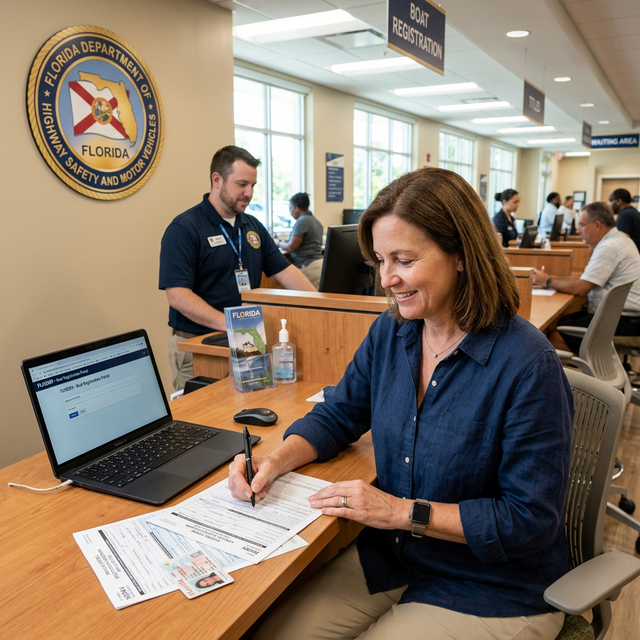
In-person registration at a local DMV, county clerk, or wildlife agency office is still available in all states and may be required for certain situations such as first-time registrations, title transfers, or when original documents need to be verified.
Mail-in registration is also an option in most states, though processing times are typically 2 to 4 weeks.
Boat Title vs. Registration
It is important to understand the difference between a boat title and boat registration. A title is a legal document proving ownership, while registration is the process of recording your vessel with the state and obtaining permission to operate it on public waterways.
Not all states require boat titles, but most require registration. Many states that do require titles only mandate them for motorized vessels or vessels above a certain length or value. For a complete breakdown, see our boat title vs. registration guide.
Registration Renewal
Boat registrations are not permanent. Depending on your state, registrations must be renewed every 1 to 3 years. Most states send renewal notices before your registration expires, and many offer online renewal for returning boat owners. Late renewals may incur penalties. For detailed renewal information, visit our registration renewal guide.
Tips for a Smooth Registration Experience
Start the process early: do not wait until the last minute, especially if you need to register in person. Peak boating season (spring and early summer) means longer wait times at state offices.
Keep copies of all documents, including your registration certificate, title, and bill of sale. Store digital copies securely as backup.
Verify the hull identification number (HIN) before purchasing a used boat. This 12-character number, usually found on the transom, is essential for registration and helps verify the boat is not stolen or has any outstanding liens. Our lien check guide can help.
Frequently Asked Questions
How long does boat registration take?
Can I operate my boat while waiting for registration?
Do I need to register my boat if it has a USCG documentation?
What happens if I move to a new state with a registered boat?
How much does it cost to register a boat?
Sources
- U.S. Coast Guard — Vessel Documentation Center (https://www.dco.uscg.mil/nvdc/)
- National Association of State Boating Law Administrators — NASBLA (https://www.nasbla.org/)
This information is provided for reference purposes only. While we strive to keep data accurate and up-to-date, registration requirements, fees, and regulations may change without notice. Always contact your state's official registration agency for the most current and authoritative information before making any decisions.