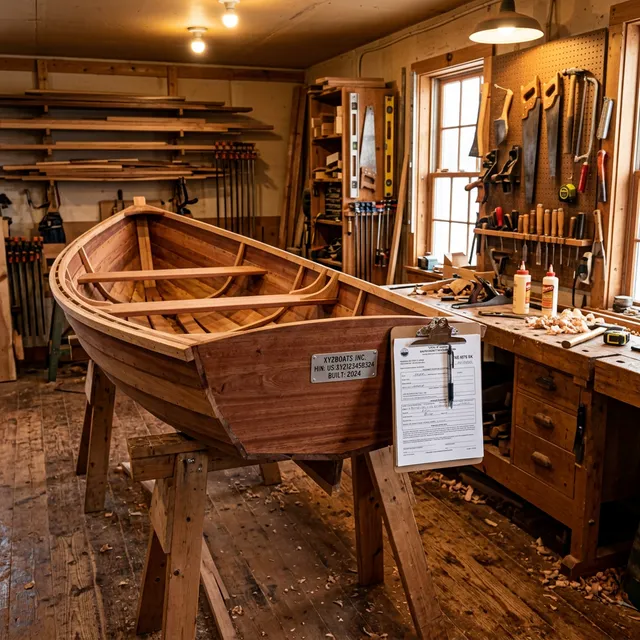
Can You Register a Homemade Boat?
Yes, you can register a homemade boat in every U.S. state, but the process is more involved than registering a factory-built vessel. When you build a boat yourself, there is no manufacturer to assign a Hull Identification Number (HIN), no Manufacturer's Statement of Origin (MSO), and no established chain of ownership documents. You will need to create proof of ownership and obtain a state-assigned HIN before your boat can be legally registered and operated on public waterways.
The registration requirements for homemade boats vary significantly from state to state, but the core steps are consistent: obtain a HIN, prove you built or own the boat, pass an inspection (in most states), and complete the standard registration application. This guide walks through each step in detail so you can get your custom-built vessel on the water legally.
The federal requirement for Hull Identification Numbers on recreational boats has been in effect since 1972 under the Federal Boat Safety Act. All boats manufactured or imported after November 1, 1972, must have a HIN — and that includes homemade vessels.
Getting a Hull Identification Number (HIN)
The Hull Identification Number is a unique 12-character serial number that serves as your boat's primary identifier, similar to a Vehicle Identification Number (VIN) on a car. Factory-built boats receive their HIN from the manufacturer, but homemade boats must receive one from the state.
To obtain a HIN for your homemade boat, contact your state's boating authority — typically the Department of Natural Resources (DNR), Department of Motor Vehicles (DMV), Fish and Wildlife Commission, or Marine Police Division. The exact agency varies by state. You will submit an application requesting a state-assigned HIN, which usually begins with your state's two-letter abbreviation followed by the letter "Z" (indicating a state-assigned rather than manufacturer-assigned number). For example, a Florida-assigned HIN might begin with "FLZ" and a Texas-assigned HIN with "TXZ."
The HIN must be permanently affixed to the outside upper starboard (right) quarter of the transom. Federal regulations also require a duplicate HIN in an unexposed location on the boat for identification in case the primary HIN is removed or damaged. Your state agency will provide specific instructions on how and where to affix the number.
Some states assign the HIN at the time of inspection, while others process the application first and send the HIN plate or instructions for engraving before the inspection takes place. Check with your state's specific process early in the building phase.
Documentation You Will Need
Since homemade boats lack the standard ownership documents that come with a dealer or manufacturer purchase, you will need to create your own paper trail. The documentation requirements generally include:
Builder's Statement or Affidavit — Most states require a sworn, notarized statement confirming that you personally built the boat. This affidavit typically includes your full name, address, a description of the vessel (length, beam, hull material, propulsion type), and a statement that the boat was constructed for personal use and not for sale. Some states provide a specific form for this purpose.
Material Receipts — Keep detailed records and receipts for all materials used in construction: hull materials, engine, electrical components, hardware, paint, and other supplies. These receipts serve double duty as proof of ownership and documentation for sales tax purposes. Some states may assess sales tax on the cost of materials if tax was not paid at the time of purchase.
Construction Photographs — Several states require or strongly recommend photographs showing the boat at various stages of construction. These photos help establish that you genuinely built the vessel and can expedite the inspection process. Document the hull construction, framing, deck installation, engine mounting, and finished exterior.
Detailed Vessel Description — Be prepared to provide comprehensive specifications: overall length, beam (width), hull material (fiberglass, aluminum, wood, composite), propulsion type (outboard, inboard, oar, sail), maximum horsepower rating (if applicable), and intended use (recreation, fishing, sailing).
The Inspection Process
Most states require a physical inspection of homemade boats before registration. The inspection is typically conducted by a state wildlife officer, boating enforcement officer, or certified marine surveyor. The purpose is to verify the boat's identity, confirm it matches the description in your application, and evaluate basic safety and seaworthiness.
During the inspection, the officer will typically check the hull for structural soundness, verify that flotation materials or devices are adequate, check that the HIN (if already assigned) is properly affixed, and confirm that required safety equipment is present. Some states also test stability by requiring the boat to be placed in water with a load.
The inspection is not intended to be an exhaustive engineering review, but rather a reasonable safety verification. If the inspector identifies significant safety concerns, they may require modifications before issuing approval. Common issues include inadequate flotation, improper electrical wiring, fuel system deficiencies, or structural weaknesses.
Schedule the inspection through your state's boating authority. Processing times vary — some states can schedule inspections within a few days, while others may take several weeks during peak boating season. Plan ahead to ensure your boat is ready for the water when you want it.
Registration Fees for Homemade Boats
Registration fees for homemade boats are typically the same as for factory-built boats of the same size class. Fees are usually based on the length of the vessel, with longer boats paying higher registration fees. Some states also factor in the engine horsepower or the type of propulsion.
In addition to the standard registration fee, you may also need to pay a title fee (in states that require boat titles), an inspection fee, and applicable taxes. The tax situation for homemade boats can be complex — some states charge sales tax on the fair market value of the completed boat, while others only tax the materials used in construction.
For a detailed breakdown of registration fees by state and boat length, use our registration fee calculator or browse the state-by-state fee comparison.
Insurance Challenges for Custom-Built Boats
Insuring a homemade boat presents unique challenges compared to factory-built vessels. Most standard boat insurance policies are designed for production boats with established market values, safety ratings, and repair histories. A homemade boat lacks all of these, making it harder to place coverage.
Many insurance companies will insure homemade boats, but they may require a marine survey or professional appraisal to establish the vessel's value and confirm its seaworthiness. The survey typically evaluates the quality of construction, materials used, structural integrity, and safety systems. Expect the survey to cost between $15 and $25 per foot of boat length.
Liability coverage (which pays for damage or injury you cause to others) is generally easier to obtain than hull coverage (which pays for damage to your own boat). Some insurers specialize in custom and homemade boat coverage — organizations like the Wooden Boat Foundation or custom boat building associations can often provide referrals.
If your state does not require boat insurance, you may choose to carry only liability coverage initially and add hull coverage once you have established a track record of operation. For more information on state insurance requirements, see our boat insurance requirements guide.
State-by-State Variations
While the general process described above applies in all states, specific requirements vary. Here are some notable differences across key states:
Florida — The Florida Fish and Wildlife Conservation Commission (FWC) handles homemade boat registrations. An FWC officer inspects the vessel and assigns the HIN. Florida requires a title for all motorized vessels, and the builder's affidavit serves as the primary ownership document.
California — The California Department of Motor Vehicles (DMV) processes homemade boat registrations. California requires a Vessel Construction Certification form and may require a stability test for certain vessel types. Sales tax applies to the fair market value of the completed boat.
Texas — The Texas Parks and Wildlife Department (TPWD) assigns HINs to homemade boats. Texas requires a notarized builder's statement and a detailed vessel description. The state also requires a title for most motorized vessels.
Michigan — The Michigan Department of Natural Resources (DNR) handles the process. Michigan requires an inspection by a conservation officer before a HIN is assigned. The state requires detailed receipts and construction photos.
Pennsylvania — The Pennsylvania Fish and Boat Commission processes homemade registrations. A marine survey and stability test may be required. Pennsylvania charges sales tax on materials if not previously paid.
For requirements specific to your state, visit your state's registration page.
Tips for a Smooth Registration Process
Based on common experiences from boat builders across the country, here are practical tips to make your homemade boat registration as smooth as possible:
Start the paperwork early. Contact your state's boating authority before you start building or as early in the process as possible. Understanding the requirements upfront prevents delays once the boat is complete.
Document everything. Keep receipts for every purchase, photograph every stage of construction, and maintain a build log. More documentation is always better when proving ownership of a homemade vessel.
Build to safety standards. Even if your state does not explicitly require compliance with ABYC (American Boat and Yacht Council) standards, building to these guidelines improves your chances of passing inspection and obtaining insurance. Focus especially on flotation, electrical systems, and fuel systems.
Get an engine serial number. If you are installing a used engine, make sure you have documentation proving ownership. Engine theft is a concern for law enforcement, and clear ownership documentation for the engine speeds up the registration process.
Budget for the full cost. Beyond materials and registration fees, factor in the costs of inspection fees, title fees, sales tax on materials, insurance survey, and any modifications required after inspection.
Frequently Asked Questions
Do I need a HIN (Hull Identification Number) for a homemade boat?
How much does it cost to register a homemade boat?
Do I need an inspection for my homemade boat?
Can I get insurance for a homemade boat?
Do I have to pay sales tax on a homemade boat?
What documents prove I own a homemade boat?
Sources
- U.S. Coast Guard — Hull Identification Number Requirements (https://www.uscg.mil/)
- NASBLA — National Association of State Boating Law Administrators (https://www.nasbla.org/)
- Individual state DNR/DMV/Fish & Wildlife official registration pages
- ABYC — American Boat and Yacht Council Standards (https://abycinc.org/)
This information is provided for reference purposes only. While we strive to keep data accurate and up-to-date, registration requirements, fees, and regulations may change without notice. Always contact your state's official registration agency for the most current and authoritative information before making any decisions.