Why Registering a Used Boat Is Different
Registering a used boat involves additional steps compared to registering a new boat from a dealer. When you purchase a used vessel from a private seller, you are responsible for verifying ownership, completing a title transfer, and ensuring the boat has no outstanding liens or legal issues before registering it in your name.
Taking the time to complete these steps properly protects you from future ownership disputes, hidden debts, and legal complications. This guide walks you through the entire process from pre-purchase verification to final registration.
Before You Buy: Pre-Purchase Verification
Before exchanging any money, perform these critical checks to avoid costly problems after the purchase.
Verify the Hull Identification Number (HIN)
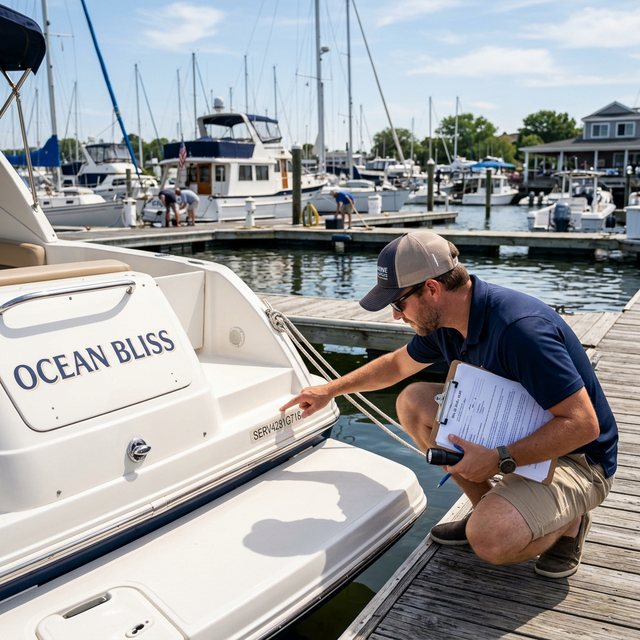
Every boat manufactured after November 1, 1972, has a unique 12-character Hull Identification Number (HIN) permanently affixed to the transom (rear) of the vessel. This number serves as the boat's fingerprint and is essential for registration, title verification, and theft recovery.
Verify that the HIN on the boat matches the HIN on the title, registration, and bill of sale. If the numbers do not match, do not proceed with the purchase until the discrepancy is resolved. A mismatched HIN can indicate a stolen vessel or identity fraud.
Check for Liens and Encumbrances
A lien is a legal claim on the boat by a creditor, usually from an unpaid loan. If you purchase a boat with an existing lien, the creditor may have the right to repossess the vessel regardless of your purchase. Contact your state's titling agency to run a lien check before buying. For more details, see our boat lien check guide.
Verify the Seller's Identity and Ownership
Confirm that the person selling the boat is the actual owner listed on the title. Request to see their photo identification and compare the name to the title document. If the seller is not the titled owner, ask for documentation such as a power of attorney or court order authorizing the sale.
Required Documents for Used Boat Registration
When registering a used boat, you will typically need the following documents: the signed title from the previous owner (with the buyer and seller sections completed), a bill of sale stating the purchase price, date of sale, and vessel details, the hull identification number (HIN), a completed registration/title application from your state, your valid photo identification, and proof of sales tax payment or tax exemption documentation.
Some states may also require a notarized title, an odometer disclosure for the engine, or a vessel condition report. Check your specific state's requirements before visiting the registration office.
The Title Transfer Process
Title transfer is the legal process of changing boat ownership from the seller to the buyer. This is a critical step that must be completed before or at the same time as registration.
Step 1: Complete the Title Assignment
The seller must sign the back of the title in the "seller" or "assignment" section. You (the buyer) fill in your information in the "buyer" section. Both seller and buyer signatures may need to be notarized depending on the state. Ensure all information is filled in completely with no blank fields.
Step 2: Create a Bill of Sale
A bill of sale is a written agreement documenting the sale. It should include: the full names and addresses of both buyer and seller, the date of sale, the purchase price, a complete description of the vessel (year, make, model, length, HIN), engine details (make, horsepower, serial number), and signatures of both parties.
Keep the original bill of sale with your important boat documents. Your state may require a copy as part of the registration process. The purchase price on the bill of sale is used to calculate sales tax.
Step 3: Submit the Title Application
Submit the signed title, bill of sale, and title application to your state's titling agency. Title transfer fees vary by state but typically range from $5 to $55. Processing times range from same-day service at walk-in offices to 4-6 weeks for mail-in applications. For a detailed overview of the title transfer process, visit our boat title transfer guide.
Registering the Boat in Your Name
Once you have the title in your name (or are processing both simultaneously), complete the registration. The registration process for a used boat follows the same general steps as a new boat: fill out your state's registration application, provide the required documents, pay registration fees and any applicable sales or use tax, and receive your registration certificate and numbers.
In many states, you can complete both the title transfer and registration in one transaction at the same office. This is the most efficient approach.
Sales Tax on Used Boats
Most states charge sales tax on used boat purchases, calculated on the purchase price stated in the bill of sale. Some states may assess tax based on the fair market value if the stated price seems significantly below market value.
A few states, such as Alaska, Delaware, Montana, New Hampshire, and Oregon, do not charge sales tax. For a complete breakdown, see our boat sales tax by state guide.
Buying a Used Boat from Out of State
Purchasing a used boat from another state adds complexity to the registration process. You will need to register the boat in your home state, not the state where you purchased it. You may need to provide an out-of-state title, have the boat inspected, and pay your home state's sales or use tax.
Some states offer tax credits for sales tax already paid in the selling state. Contact your state's registration agency before purchasing an out-of-state boat to understand any additional requirements. For more information, visit our out-of-state boat registration guide.
Common Mistakes to Avoid
Not verifying the HIN before purchase: always match the HIN on the boat to the paperwork. Skipping the lien check: a known leading cause of buyer headaches. Accepting a boat without a title: in states that require titles, a boat without one can be nearly impossible to register. Not getting a proper bill of sale: verbal agreements are not sufficient. Waiting too long to register: most states require registration within 15-30 days of purchase to avoid late fees.
Frequently Asked Questions
Can I register a used boat without a title?
How do I register a used boat bought from a private seller?
Do I have to pay sales tax on a used boat?
How long do I have to register a used boat after purchase?
Sources
- U.S. Coast Guard — Hull Identification Number Requirements (https://www.ecfr.gov/current/title-33/chapter-I/subchapter-S/part-181)
- National Association of State Boating Law Administrators — NASBLA (https://www.nasbla.org/)
This information is provided for reference purposes only. While we strive to keep data accurate and up-to-date, registration requirements, fees, and regulations may change without notice. Always contact your state's official registration agency for the most current and authoritative information before making any decisions.