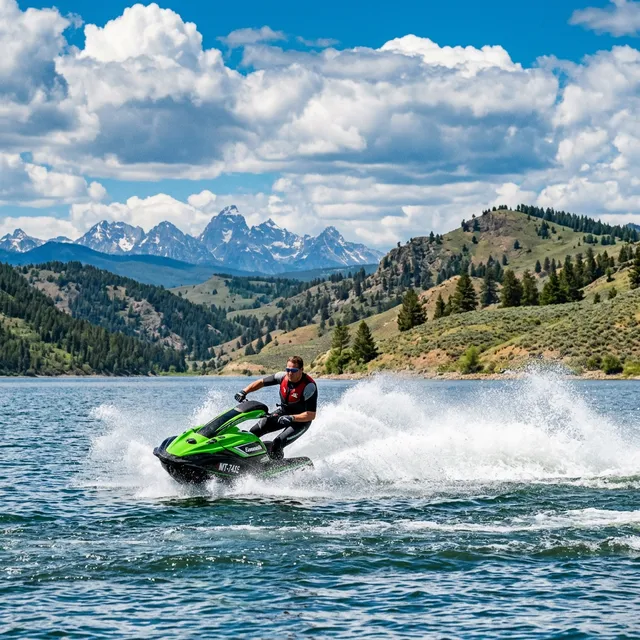
Montana Jet Ski & PWC Laws Overview
Montana classifies personal watercraft (PWC) — including jet skis, WaveRunners, and Sea-Doos — as motorboats. This means every PWC operating on Montana public waters must be titled and registered, just like any motorboat. The good news: Montana offers permanent registration with no annual renewal fees and charges zero sales tax on the purchase.
Montana's PWC laws are enforced by Fish, Wildlife & Parks (FWP) wardens throughout the boating season. Key rules cover age restrictions, boater education requirements for young operators, mandatory safety equipment, operating hours, and specially designated no-wake zones.
This guide covers everything PWC owners and riders need to know for 2026, from registration and titling through operating rules and penalties. For general boat registration details, see our Montana Boat Registration page.
PWC Registration and Title Requirements
Since Montana treats PWC as motorboats, all titling and registration requirements apply:
| Requirement | Details | Fee |
|---|---|---|
| Certificate of Ownership (title) | Required for all PWC | $12.00 |
| Registration (under 16 ft) | One-time, permanent — most PWC | $65.50 |
| Registration numbers | MT format, 3" block letters on bow | Included |
| Validation decal | 3-year period, renewable at no cost | Free renewal |
| Sales tax | Montana has no sales tax | $0.00 |
| AIS Prevention Pass (non-resident) | Annual — PWC classified as motorized | $30.00 |
Most PWC are under 16 feet in length, so the standard one-time permanent registration fee is $65.50. Combined with the $12 title fee and zero sales tax, the total government cost to register a PWC in Montana is just $77.50 for life. For details on the titling process, see our Montana boat title transfer guide. To estimate your total costs, use our registration fee calculator.
Age Restrictions for PWC Operators
Montana has specific age restrictions for PWC operation that differ from general motorboat rules:
Under 12: Children under 12 cannot operate any motorboat with more than 10 horsepower (HP). Since virtually all PWC engines exceed 10 HP (typically 60-310 HP), children under 12 are effectively prohibited from operating a PWC in Montana. They can ride as a passenger with an adult operator.
Ages 13-14: Operators aged 13-14 may operate a PWC if they hold a valid NASBLA-approved boating safety certificate OR are accompanied by an adult 18 or older. Non-resident teens with a valid home-state boater education certificate that meets NASBLA standards are accepted.
Ages 15 and older: No age-based restrictions. Operators 15+ can operate any PWC without boater education requirements. Montana does not require a "jet ski license" — there is no such license category. For more on education requirements, see our boater education guide.
Required Safety Equipment for PWC
Montana requires the following safety equipment on every PWC:
Life jackets (PFDs): Every person on the PWC must wear a US Coast Guard-approved Type I, II, or III life jacket. Unlike regular boats where you just need PFDs "on board," PWC operators and passengers must have them on their person at all times.
Engine cutoff lanyard (kill switch): Montana requires all PWC operators to attach the engine cutoff lanyard to their person, PFD, or clothing while operating. If the operator falls off, the lanyard pulls the kill switch and the engine shuts off. This prevents the "circle of death" — an unmanned PWC circling back toward a person in the water.
Fire extinguisher: PWC with an enclosed engine compartment must carry a US Coast Guard-approved fire extinguisher (Type B-I minimum). Most modern PWC have enclosed compartments and require one.
Sound-producing device: A whistle or horn that can be heard from at least half a mile. Many PFDs come with built-in whistles that satisfy this requirement.
Navigation lights: If operating between sunset and sunrise, navigation lights are required. However, Montana law prohibits PWC operation during darkness (see operating rules below), so this is typically relevant only during permitted twilight hours where applicable.
Operating Rules and Restrictions
Montana imposes specific operating rules for PWC beyond standard motorboat regulations:
Operating hours: PWC may operate from sunrise to sunset. Operating a PWC after sunset is prohibited in Montana, even with proper navigation lights. This rule exists because PWC operators have limited visibility and reduced reaction time in low-light conditions.
No-wake zones: PWC must observe all posted no-wake zone markers, typically near docks, marinas, swim areas, and shoreline habitats. In no-wake zones, PWC must operate at the slowest speed necessary to maintain steerage — no wake or minimal wake.
Distance rules: PWC must maintain a safe distance from other vessels, swimmers, docks, and shore. While Montana does not specify an exact distance in statute for all situations, FWP guidelines recommend at least 100 feet from docks, swimmers, and anchored vessels when operating at planing speed.
Reckless operation: Montana law prohibits reckless or negligent operation, which for PWC specifically includes: weaving through congested traffic, jumping the wake of another vessel within 100 feet, and operating in a manner that creates unnecessary hazards. Violations can result in fines and potential impoundment.
Lake-specific restrictions: Some Montana lakes have additional PWC restrictions, including complete PWC bans on certain smaller lakes and reservoirs. Always check FWP fishing access site postings and local regulations before launching.
Montana vs. Neighboring States: PWC Law Comparison
| Rule | Montana | Idaho | Wyoming | N. Dakota |
|---|---|---|---|---|
| Minimum operator age | 13 (with cert) | 14 | 16 | 12 (with cert) |
| Education required (adults) | No | No | No | No |
| Registration fee | $65.50 (permanent) | ~$20/yr | ~$15/yr | ~$20/yr |
| Sales tax on purchase | 0% | 6% | 4% | 5% |
| Kill switch lanyard | Required | Required | Required | Required |
| Night operation | Prohibited | Prohibited | Prohibited | Prohibited |
Montana is one of the most affordable and accessible states for PWC ownership in the region: permanent registration ($65.50 once), zero sales tax, and no adult education requirement. Wyoming requires a minimum age of 16 for PWC operation — significantly stricter than Montana's 13 (with certificate). For full details on each neighbor, visit our pages for Idaho, Wyoming, and North Dakota.
Renting a Jet Ski in Montana
If you are renting a PWC while visiting Montana, the rental operator handles registration and titling — those are the owner's responsibility. However, as the operator, you are responsible for:
Age requirements: You must meet the minimum age requirements. Rental companies typically require operators to be at least 16 or 18 years old, which is stricter than state law.
Safety briefing: Montana does not mandate a specific safety course for renters, but most rental operators provide a safety orientation covering basic controls, no-wake zones, and emergency procedures.
AIS Prevention Pass: If you are a non-resident, you need an AIS Prevention Pass ($30 for motorized). Some rental operators include this in the rental price — ask before booking. For more on the AIS pass, see our Montana non-resident boating guide.
Insurance: Rental operators typically provide liability coverage, but verify the details before riding. Your own boat insurance policy may include a "substitute watercraft" clause that covers rental PWC — check with your insurer.
Penalties for PWC Violations
Montana FWP wardens enforce PWC regulations on the water. Common violations and their consequences include:
| Violation | Potential Penalty |
|---|---|
| Operating unregistered PWC | Fine + impoundment until registered |
| Underage operator (under 12) | Fine to adult responsible party |
| No PFD worn | Fine per person without PFD |
| No kill switch lanyard attached | Fine + possible termination of trip |
| Operating after sunset | Fine |
| Reckless operation | Fine, possible criminal charge, impoundment |
| No AIS Prevention Pass (non-res) | Fine |
| Bypassing inspection station | Fine up to $1,000+ |
Montana treats boating under the influence (BUI) the same as driving under the influence (DUI). Operating a PWC with a blood alcohol concentration (BAC) of 0.08% or higher is a criminal offense carrying fines, jail time, and loss of boating privileges.
Best Montana Lakes for Jet Skiing
Montana offers exceptional PWC opportunities across the state. Top destinations include:
Flathead Lake: The largest natural freshwater lake west of the Mississippi. Flathead Lake offers 191 square miles of riding area with crystal-clear water. Multiple public ramps and marinas. Located near Glacier National Park. Note: enhanced AIS inspections apply in the Flathead Basin.
Fort Peck Reservoir: Montana's largest body of water with over 245,000 acres. Expansive open water ideal for PWC. Located in northeastern Montana with plenty of access points and less crowded than western Montana lakes.
Canyon Ferry Lake: Near Helena, this 35-mile-long reservoir on the Missouri River is one of Montana's most popular recreation lakes. Good PWC access with multiple ramps. Can get busy on summer weekends.
Whitefish Lake: A scenic resort-area lake near Whitefish. Warmer water than many Montana lakes. Flathead Basin AIS rules apply. Some restricted zones near the city park and swimming areas.
For more on the tax benefits of purchasing a PWC in Montana, see our guide on Montana boat sales tax.
Frequently Asked Questions
Do you need a license to ride a jet ski in Montana?
How old do you have to be to drive a jet ski in Montana?
How much does it cost to register a jet ski in Montana?
Can you ride a jet ski at night in Montana?
Is a kill switch lanyard required on jet skis in Montana?
Do non-residents need an AIS pass for a jet ski in Montana?
Sources
- Montana Fish, Wildlife & Parks — Boating Regulations (https://fwp.mt.gov/activities/boating/regulations)
- Montana Code Annotated §23-2-502 — PWC Definitions
- Montana Code Annotated §23-2-523 — Operating Regulations for Motorboats and PWC
- Montana FWP — Boating Safety Education Requirements
This information is provided for reference purposes only. While we strive to keep data accurate and up-to-date, registration requirements, fees, and regulations may change without notice. Always contact your state's official registration agency for the most current and authoritative information before making any decisions.