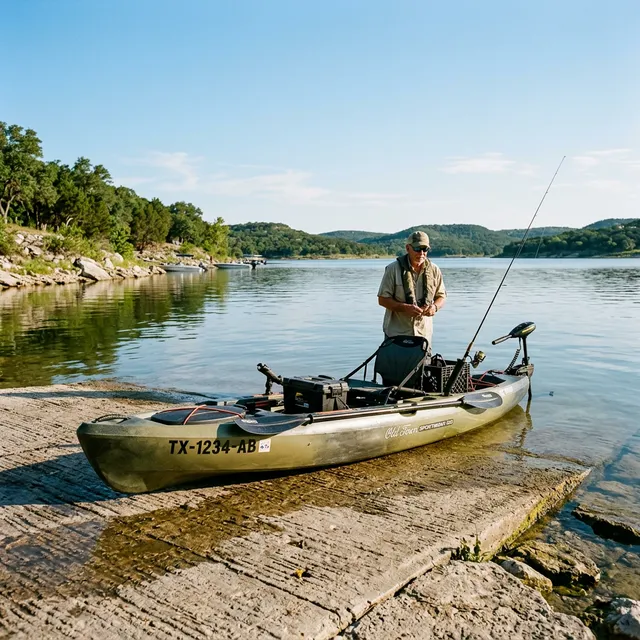
Do You Need to Register a Kayak in Texas?
The short answer: it depends on whether your kayak has a motor. Texas draws a clear line between paddle-powered and motor-powered vessels, and that single distinction determines your entire registration obligation.
Non-motorized kayaks (human-powered only, no motor of any kind) are exempt from registration in Texas. You can paddle on any public waterway without registration numbers, decals, or title paperwork.
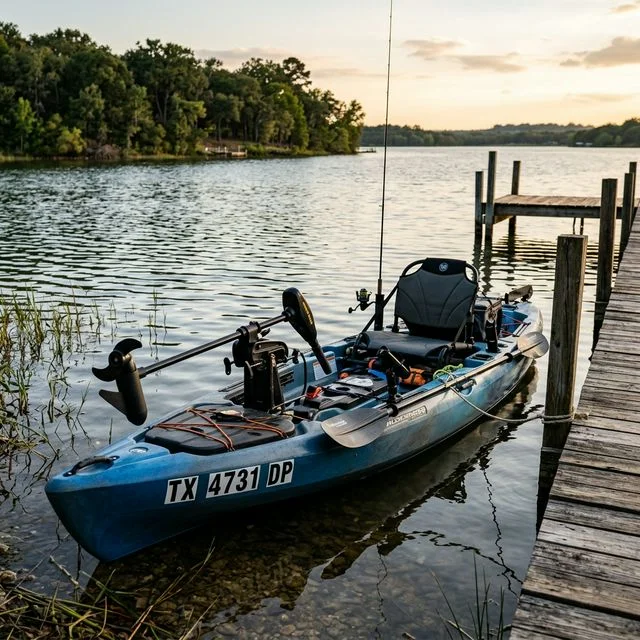
Motorized kayaks — including kayaks with trolling motors, electric motors, or any auxiliary engine — must be registered and titled with the Texas Parks and Wildlife Department (TPWD). This rule applies regardless of the motor's horsepower, thrust rating, or whether the motor is permanently mounted or removable.
This guide covers everything Texas kayakers need to know about registration: what triggers the requirement, how to register, what it costs, and what safety equipment you need on the water.
The Registration Decision: Motor vs No Motor
The key takeaway: any motor, of any size, at any power level, changes your kayak from exempt to registered. A removable 30-pound thrust trolling motor that you clip on for bass fishing triggers the same registration requirement as a permanent outboard. There is no "minimum HP" or "minimum thrust" exemption.
Registering a Motorized Kayak in Texas
If you add a motor to your kayak, here is the registration process:
1. Gather your documents: You will need a bill of sale for the kayak (or Manufacturer's Statement of Origin / MSO if brand new), a bill of sale for the motor, valid photo ID, and payment for fees and sales tax.
2. Complete Form PWD 143 (Vessel/Boat Application) for the kayak itself. If your outboard motor is 25 HP or greater, you will also need Form PWD 144 for the motor. Most trolling motors are well under 25 HP, so typically only the vessel application (PWD 143) is needed.
3. Submit to TPWD in person at a TPWD field office, by mail, or through an authorized agent. You must submit within 45 working days of purchase to avoid late fees.
4. Display your registration number on both sides of the bow in block letters at least 3 inches tall. The format is TX 1234 AB (state abbreviation, 4 digits, 2 letters with spaces between groups). Attach your registration decals adjacent to the number.
Registration and Title Fees for Kayaks
Since most kayaks and canoes are under 16 feet, the fees are the lowest tier available:
| Fee Type | Amount | Notes |
|---|---|---|
| Registration (2-year) | $32.00 | Vessels under 16 ft |
| Title Fee | $27.00 | One-time, for the vessel |
| Sales Tax | 6.25% | On kayak + motor purchase price |
| Motor Title Fee | $27.00 | Only if motor is 25+ HP (rare for kayaks) |
| Late Fee | Varies | If submitted after 45-day deadline |
For a typical fishing kayak ($800) with a trolling motor ($150), your estimated costs would be: sales tax $59.38 (6.25% on $950), title fee $27.00, and registration $32.00 — approximately $118 total. Use our fee calculator for a personalized estimate.
Safety Equipment Requirements
Whether your kayak is registered or not, Texas law requires certain safety equipment on all vessels — including human-powered kayaks and canoes:
| Equipment | Non-Motorized Kayak | Motorized Kayak |
|---|---|---|
| PFD (Life Jacket) | 1 per person, USCG-approved | 1 per person, USCG-approved |
| Children Under 13 | Must wear PFD while underway | Must wear PFD while underway |
| Sound-Producing Device | Whistle or horn required | Whistle or horn required |
| Navigation Lights | Required if on water between sunset and sunrise | Required if on water between sunset and sunrise |
| Fire Extinguisher | Not required | Required if enclosed engine compartment |
| Registration Numbers | Not required | Required on both sides of bow |
Important note on PFDs: While adults are not required to wear their PFD on a non-motorized kayak (only to have one accessible), many experienced paddlers always wear one. Falls from kayaks happen quickly and often in conditions where reaching a stored PFD is difficult.
Boater Education for Kayakers
Texas boater education requirements depend on whether your kayak has a motor and how powerful it is:
Non-motorized kayaks: No boater education card required. Anyone of any age can paddle on Texas public waters without certification.
Motorized kayaks with 15 HP or less (including trolling motors): No boater education card required for adults. However, operators born on or after September 1, 1993, who operate vessels with motors over 15 HP do need a boater education card. Since virtually all trolling motors are well under 15 HP, most motorized kayak operators are exempt from the education requirement.
Why you might still want one: Even if not legally required, a NASBLA-approved boater safety course teaches navigation rules, weather awareness, and emergency procedures applicable to all paddlers. Many insurance companies also offer discounts for completing a safety course.
Canoes, SUPs, and Other Paddle Craft
The same motor-vs-no-motor rule applies to all types of paddle craft in Texas:
Canoes: Exempt from registration when paddle-powered. If you add a trolling motor, registration and title are required.
Stand-Up Paddleboards (SUPs): Not classified as vessels in most enforcement contexts. No registration required. USCG recommends (and some jurisdictions require) carrying a PFD and whistle.
Rowing shells and sculls: Exempt from registration. Subject to standard PFD requirements.
Inflatable kayaks: Same rules as rigid-hull kayaks. No motor = exempt. Motor added = must register.
Pedal-drive kayaks (Hobie MirageDrive, etc.): Pedal-driven systems that use rotating fins or propellers are human-powered and do not constitute a motor. These kayaks remain exempt from registration. However, if you add an electric power-assist or any motorized pedal system, registration is required.
Where to Launch: Texas Public Boat Ramps
Texas offers hundreds of public launch points for kayakers, from developed ramps to informal shore access. Key considerations for kayakers:
State parks: Texas Parks and Wildlife manages over 80 state parks with water access. Most charge a $5–$7 daily entrance fee per person. Annual Texas State Parks Pass ($70) is recommended for frequent visitors.
Army Corps of Engineers lakes: Many major Texas reservoirs (Lake Texoma, Lake Whitney, Canyon Lake) have free or low-cost public ramps managed by the Army Corps. These typically have concrete ramps, restrooms, and parking.
City and county ramps: Municipalities along the Gulf Coast and major lakes often maintain free kayak-specific launch areas with shallow-water access points designed for paddle craft.
Kayak-specific access: Some locations have "kayak only" launches that are too shallow or narrow for powerboats, reducing congestion and improving safety for paddlers.
Neighboring State Rules for Kayakers
If you kayak near state borders, understanding neighboring states' rules prevents citation surprises:
| State | Non-Motorized Kayak | Motorized Kayak | Key Difference |
|---|---|---|---|
| Texas | Exempt | Must register + title | No HP minimum for registration trigger |
| Louisiana | Exempt | Must register | No title required for boats under 14 ft |
| Oklahoma | Exempt (under 16 ft) | Must register + title | Non-motorized exempt only if under 16 ft |
| Arkansas | Exempt | Must register | All motorized vessels must register, no title system |
| New Mexico | Exempt | Must register | Electric motors under 5 HP may be exempt in certain contexts |
For the full state-by-state comparison across all 50 states, see our cost comparison page.
Common Questions About Kayak Modifications
"I only use the trolling motor occasionally — do I still need to register?" Yes. The registration requirement is triggered by the motor being mounted or available for use on the vessel, not by whether you use it on a particular trip. If the motor is on the kayak when you launch, registration is required.
"Can I remove the motor before launching to avoid registration?" Technically, if you remove the motor and paddle only, the kayak is non-motorized and exempt. However, if a Game Warden sees a trolling motor mount, battery, and motor in your vehicle — and your kayak on the water without registration — you may face questioning. The cleanest approach is to register if you ever use a motor.
"Does a fish finder or depth sounder with a built-in trolling motor count?" If any device on the kayak can propel the vessel through the water using a motor, it triggers the registration requirement. A fish finder alone (with only a transducer, no propulsion) does not.
"What about solar-powered trolling motors?" Any motor, regardless of power source (battery, solar, gas), makes the kayak a "motorized vessel" that requires registration.
Frequently Asked Questions
Do I need to register a kayak in Texas?
How much does it cost to register a motorized kayak in Texas?
Do I need a boater education card to use a motorized kayak in Texas?
What safety equipment do I need on a kayak in Texas?
Does a pedal-drive kayak need to be registered in Texas?
Sources
- Texas Parks and Wildlife Department — Vessel Registration Requirements (https://tpwd.texas.gov/fishboat/boat/)
- Texas Water Safety Act — Chapter 31, Texas Parks and Wildlife Code
- TPWD Form PWD 143 — Vessel/Boat Application
- USCG — Federal Requirements for Recreational Vessels
This information is provided for reference purposes only. While we strive to keep data accurate and up-to-date, registration requirements, fees, and regulations may change without notice. Always contact your state's official registration agency for the most current and authoritative information before making any decisions.