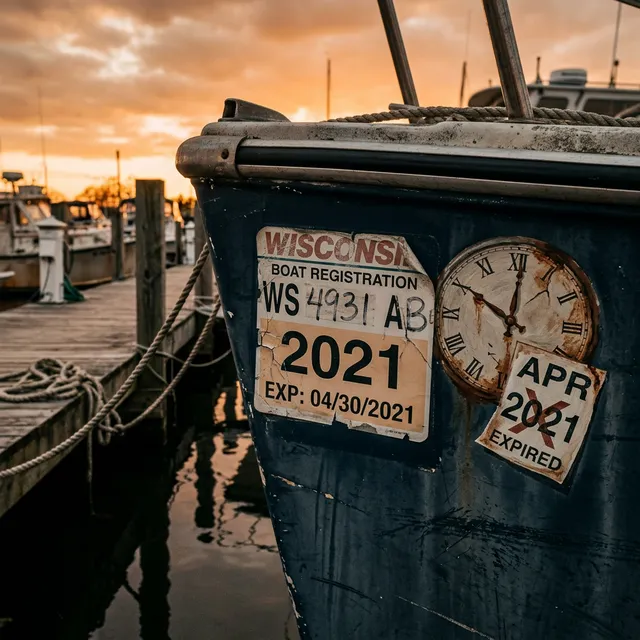
What Happens When Your Boat Registration Expires
Do not operate a boat on public waterways after its registration expires unless the state agency gives you a valid temporary authorization. The consequence of a lapse depends on the state and can include a late fee, citation, or extra paperwork.
Most states renew boat registrations on a recurring term. When the term ends, the registration record and validation decals may no longer be current, even if the boat itself has not changed ownership.
This guide focuses on the practical next step: confirm the current state rule, renew or reinstate the registration, and find out whether a long lapse changes the filing method or amount due.
What a State May Charge or Require
A state may use a late fee, a citation for operating while expired, a back-fee rule, an in-person review, or a combination of these. The current schedule is state-specific and can change, so do not rely on a national fine amount.
Use our penalty calculator to estimate the likely late-fee impact, then check your state page for the current renewal rules.
How to Renew an Expired Registration
Renewing an expired boat registration follows essentially the same process as a standard renewal, though some states add late fees or require additional steps for long-expired registrations. Here is the general process:
Step 1: Gather your documents. Start with the expired registration card or number, ownership evidence, HIN details, and photo ID. Add any title, tax, inspection, or insurance document the state agency lists.
Step 2: Confirm the filing method. Check whether the agency allows online renewal for this length of lapse. A long-expired record may require mail or in-person processing.
Step 3: Confirm the amount due. Ask the agency whether you owe only the current term or also a late fee, back fee, inspection charge, or other state-specific amount.
Step 4: Replace the current documents. After approval, follow the agency's instructions for the current certificate, number record, and validation decals. Do not operate until the documents or temporary authorization are valid.
For a detailed walkthrough of the standard renewal process and state-by-state requirements, see our boat registration renewal guide.
Long-Expired Registrations: What If It Has Been Years?
If your boat registration has been expired for a long period, the renewal process may differ from standard renewals. Some states require an in-person visit to complete the process, as online or mail renewal may not be available for long-expired registrations.
A long lapse does not always mean you must start over, but the agency may ask for the old registration number, ownership evidence, HIN verification, a new application, or an inspection. Some states charge back fees; others use a current-term or reinstatement charge.
If you cannot locate any of your previous registration documents, you may need to request a duplicate registration first (see our lost registration replacement guide) or provide alternative proof of ownership such as a title document or bill of sale.
For USCG-documented vessels, the reinstatement process is handled separately through the Coast Guard documentation system. Check the current federal instructions and fee schedule before filing.
Can You Operate a Boat With Expired Registration?
Not until the state confirms that the registration is current or gives you a valid temporary authorization. A payment receipt is not automatically a temporary operating permit.
If you are stopped with an expired registration, the enforcement response depends on the state, the facts of the stop, and whether the boat has any other violation. Do not assume a grace period allows operation.
Carry the current registration certificate or card in the manner your state requires. A missing document can create a separate problem even after the registration record is renewed.
Storage situations are different. If your boat is stored on a trailer or in dry dock and is not being operated on public waterways, most states do not require current registration. However, some states have provisions that require registration to remain current even for stored vessels, especially if the boat remains in the water at a marina or mooring.
How to Avoid Expired Registration
Preventing a registration lapse is far easier (and cheaper) than dealing with one after the fact. Here are practical strategies to stay current:
Set a calendar reminder well before your registration expires. Renewal notices may be delayed or unavailable, so use your own reminder as the primary prompt.
Use online renewal where the agency offers it, but confirm whether early renewal preserves the current expiration date and whether a lapse changes the filing method.
Consider multi-year registration if your state offers it. Many states allow you to register for two or three years at a time, reducing the frequency of renewals and the risk of an accidental lapse.
Keep your mailing address current with your state's registration agency. If you have moved since your last renewal, update your address to ensure renewal notices reach you.
Use our registration fee calculator to budget for upcoming renewal costs, and visit your state's registration page for specific renewal deadlines and procedures.
Frequently Asked Questions
How much is the fine for an expired boat registration?
Can I renew an expired boat registration online?
Do I have to pay back fees for years I missed?
Will I get pulled over for expired boat registration?
Can I sell a boat with an expired registration?
Is there a grace period after boat registration expires?
Sources
- NASBLA — National Association of State Boating Law Administrators (https://www.nasbla.org/)
- Individual state DMV/DNR official registration and penalty schedules
- U.S. Coast Guard — Recreational Vessel Documentation (https://www.uscg.mil/)
This information is provided for reference purposes only. While we strive to keep data accurate and up-to-date, registration requirements, fees, and regulations may change without notice. Always contact your state's official registration agency for the most current and authoritative information before making any decisions.