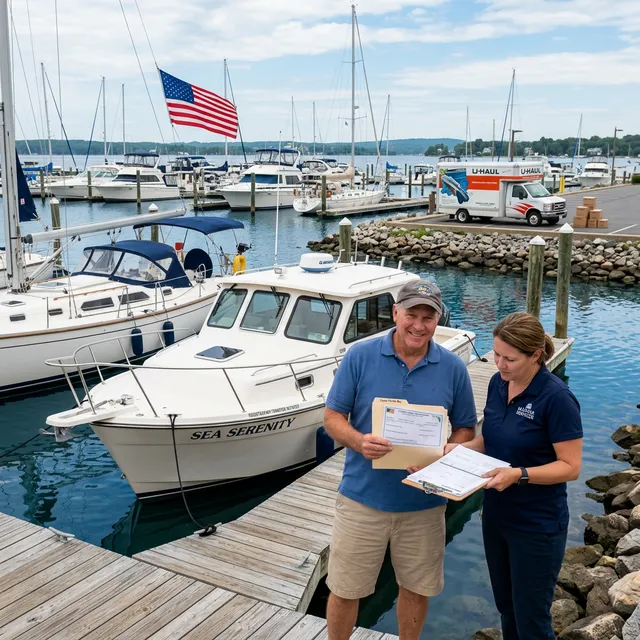
When You Move a Boat to a New State
If you move to a new state permanently, you may need to register your boat in the new state once residency, storage, or principal use changes. The exact trigger is state-specific: some agencies focus on the owner's residency, while others focus on where the boat is kept or operated.
| Move scenario | Likely next step | Key risk |
|---|---|---|
| You became a resident | Check new-resident vessel registration and title deadlines | The clock may start before your first launch |
| Boat is now stored in the new state | Check principal-use, storage, and marina rules | Registration may be required even if you live elsewhere |
| You bought an out-of-state boat | File title/registration and tax paperwork in the state of use | Old-state papers may not satisfy new-state title rules |
| Boat is USCG documented | Keep federal documentation current and check state decal/tax rules | Documentation does not automatically remove every state requirement |
| You are only visiting | Use the host state's temporary-use or reciprocity rule | A visit can become taxable/registrable if it turns into principal use |
The requirement to transfer registration is different from a short visit. If you are temporarily using your boat in another state, the host state may allow temporary use with valid home-state registration for a fixed period or under a principal-use rule. For longer-term non-resident use, see our non-resident registration guide.
Common scenarios that can trigger a registration transfer include relocating your primary residence, changing your driver's license to the new state, keeping the boat at a marina in the new state, or buying an out-of-state vessel that will be used mainly in your state.
Documents You Will Need
Before visiting your new state's registration office, gather all relevant documentation. Having complete paperwork on your first visit can save significant time and prevent multiple trips. The standard documents required include:
Proof of Ownership — This is the most critical document. Acceptable forms include your current boat title (Certificate of Ownership) from the previous state, a Manufacturer's Statement of Origin (MSO) if the boat is new, or a transferable registration card. If your previous state was a "registration-only" state (one that does not issue titles), you will need the original registration card plus a bill of sale.
Current Registration — Your boat's current registration certificate from the previous state, even if it is expired. This helps the new state verify the boat's history and previous registration number.
Bill of Sale — A detailed bill of sale showing the purchase price, date of sale, seller and buyer information, and a description of the vessel. This is especially important if the boat was recently purchased or if the previous state did not issue titles.
Hull Identification Number (HIN) — The 12-digit HIN permanently attached to the boat's transom. The new state will verify this number against your documentation to confirm identity.
Government-Issued Photo ID — A valid driver's license, passport, or other government-issued identification. Some agencies also ask for proof of the new address or residency.
Proof of Sales Tax Payment — Documentation showing that sales or use tax was paid on the boat. If tax was not paid (or was paid at a lower rate than the new state requires), you will likely owe use tax to the new state.
USCG Documentation — If your boat is federally documented with the U.S. Coast Guard, bring your Certificate of Documentation. Documented vessels generally use federal identification instead of state bow numbers, but many states still require registration records, validation decals, or tax paperwork. For more details, see our USCG documentation guide.
Step-by-Step Transfer Process
While specific procedures vary by state, the general transfer process follows these steps:
Step 1: Research your new state's requirements. Visit your new state's DMV, DNR, or Fish and Wildlife website to understand the exact forms, fees, and documentation required. Each state has its own process, and requirements can differ significantly. Use our state-by-state registration pages as a starting point.
Step 2: Complete the application form. Fill out the new state's vessel registration and/or title application. These forms are typically available online for download or at local agency offices. Provide accurate information about the vessel, including make, model, year, length, HIN, engine details, and propulsion type.
Step 3: Submit documents and pay fees. Bring your completed application, all supporting documents, and payment to the appropriate office. Fees typically include registration fees (based on vessel length or type), title fees (if the new state requires a title), and applicable sales/use tax.
Step 4: Receive new registration. Upon successful processing, you will receive a new registration certificate, validation decals, and (in titling states) a new boat title. State-numbered vessels display the new registration number and decals according to the new state's display rules; documented vessels may follow a separate marking and decal pattern.
Step 5: Cancel the old registration. Some states require you to formally cancel the old registration, while others will handle it automatically when the new state's records are processed. Check with your previous state's agency to confirm whether any action is needed on your end.
Deadlines by State
Each state sets its own deadline or trigger for a boat brought in by a new resident. Missing the applicable rule can result in late fees, tax penalties, or citations. Do not rely on a single national deadline.
| Situation | What to verify | Why it matters |
|---|---|---|
| New resident | Resident registration deadline and proof-of-residency documents | The clock may start when residency is established, not when you first launch |
| Boat kept in the new state | Principal-use or storage rule | A boat stored at a marina can trigger local registration even if the owner lives elsewhere |
| Recently purchased boat | Purchase filing deadline, tax deadline, and title-transfer deadline | Tax and title paperwork may have separate deadlines |
| USCG documented vessel | State validation decal, registration, and tax treatment | Federal documentation does not automatically satisfy state use or tax rules |
Use the new state's official agency page before you move, then keep dated proof of the move, storage location, prior registration, and tax payment with your application.
Tax Implications of State Transfers
One of the most significant financial considerations when transferring a boat registration is the potential use tax obligation. Use tax is the counterpart to sales tax and applies when you bring a boat purchased in one state into another state for registration.
If you already paid sales tax in another state, many agencies will credit that amount against the use tax owed. The credit calculation is state-specific, and some agencies require a tax receipt rather than only a bill of sale.
If you purchased the boat in a state with no sales tax and then move to a state that charges use tax, you may owe use tax unless an exemption, credit, timing rule, or resident-move rule applies. This can be a significant expense, particularly for expensive vessels in higher-tax states.
Some states calculate use tax based on the purchase price, while others may use current value, book value, or an agency valuation method. Check your new state's specific use tax rules before budgeting the transfer.
For a detailed breakdown of sales tax rates and caps across all states, see our boat sales tax guide and use our fee calculator to estimate your total costs.
Title vs. Registration-Only States
An important factor in the transfer process is whether your old state and new state are "titling" states or "registration-only" states. Titling states issue a Certificate of Ownership (title) in addition to the registration, while registration-only states issue only a registration certificate.
Transferring from a titling state to another titling state is the most straightforward scenario. You submit the old title to the new state, which issues a new title in its name. The old title is typically surrendered or voided.
Transferring from a registration-only state to a titling state can be more complex. Without a title from the previous state, you may need to provide additional documentation to prove ownership — typically a bill of sale, the old registration card, and possibly a sworn statement. Some states may require a VIN/HIN inspection to verify the boat's identity.
Transferring from a titling state to a registration-only state is generally simple — you bring the title as proof of ownership, and the new state issues registration based on it.
For a detailed explanation of the differences between these systems, see our boat title vs. registration guide.
Common Pitfalls and How to Avoid Them
Based on common issues encountered by boat owners during interstate transfers, here are the most frequent pitfalls and how to avoid them:
Missing the deadline. This is a frequent transfer problem. Mark your calendar as soon as you move and begin the transfer process early. Late fees and penalties can add hundreds of dollars to the cost.
Incomplete documentation. Arriving at the registration office without all required documents wastes time and requires a return visit. Gather everything listed above before your first visit. Call the office in advance if you are unsure about specific requirements.
Unexpected use tax bill. Many boat owners are surprised by the use tax obligation when transferring to a higher-tax state. Research the tax implications before you move, and budget accordingly.
Liens and loan complications. If you have a loan on the boat, the lienholder must be involved in the title transfer process. Contact your lender early to understand what documents they need to provide and how long the process takes on their end.
Outstanding violations or fees. If you have unpaid fines, back registration fees, or other outstanding obligations in your previous state, these may need to be resolved before the new state will process your transfer. Check for any outstanding issues before you begin.
Boater education requirements. Some states require a boater safety education certificate to operate on their waters. If your new state has this requirement and your old state did not, you may need to complete a boating safety course. Check our boater education guide for state-specific requirements.
Frequently Asked Questions
How long do I have to transfer my boat registration after moving?
Do I have to pay sales tax again when I transfer to a new state?
What if my old state did not issue a boat title?
Do I need to cancel my old state registration?
Can I keep my old registration number?
What about USCG-documented boats?
Sources
- NASBLA — National Association of State Boating Law Administrators (https://www.nasbla.org/)
- Individual state DMV/DNR official registration transfer pages
- Discover Boating — State Registration Requirements (https://www.discoverboating.com/)
- U.S. Coast Guard — Recreational Vessel Documentation (https://www.uscg.mil/)
This information is provided for reference purposes only. While we strive to keep data accurate and up-to-date, registration requirements, fees, and regulations may change without notice. Always contact your state's official registration agency for the most current and authoritative information before making any decisions.