California PWC Laws at a Glance
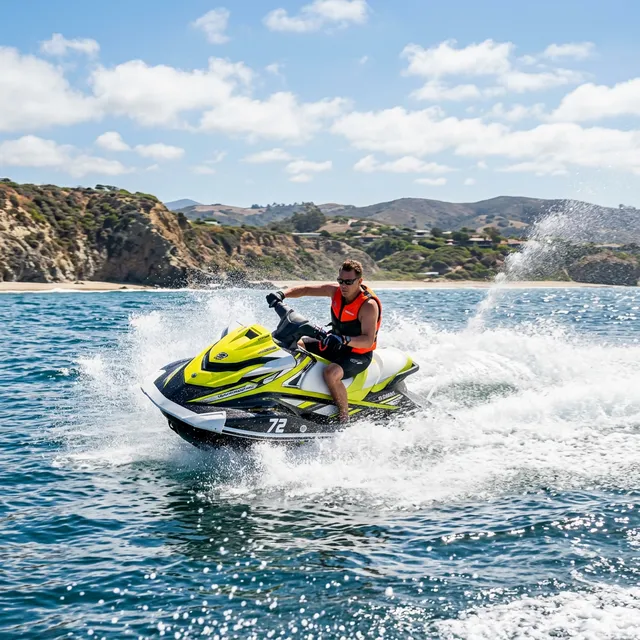
Personal watercraft (PWC) — commonly known by brand names like Jet Ski (Kawasaki), WaveRunner (Yamaha), and Sea-Doo (BRP) — are among the most regulated vessel types in California. While they offer thrilling on-water experiences, their speed, maneuverability, and popularity have led California to impose specific laws beyond standard motorized vessel regulations.
Here is a quick reference of the most important California PWC rules:
| Rule area | California PWC answer |
|---|---|
| Operating hours | PWC operation is limited to official sunrise through official sunset. |
| Registration | PWC must be registered with California DMV and display CF numbers/decals. |
| Boater Card | Covered motorized-vessel operators must carry a California Boater Card or accepted proof. |
| Age | Under-16 operation is limited; 12-15 operators need adult onboard supervision for vessels over 15 HP. |
| Life jacket | PWC riders and people being towed must wear an approved life jacket. |
| Engine cutoff | Use the engine cutoff switch/lanyard according to California and manufacturer rules. |
| Wake jumping | Do not jump another vessel's wake within the prohibited distance or in a reckless manner. |
Operating Hours: Sunrise to Sunset Only
California law restricts personal watercraft operation to the period between official sunrise and official sunset. This is one of the strictest time limitations among boating regulations — standard motorized boats can operate 24 hours a day with proper navigation lights, but PWCs cannot.
This restriction applies even if your PWC is equipped with navigation lights. The rationale is safety: PWCs sit low in the water, are difficult for other vessels to see at night, and the high-speed maneuvers typical of PWC operation become especially dangerous in low-visibility conditions.
Sunrise and sunset times vary by date and location. Check official sunrise and sunset times for the specific waterway on the day you plan to ride.
Age Requirements for PWC Operation
California has three age tiers for PWC operation:
| Age group | California operating rule | What to verify |
|---|---|---|
| 16 and older | May operate covered motorized vessels if the Boater Card rule is satisfied | Card, rental policy, and local waterway restrictions |
| 12 to 15 | May operate certain motorized vessels over 15 HP only with adult onboard supervision | Adult age, card status, and whether the vessel/PWC is allowed |
| Under 12 | Cannot operate motorboats over 15 HP, which excludes most PWC operation | Local rules and vessel horsepower |
The supervising adult must be physically on board, not merely watching from shore. For a rental or organized activity, also follow the operator's stricter age and supervision policy.
Registration and Boater Card
All personal watercraft operated on California waterways must be registered with the California DMV. The registration process and fees are the same as for any motorized vessel:
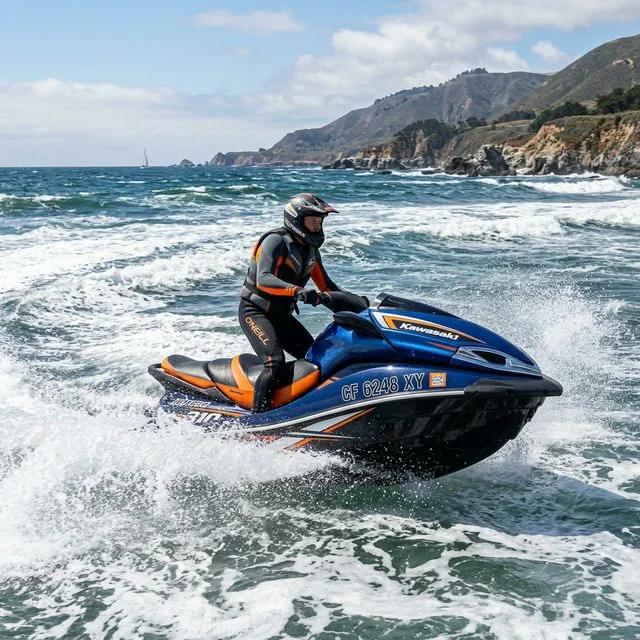
Registration: Complete the DMV vessel registration process, provide proof of ownership, pay current DMV fees, and display the CF number on both sides of the bow in contrasting block letters at least 3 inches high. Current registration stickers must also be displayed. For complete registration details, see California boat registration.
Boater Card: As of January 1, 2025, California's Boater Card requirement applies broadly to operators of covered motorized vessels, including PWC operators who are legally permitted to operate. Complete an accepted boating safety course and confirm any out-of-state certificate or rental exception with California DBW before riding.
Safety Equipment Requirements
PWCs have stricter safety equipment requirements than many other vessel types:
Life Jackets (PFDs): Every person on board the PWC and every person being towed (for tubing, skiing, etc.) must wear a USCG-approved life jacket approved for the activity.
Kill Switch Lanyard: The engine cutoff switch (kill switch) lanyard should be attached to the operator's person, clothing, or life jacket as required. If the operator falls off, the lanyard pulls free and shuts down the engine, preventing the PWC from circling unmanned.
Fire Extinguisher: PWCs with enclosed engine compartments (which includes most modern PWC models) must carry a USCG-approved Type B-1 fire extinguisher. Make sure it is readily accessible and the charge indicator shows green.
Sound-Producing Device: A whistle, horn, or other audible signal device is required. Many riders clip a waterproof whistle to their life jacket.
Operating Rules and Prohibited Behavior
California law defines several specific PWC behaviors as illegal:
Wake jumping within 100 feet: Intentionally jumping the wake of another vessel within 100 feet of that vessel is prohibited. This is one of the most commonly cited PWC violations.
Following too closely: Operating a PWC in the wake of another vessel in a manner that obstructs visibility or creates a collision risk is illegal.
Reckless or negligent operation: Operating at unsafe speeds near swimmers, docks, launching ramps, or other vessels. Engaging in dangerous maneuvers near shore or in crowded areas.
Weaving through vessel traffic: Using a PWC to aggressively weave between other boats, especially in congested areas or no-wake zones.
Speed in restricted zones: Many California lakes, harbors, and waterways have posted speed limits (typically 5 mph in harbor areas and near swimming beaches). These apply to PWCs just as they do to any vessel.
Towing restrictions: When towing a person behind a PWC (skiing, tubing, etc.), verify observer, mirror, seating-capacity, and local towing rules before launching. Rental operators and managed lakes may impose stricter rules.
Where You Can (and Cannot) Ride in California
California offers extensive PWC riding opportunities, but many waterways have specific restrictions:
Ocean and coastal waters: PWC operation may be allowed in many coastal areas, but harbors, marine sanctuaries, state marine protected areas, and local agencies can impose speed, launch, distance, or access restrictions.
Lakes and reservoirs: Many lakes allow PWCs, while others restrict PWC zones, launch hours, mussel inspections, engine types, or seasonal access.
Rivers and managed waterways: Rivers, deltas, aqueducts, and water conveyance systems can have local speed, wake, safety, and access rules that differ from the statewide baseline.
As a general rule, contact the local managing agency (county parks, USFS, Army Corps of Engineers, or local harbor authority) before visiting any waterway for the first time with a PWC. Rules can change seasonally, and some areas require specific permits or launch reservations during peak periods.
Penalties and Fines
Violations of California PWC laws can result in warnings, citations, court costs, fines, vessel stop orders, or criminal charges in serious cases. The final amount depends on the violation, local court schedule, and repeat-offense history:
| Violation area | Why it matters |
|---|---|
| Operating without registration | DMV credentials and decals prove the PWC is currently registered. |
| Operating without required boater education proof | California Boater Card rules apply to covered motorized-vessel operators. |
| Operating after sunset | PWC operation is limited to official sunrise through official sunset. |
| No life jacket worn | PWC riders and towed persons must wear approved PFDs. |
| No engine cutoff lanyard use | The cutoff device is a core PWC safety requirement. |
| Reckless operation or wake jumping | Can create collision risk and lead to enhanced enforcement. |
| Underage operation | Age and supervision rules are enforced separately from registration. |
| BWI | Boating under the influence can lead to criminal penalties. |
California's Boating While Intoxicated (BWI) law applies the same BAC limit (0.08%) as driving under the influence. Penalties for BWI are severe and can include jail time, fines, mandatory boating safety courses, and a prohibition on operating any vessel. Do not operate a PWC — or any watercraft — under the influence of alcohol or drugs.
Insurance and Liability
California does not legally require boat or PWC insurance. However, carrying liability insurance on a personal watercraft is strongly recommended for several practical reasons:
The high speeds, fast turns, and proximity to other watercraft and swimmers create collision risk. If you cause an accident resulting in injury or property damage, you can be personally liable for the loss.
Marina operators, rental companies, lenders, and some managed waterways may require proof of liability insurance before allowing PWC launching, rental, storage, or financing. Quotes depend on the make/model, location, use, coverage limits, and operator profile.
For more information on boat insurance options and requirements across all states, see our boat insurance requirements guide.
Renting a Jet Ski in California
If you are visiting California or want to try PWC riding without purchasing, rentals are widely available at popular coastal and lake destinations. Here is what you need to know:
Boater Card: Ask the rental operator how it handles California Boater Card, accepted out-of-state proof, and rental instruction requirements. Do this before you arrive, because policies can differ by operator and waterway.
Age: Most rental companies require riders to be at least 18 years old (stricter than the state's 16-year minimum). Operators under 18 may be permitted with a parent/guardian present and signing a waiver, but policies vary by operator.
Safety briefing: Reputable rental operators provide a safety briefing covering local waterway rules, speed restrictions, operational boundaries, and emergency procedures. Pay attention to this briefing — local rules often differ from general state law.
Insurance: Rental companies carry their own insurance, but you may be offered a damage waiver or supplemental coverage. Review the rental agreement carefully to understand your liability for damage to the PWC.
Frequently Asked Questions
What are the operating hours for jet skis in California?
How old do you have to be to ride a jet ski in California?
Do I need a license to drive a jet ski in California?
Is a kill switch lanyard required on jet skis in California?
Do you have to wear a life jacket on a jet ski in California?
Can you ride a jet ski on Lake Tahoe?
Sources
- California Division of Boating and Waterways — PWC Regulations (https://dbw.parks.ca.gov/)
- California Harbors and Navigation Code — Personal Watercraft (https://leginfo.legislature.ca.gov/)
- California Boater Card Program (https://californiaboatercard.com/)
- California DMV — Vessel Registration (https://www.dmv.ca.gov/portal/vehicle-registration/vessel-registration/)
This information is provided for reference purposes only. While we strive to keep data accurate and up-to-date, registration requirements, fees, and regulations may change without notice. Always contact your state's official registration agency for the most current and authoritative information before making any decisions.