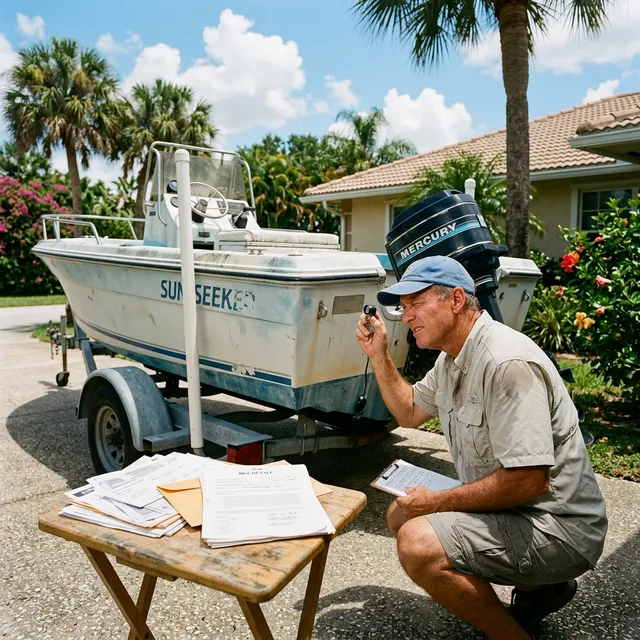
Can You Register a Florida Boat Without a Title?
Sometimes, but a missing title is not a shortcut. Florida says all motorized vessels operating on Florida public waterways must be titled and registered, and applications are filed through a county tax collector or license plate agent. If the boat should have a title, the cleanest answer is usually to have the recorded owner obtain a duplicate title before the sale or transfer.
If the title never existed, the boat is homemade, the paperwork is incomplete, or the seller cannot be reached, treat the case as an ownership-proof problem. Bring every available document to the county office and ask what they will accept before you spend money on the boat. For a normal transfer with a signed title, use our Florida boat title transfer guide instead.
Start With the Reason the Title Is Missing
| Situation | Best first step | Why it matters |
|---|---|---|
| Seller lost a Florida title | Ask the seller to request a duplicate title before closing | The recorded owner is in the best position to replace a lost title. |
| Boat has only a bill of sale | Call the county tax collector before purchase | A bill of sale alone may not prove ownership for a titled vessel. |
| Homemade vessel | Ask about HSMV 82040 and the homemade-vessel forms | FLHSMV lists HSMV 82040 and HSMV 87002 for certain homemade vessel applications. |
| Abandoned vessel | Contact law enforcement or FWC guidance first | Florida states that finding an abandoned vessel does not automatically create ownership. |
| Out-of-state or older boat | Bring prior registration, seller documents, and HIN evidence | The county office needs a documented ownership chain. |
The main SEO answer is simple: do not search for a magic Florida bonded-title form for boats. Florida vessel applications run through FLHSMV and the county tax collector system. If an office asks for extra ownership proof, follow that office-specific instruction rather than relying on a generic vehicle bonded-title process.
Documents That Usually Help
Gather documents that connect the seller, the buyer, and the physical vessel. Useful proof can include a detailed boat bill of sale, prior registration card, any old title copy, lien release, probate or estate documents, dealer paperwork, repair receipts, marina storage records, and clear photos of the Hull Identification Number (HIN).
Make every document consistent. The HIN, make, year, length, seller name, buyer name, and sale date should not conflict. If the HIN is missing, altered, or unreadable, stop and ask the county office or the appropriate enforcement agency what inspection or assignment process applies before submitting an application.
Florida Costs to Expect
For a homemade vessel application, FLHSMV lists a $5.25 electronic title fee, $7.75 paper title fee, or $11 expedited title fee, plus a registration fee based on vessel length and any applicable sales tax. Standard Florida registration fees vary by length, so use the official fee schedule or our boat registration calculator after you know the boat class.
Avoid planning around fixed inspection fees or fixed processing times unless your county gives them to you in writing. Missing-title cases can require extra review, and the timeline depends on the county office, the paperwork quality, the HIN status, and whether ownership can be verified.
When You Should Walk Away
Walk away, or at least pause the sale, if the seller will not provide ID, the HIN looks altered, the boat price is far below market value, the seller refuses to sign a detailed bill of sale, or there is any sign of an unpaid lien. A cheap boat can become expensive if you cannot title or register it.
Before paying, run a basic ownership check using the HIN and review our boat lien check guide. If you are unsure whether title or registration is required, compare the paperwork basics in boat title vs. registration.
Frequently Asked Questions
Can I register a boat with only a bill of sale in Florida?
What if the Florida seller lost the boat title?
Does Florida automatically give ownership of an abandoned boat to the finder?
What forms are used for a homemade boat in Florida?
How long does a no-title Florida boat case take?
Sources
- FLHSMV — Vessel Titling and Registrations (https://www.flhsmv.gov/motor-vehicles-tags-titles/vessels/vessel-titling-registrations/)
- Florida Statutes, Chapter 328 — Vessels (http://www.leg.state.fl.us/statutes/index.cfm?App_mode=Display_Statute&URL=0300-0399/0328/0328.html)
- Florida Fish and Wildlife Conservation Commission — Boating and derelict vessel guidance (https://myfwc.com/boating/)
This information is provided for reference purposes only. While we strive to keep data accurate and up-to-date, registration requirements, fees, and regulations may change without notice. Always contact your state's official registration agency for the most current and authoritative information before making any decisions.