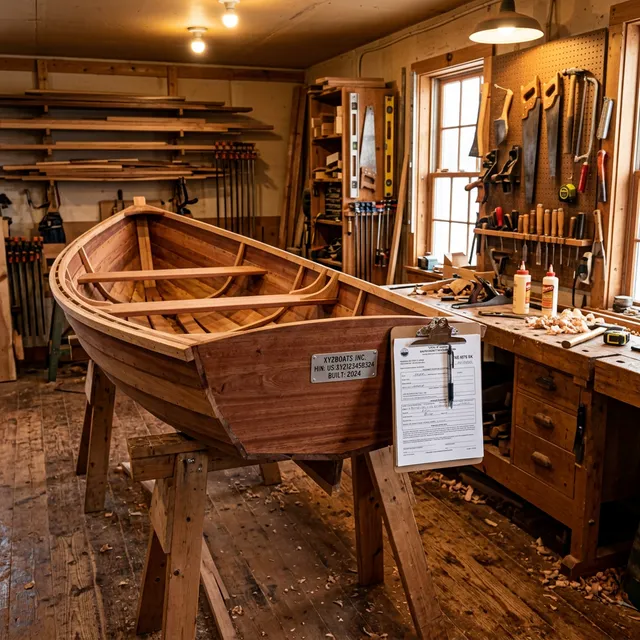
Can You Register a Homemade Boat?
Yes, a homemade boat can usually be registered, but the paperwork is different from a factory-built vessel. There is no manufacturer-issued HIN or MSO, so the builder must document ownership and follow the state process for obtaining the required HIN before operation.
The exact forms and inspection steps vary by state. The common path is to document the build, obtain a state-issued HIN, complete any inspection or ownership review, and file the registration and title applications that apply to the vessel.
Do not invent a HIN or assume that a self-created serial number satisfies the state rule. Ask the issuing authority for the current homemade-vessel process before the boat is finished.
Getting a Hull Identification Number (HIN)
A HIN is a unique 12-character identifier for a vessel. Factory-built boats receive it from the manufacturer; a homemade boat must follow the state process for obtaining a state-issued HIN.
Under the federal HIN rules in 33 CFR Part 181, an owner-built boat for personal use follows the issuing authority for the state of principal operation. Contact the state boating authority before filing because the office, application, and inspection sequence vary.
For a boat with a transom, the primary HIN is permanently affixed to the starboard outboard side of the transom, within two inches of the top. Follow the state agency's instructions for the plate, marking method, and any additional concealed identifier.
Some states assign the HIN during an inspection; others approve the application first and then provide the number or marking instructions. Start this step before the boat is ready to launch.
Documentation You Will Need
Since homemade boats lack the standard ownership documents that come with a dealer or manufacturer purchase, you will need to create your own paper trail. The documentation requirements often include:
Builder's Statement or Affidavit — A state may require a sworn statement confirming who built the boat and whether it was constructed for personal use. The form may ask for your name, address, vessel description, construction dates, and intended use. Use the state form if one is provided.
Material Receipts — Keep records for hull materials, engine, electrical components, hardware, and other major purchases. Receipts can support the ownership trail and help answer state tax questions, but they do not replace the state's required title or registration documents.
Construction Photographs — Several states require or strongly recommend photographs showing the boat at various stages of construction. These photos help establish that you genuinely built the vessel and can expedite the inspection process. Document the hull construction, framing, deck installation, engine mounting, and finished exterior.
Detailed Vessel Description — Be prepared to provide comprehensive specifications: overall length, beam (width), hull material (fiberglass, aluminum, wood, composite), propulsion type (outboard, inboard, oar, sail), maximum horsepower rating (if applicable), and intended use (recreation, fishing, sailing).
The Inspection Process
Many states require a physical inspection or document review before a homemade boat can be registered. The inspection may verify the vessel identity, the build description, the HIN placement, and required safety equipment.
Inspection scope is state-specific. The officer may identify structural, flotation, electrical, fuel-system, or documentation issues that must be corrected before approval.
Schedule the inspection through the state boating authority and ask whether the HIN must be assigned before the visit. Do not plan to launch until the agency confirms the registration or temporary authorization path.
Registration Fees for Homemade Boats
Registration fees for homemade boats are typically the same as for factory-built boats of the same size class. Fees are usually based on the length of the vessel, with longer boats paying higher registration fees. Some states also factor in the engine horsepower or the type of propulsion.
In addition to the standard registration fee, you may also need a title fee, inspection fee, or applicable tax. Tax treatment is state-specific: the agency may ask about materials, labor, purchase history, or the completed vessel rather than applying one national rule.
For a detailed breakdown of registration fees by state and boat length, use our registration fee calculator or browse the state-by-state fee comparison.
Insurance Challenges for Custom-Built Boats
Insuring a homemade boat presents unique challenges compared to factory-built vessels. Most standard boat insurance policies are designed for production boats with established market values, safety ratings, and repair histories. A homemade boat lacks all of these, making it harder to place coverage.
Many insurance companies will insure homemade boats, but they may require a marine survey or professional appraisal to establish the vessel's value and confirm its seaworthiness. The survey typically evaluates the quality of construction, materials used, structural integrity, and safety systems. Survey pricing varies by boat size and complexity.
Liability coverage (which pays for damage or injury you cause to others) is generally easier to obtain than hull coverage (which pays for damage to your own boat). Some insurers specialize in custom and homemade boat coverage, and marine surveyors or custom boat building groups can often provide referrals.
If your state does not require boat insurance, you may choose to carry only liability coverage initially and add hull coverage once you have established a track record of operation. For more information on state insurance requirements, see our boat insurance requirements guide.
State-by-State Variations
While the general process described above applies everywhere, the exact forms, inspections, and agencies vary by state. Some states handle homemade vessel paperwork through the DMV, while others route it through wildlife, conservation, or boating enforcement offices.
Before you finish the build, check your state page for any extra affidavit, photo, receipt, or inspection requirements. Our state-by-state fee comparison is a good starting point for the correct agency and contact details.
Tips for a Smooth Registration Process
Based on common experiences from boat builders across the country, here are practical tips to make your homemade boat registration as smooth as possible:
Start the paperwork early. Contact your state's boating authority before you start building or as early in the process as possible. Understanding the requirements upfront prevents delays once the boat is complete.
Document everything. Keep receipts for every purchase, photograph every stage of construction, and maintain a build log. More documentation is always better when proving ownership of a homemade vessel.
Build to recognized safety standards. Even when the state does not name a particular private standard, clear flotation, electrical, fuel-system, and structural records can make inspection and insurance review easier.
Get an engine serial number. If you are installing a used engine, make sure you have documentation proving ownership. Engine theft is a concern for law enforcement, and clear ownership documentation for the engine speeds up the registration process.
Budget for the full cost. Beyond materials and registration fees, factor in the costs of inspection fees, title fees, sales tax on materials, insurance survey, and any modifications required after inspection.
Frequently Asked Questions
Do I need a HIN (Hull Identification Number) for a homemade boat?
How much does it cost to register a homemade boat?
Do I need an inspection for my homemade boat?
Can I get insurance for a homemade boat?
Do I have to pay sales tax on a homemade boat?
What documents prove I own a homemade boat?
Sources
- eCFR — 33 CFR Part 181, Hull Identification Numbers (https://www.ecfr.gov/current/title-33/chapter-I/subchapter-S/part-181)
- NASBLA — National Association of State Boating Law Administrators (https://www.nasbla.org/)
- Individual state DNR/DMV/Fish & Wildlife official registration pages
- ABYC — American Boat and Yacht Council Standards (https://abycinc.org/)
This information is provided for reference purposes only. While we strive to keep data accurate and up-to-date, registration requirements, fees, and regulations may change without notice. Always contact your state's official registration agency for the most current and authoritative information before making any decisions.