
When You Don't Need a Title in Michigan
Michigan has a unique titling threshold that benefits many small boat owners. A title is only required for watercraft that meet one of these criteria: the vessel is 20 feet or longer, or the vessel has a permanently affixed engine (inboard or sterndrive motor) regardless of length.
This means a large category of boats can be registered and operated in Michigan without ever needing a title:
| Boat Type | Title Required? | Why |
|---|---|---|
| 14 ft aluminum with outboard motor | No | Under 20 ft + detachable engine |
| 18 ft bass boat with outboard | No | Under 20 ft + detachable engine |
| 16 ft bowrider with I/O sterndrive | Yes | Permanently affixed engine |
| 22 ft pontoon with outboard | Yes | 20 ft or longer |
| 12 ft jon boat with trolling motor | No | Under 20 ft + detachable motor |
For boats that do not require titles, ownership can be transferred using the back of the registration form or a comprehensive bill of sale. This makes Michigan one of the simpler states for buying and selling smaller boats. For an in-depth comparison, see our title vs. registration guide.
Registering a No-Title Boat: Step by Step
If you are buying or already own a boat that falls below Michigan's title threshold, here is how to register it without a title:
Option A — Seller has registration: The seller signs the back of the watercraft registration card, filling in the buyer's name, address, date, and sale price. Both parties then visit a Secretary of State office to complete the transfer.
Option B — No registration exists: If the registration has been lost or the boat has never been registered, prepare a detailed bill of sale that includes the boat's year, make, Hull Identification Number (HIN), any previous MC number, full names and addresses of both buyer and seller, sale price, and date. Both parties should sign the bill of sale.
Bill of Sale Requirements
When a title is not available and there is no registration to transfer, the bill of sale becomes the primary ownership document. Michigan's Secretary of State accepts a comprehensive bill of sale for boats that do not require titles, but the document must be thorough:
| Required Information | Details |
|---|---|
| Hull Identification Number (HIN) | 12-character code on transom; critical for verification |
| Year, Make, Model | As accurate as possible; manufacturer name if known |
| Length and Hull Material | Overall length in feet; fiberglass, aluminum, wood, etc. |
| Michigan MC Number (if any) | Previous registration number, if the boat was ever registered in MI |
| Seller's Full Name & Address | Legal name matching government ID; signature required |
| Buyer's Full Name & Address | Legal name matching government ID; signature required |
| Sale Price & Date | Actual transaction amount; 6% use tax will be assessed on this |
| Motor Information | If motorized: engine make, horsepower, serial number |
A notarized bill of sale, while not strictly required for boats under the title threshold, adds an extra layer of legal protection and is strongly recommended for any purchase over $1,000. Keep multiple copies of all documentation.
The Surety Bond Process: When Title Is Required but Unavailable
If your boat requires a title (20 ft+ or permanently affixed engine) but the previous owner cannot provide one, Michigan offers a surety bond pathway. This is the legal workaround for obtaining a title when standard documentation is missing.
The surety bond process involves three key Michigan Department of State forms:
| Form | Name | Purpose |
|---|---|---|
| TR-121 | Vehicle Uniform Surety Bond | The actual surety bond form filed with the SOS |
| TR-205 | Self-Certification of Vehicle Ownership | Your sworn statement about how you acquired the boat |
| TR-54 | Hull Identification Number Inspection | Physical verification of the HIN by law enforcement (required if no existing MI record) |
The surety bond amount in Michigan is twice the fair market value of the watercraft. The bond must come from a surety company licensed to operate in Michigan. The actual cost you pay to a bonding company (the premium) is typically 1-3% of the bond amount — so for a $10,000 boat, the bond face value is $20,000, but your out-of-pocket premium might be $200-$600.
Surety Bond Step-by-Step Process
Here is the complete process for obtaining a Michigan boat title through the surety bond pathway:
Step 1 — Determine value: Get a fair market value assessment using NADA Guides, BUC Used Boat Values, recent comparable sales, or a marine surveyor's appraisal. The SOS may question unreasonably low valuations.
Step 2 — Purchase bond: Contact a surety bond company licensed in Michigan. Provide the boat's details and your estimated value. The bond amount will be twice the assessed value. Your actual premium is typically 1-3% of the bond face value.
Step 3 — Complete paperwork: Fill out Form TR-121 (the bond itself, completed by the bonding company) and Form TR-205 (your self-certification of how you acquired the vessel — gift, private sale, auction, abandonment, etc.).
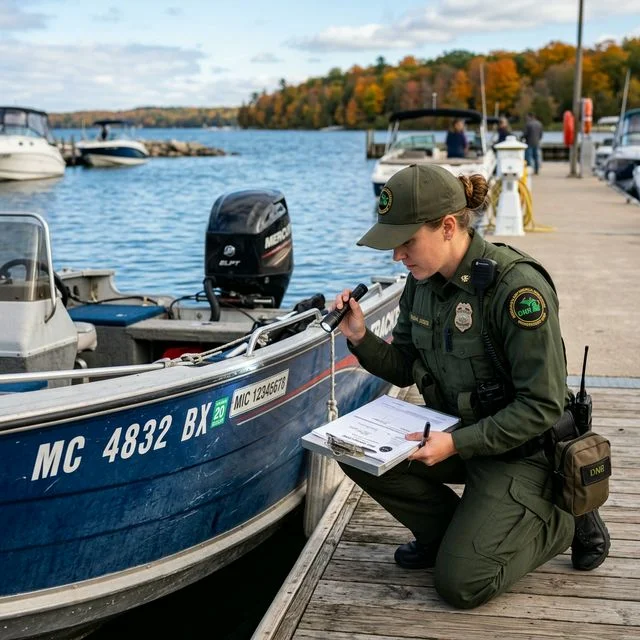
Step 4 — HIN inspection: If the boat has no existing Michigan record, request a Hull Identification Number inspection using Form TR-54. A Michigan State Police trooper, sheriff's deputy, or DNR Conservation Officer can perform this inspection. They verify the HIN stamped on the transom matches your paperwork.
Step 5 — Submit to SOS: Bring all forms, the surety bond, bill of sale, valid photo ID, and 6% use tax payment to a Secretary of State office. Pay the $5 standard or $10 instant title fee.
Cost Breakdown: Bonded Title
The bonded title process adds costs beyond a standard title transfer. Here's a realistic breakdown for a $10,000 boat:
| Cost Item | Amount | Notes |
|---|---|---|
| Surety bond premium | $200-$600 | 1-3% of $20,000 bond face value |
| Title fee | $5-$10 | Standard ($5) or instant ($10) |
| 6% use tax | $600 | On purchase price |
| 3-year registration | Varies | $14-$448 based on length |
| Estimated total | $860-$1,660 | For a $10,000 boat (20+ ft) |
While the bonded title adds cost, it's the only legal pathway to title a boat without proper documentation. The good news is that Michigan's base title fees ($5/$10) keep the process affordable compared to states where title fees alone can exceed $50. For a detailed fee breakdown, see our Michigan title transfer guide.
When to Walk Away from a No-Title Boat
Not every no-title boat is a good deal. There are legitimate red flags that suggest walking away, even if the price is attractive:
- Seller refuses to provide bill of sale — This may indicate stolen property
- HIN has been removed, defaced, or altered — This is a federal crime and the boat may be stolen or salvaged
- Seller cannot explain how they acquired the boat — Legitimate ownership should have a traceable history
- Price is dramatically below market value — While this could indicate a motivated seller, it can also signal problems
- Multiple lien holders — A surety bond does not eliminate existing liens; you could inherit debt
Before purchasing any boat without a title, consider running a boat history report using the HIN. This can reveal theft records, insurance total losses, accident history, and outstanding liens. See our boat lien check guide for more information.
Alternatives to the Surety Bond
Before committing to the surety bond process, explore these alternatives that may provide the documentation you need:
- Contact the previous owner: Ask them to apply for a duplicate title ($5) at any SOS office — this is the simplest solution
- Search the SOS database: The Michigan SOS may have records of the boat's registration history even if the physical documents are lost
- USCG documentation: For vessels 5 net tons or larger, USCG documentation provides federal proof of ownership that bypasses state title requirements entirely. See our USCG documentation guide
- Court-ordered title: In complex situations (estate disputes, abandoned vessels), a court order can establish ownership and compel the SOS to issue a title
Each alternative has trade-offs in time, cost, and complexity. For most buyers, getting the previous owner to apply for a duplicate title ($5) is the fastest and cheapest path forward.
Buying Tips: Protecting Yourself
When buying a boat without standard title documentation in Michigan, follow these best practices to protect yourself legally and financially:
- Verify the HIN physically: Check the HIN plate on the transom matches what the seller claims — bring a flashlight and camera
- Get a written bill of sale: Even for boats under the title threshold, a detailed bill of sale is your proof of legitimate purchase
- Both parties visit SOS together: Having both buyer and seller present at the Secretary of State office eliminates most ownership disputes
- Pay by traceable method: Use a check, cashier's check, or bank transfer — avoid cash-only transactions for boats over $1,000
- Photograph everything: Take photos of the boat, HIN, seller's ID, and all documents before and during the transaction
- Keep copies for 5+ years: Store copies of the bill of sale, registration, and any correspondence related to the purchase
For used boat purchasing advice across all states, see our comprehensive guide to registering used boats.
Frequently Asked Questions
Can I register a boat without a title in Michigan?
How much does a Michigan boat surety bond cost?
What forms do I need for a Michigan bonded boat title?
How long does a bonded title last in Michigan?
What is the difference between a detachable and permanently affixed engine?
Sources
- Michigan Secretary of State — Watercraft Titling and Surety Bonds (https://www.michigan.gov/sos/vehicle/boat)
- Michigan Department of State — Forms TR-121, TR-205, TR-54 (https://www.michigan.gov/sos)
- Michigan Legislature — Natural Resources and Environmental Protection Act, Part 801
This information is provided for reference purposes only. While we strive to keep data accurate and up-to-date, registration requirements, fees, and regulations may change without notice. Always contact your state's official registration agency for the most current and authoritative information before making any decisions.