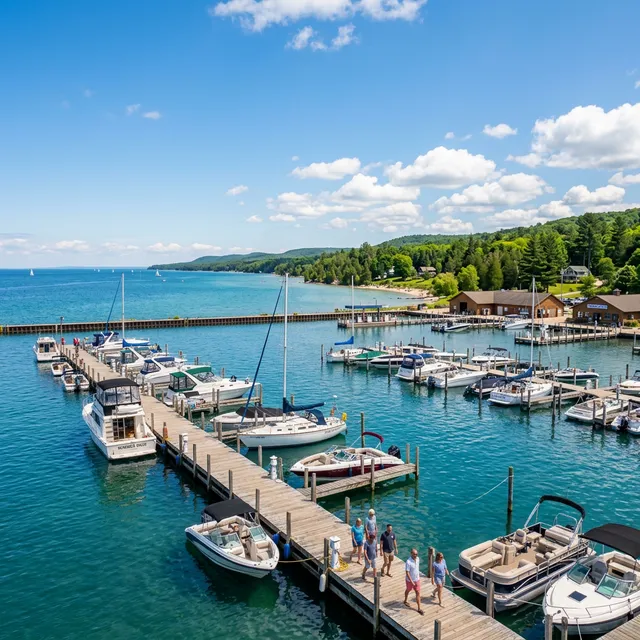
When Michigan Requires a Watercraft Title
Michigan does not title every boat. The Secretary of State lists two main title triggers: the watercraft is 20 feet or longer, or it has a permanently affixed engine, such as an inboard motor, regardless of length.
Smaller boats with removable outboard motors may still be registered, but a Michigan title is not always required. If you need to add a lienholder or create a clearer resale record, Michigan also allows some normally untitled watercraft to be titled through a Secretary of State office.
U.S. Coast Guard documented vessels are a separate case. Michigan says a Certificate of Documentation serves as proof of ownership, a state title is not needed, but Michigan registration is still required when the vessel is based or operated in Michigan beyond the temporary-use allowance.
Private Sale Transfer Checklist
For a titled Michigan watercraft, the seller signs the Michigan watercraft title to transfer ownership. The buyer then completes the registration and title work with the Michigan Secretary of State before operating the boat on public waters.
- Signed Michigan watercraft title if the boat is required to be titled.
- License or ID for the person completing the transaction.
- Proof of ownership, which may include the previous registration with seller signature, a bill of sale, manufacturer certificate of origin, title when required, surety bond, self-certification, or USCG documentation depending on the situation.
- Bill of sale details including year, make, HIN, buyer name and address, seller name and address, sale date, and price.
- Payment for title, registration, and 6% sales or use tax unless proof of tax paid or an exemption applies.
For the broader Michigan registration process, start with our Michigan boat registration guide. If you are comparing documents, our title vs. registration guide explains what each record proves.
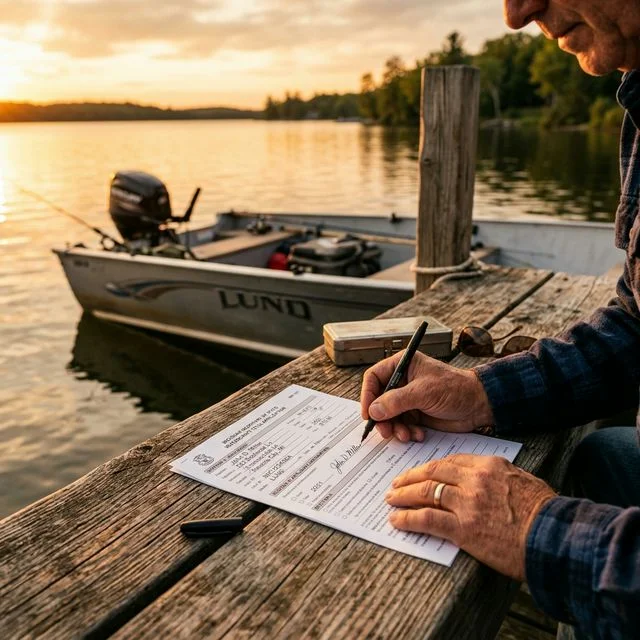
Lost or Damaged Michigan Boat Title
If the seller lost or damaged the title, do not rely on a handshake sale. Michigan lists a duplicate-title path and an office path for seller-and-buyer transactions when the Secretary of State system already has a title record.
The cleanest path is for the seller to order a duplicate title before the sale. Michigan also lists an office option where the seller and buyer appear together with proof of the Hull Identification Number, lien termination if applicable, and a title record in the Secretary of State system.
If the boat was never titled because it does not meet Michigan title requirements, use the proof-of-ownership path for registration instead of trying to force a title transfer that does not exist.
Michigan Boat Title Fees and Tax
Michigan lists a $5 watercraft title fee and a separate $5 instant title fee. Registration fees are separate and are based on the watercraft type and length.
| Cost item | Michigan SOS treatment |
|---|---|
| Watercraft title | $5 |
| Instant title | $5 additional title service listed by SOS |
| Registration | Based on length and vessel class; three-year registrations expire March 31 |
| Sales or use tax | 6% due at registration unless tax was already paid or an exemption applies |
Use the current Secretary of State fee chart before paying, especially for pontoon boats, commercial use, or USCG documented vessels based at a Michigan port.
Out-of-State Boat Coming Into Michigan
If Michigan becomes the boat's state of principal use, bring the ownership documents from the prior state to a Secretary of State office. The exact paperwork depends on whether the other state issued a title, registration-only record, or USCG documentation.
Michigan accepts proof of ownership in several forms, but the safest private-sale packet is the prior title when required, prior registration, bill of sale, HIN details, photo ID, lien release if needed, and tax documentation.
If the boat is only visiting Michigan temporarily, read our Michigan non-resident boating guide before starting a transfer.
When a Surety Bond or Self-Certification May Apply
Michigan lists two fallback ownership paths for some watercraft with missing standard documents: a surety bond for watercraft valued at more than $2,500, and a self-certification procedure for watercraft valued at $2,500 or less.
These fallback paths are not a shortcut around a known title problem. Before buying, check whether the boat should have a title, whether a lien exists, and whether the seller can obtain a duplicate title instead.
Frequently Asked Questions
How much is a Michigan boat title transfer?
Do all boats need a Michigan title?
Can a Michigan boat title transfer be done online?
What if the seller lost the Michigan boat title?
Is a USCG documented boat titled in Michigan?
Sources
- Michigan Secretary of State — Recreational vehicles and watercraft (https://www.michigan.gov/sos/vehicle/recreational-vehicles-watercraft)
- Michigan Legislature — Natural Resources and Environmental Protection Act, Part 801 (https://www.legislature.mi.gov/)
- Michigan Department of Treasury — Sales and Use Tax (https://www.michigan.gov/treasury)
This information is provided for reference purposes only. While we strive to keep data accurate and up-to-date, registration requirements, fees, and regulations may change without notice. Always contact your state's official registration agency for the most current and authoritative information before making any decisions.