Understanding Sales Tax on Boats
Sales tax on a boat purchase can represent one of the largest costs beyond the actual vessel price. On a mid-priced boat, the tax bill can run into the thousands, and on a higher-value vessel it can be substantial. For many buyers, understanding which states offer the most favorable tax treatment is essential to making a smart purchasing decision.
Unlike most consumer goods, boats are mobile assets that can be purchased in one state, registered in another, and used in a third. This creates a complex tax landscape where sales tax rates, caps, exemptions, and enforcement all vary dramatically from state to state. The good news is that several states impose no sales tax at all on boat purchases, and others cap the total tax or exempt boats from the general rate.
This guide breaks down which states have no state-level sales tax for boat buyers, which have special boat exemptions or caps, and how use tax rules may still apply even if you buy in a zero-tax state.
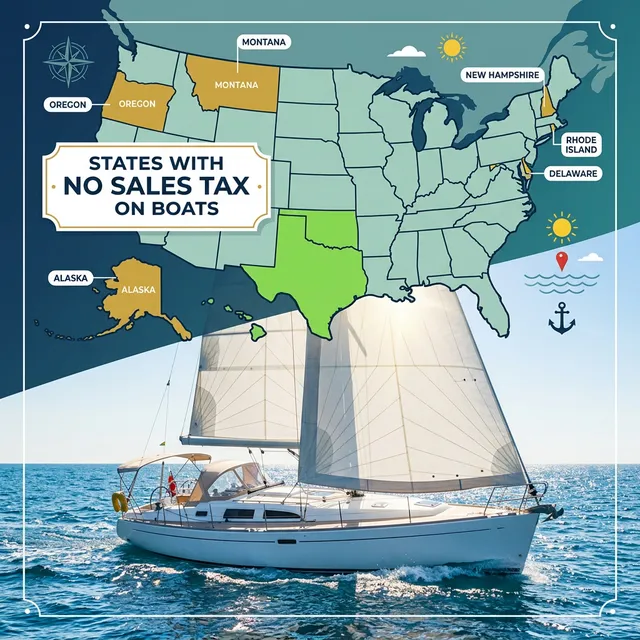
States With No Sales Tax on Boats
Five states levy no general sales tax whatsoever, meaning boats purchased and registered in these states incur zero state-level sales tax. These states are:
Alaska — No state sales tax, though local municipal taxes may still apply in some places.
Delaware — No general retail sales tax. Buyers should still confirm title, registration, documentation, and any agency fees.
Montana — No state or local sales tax. Registration, title, permanent-registration, and use-location rules still matter.
New Hampshire — No state or local sales tax. New Hampshire remains a popular zero-tax choice in New England.
Oregon — No state or local sales tax. Oregon is the only West Coast state without sales tax, making it attractive for Pacific Northwest boaters.
Rhode Island: A Special Exemption State
Rhode Island stands out as a unique case. While the state does have a general sales tax, Rhode Island law currently exempts boat sales from sales and use tax.
That exemption does not automatically cover spare parts or every other item purchased for the vessel, so confirm the current tax treatment before relying on the exemption.
States With Sales Tax Caps on Boats
Beyond the zero-tax states, several states cap the maximum sales tax or excise tax on boat purchases. These caps can still save buyers money on expensive vessels. Key cap states include:
South Carolina — Has one of the lowest caps on boat taxes, which can make high-value purchases comparatively inexpensive.
North Carolina — Uses a low percentage cap on boat purchases, which helps keep large-vessel taxes predictable.
Virginia — Combines a relatively low boat tax with a cap that can benefit higher-value purchases.
Maryland — Applies a boat excise tax with a cap that still provides meaningful savings on higher-priced vessels.
Florida — Applies a boat sales tax cap that can limit the tax burden on expensive yachts.
New Jersey — Uses a reduced boat tax rate with a cap to stay competitive with nearby states.
New York — Caps tax on the taxable portion of higher-value boats, which can soften the cost of luxury purchases.
To estimate your total boat purchase costs including sales tax and registration fees in any state, use our registration fee calculator and sales tax calculator.
Use Tax: Why Buying in a Tax-Free State May Not Save You Money
One of the most common misconceptions among boat buyers is that purchasing a vessel in a zero-tax state automatically eliminates their sales tax obligation. In reality, the critical factor is not where you buy the boat but where you register and primarily use it.
Use tax is the complement to sales tax. It applies when you purchase an item in one state (or with no tax) but use it in your home state. The use tax rate is almost always identical to your home state's sales tax rate. When you attempt to register a boat purchased elsewhere, your state will typically require proof of sales tax payment or assess use tax at that point.
For example, if you purchase a boat in Montana (no sales tax) and then bring it to a state with sales tax, that state may assess use tax when you register the vessel. The resulting bill can be substantial.
Most states offer credit for sales tax paid in other states. If you paid 4 percent in State A and your home state charges 6 percent, you owe only the 2 percent difference. But if you paid nothing, you owe the full amount.
States often enforce use tax through the boat registration process and may ask for tax-paid proof, exemption documents, or credit for tax paid elsewhere. For a deeper breakdown of sales tax rates in every state, see our complete sales tax guide.
Montana LLC Ownership: Risks and Legal Considerations
One heavily discussed ownership structure involves forming a limited liability company (LLC) in Montana and titling the boat under that LLC. Because Montana has no sales tax, the Montana purchase stage may not create a Montana sales-tax bill.
The typical setup works like this: the buyer forms a Montana LLC, the LLC purchases the boat, and the vessel is titled in Montana. The main question is not the paperwork itself but where the boat will actually be used and registered over time.
While forming a Montana LLC can be legal, using one while the boat is kept or primarily used in another state can create use-tax exposure. Before using any LLC-based ownership structure, consult with a tax attorney who specializes in marine or vehicle taxation in your state.
How to Calculate Your Potential Tax Savings
The value of purchasing in a low-tax or no-tax state depends heavily on the price of the vessel and the tax rules of your home state. Here is a practical framework for estimating the tax difference.
First, determine your home state's effective boat sales tax rate and whether a cap applies. Then calculate the tax you would owe: multiply the purchase price by the rate (or use the cap if applicable). Compare this to the cost in a zero-tax or capped state, factoring in any transport costs, temporary registration fees, and potential use tax obligations.
For a lower-priced boat, the tax difference may not justify the logistics of an out-of-state purchase. For a high-value yacht, the difference between a zero-tax or capped-tax state and a full-tax state can be large enough to matter.
Use our boat registration fee calculator to estimate your state-specific costs, or compare all 50 states on our fee comparison page.
Recent Changes and 2026 Updates
Several states change boat tax rules regularly, and local taxes can affect the final bill even when a state looks favorable on paper.
Tax laws change frequently. Always verify current rates with your state's official DMV, DNR, or tax authority before making a purchase decision.
Frequently Asked Questions
Which states have no sales tax on boats?
Can I avoid sales tax by buying a boat in a tax-free state?
What state has the lowest boat sales tax cap?
Is the Montana LLC strategy for avoiding sales tax legal?
Do I pay sales tax on a used boat from a private seller?
Are there sales tax exemptions for commercial boats?
Sources
- Tax Foundation — State Sales Tax Rates (https://taxfoundation.org/)
- NASBLA — National Association of State Boating Law Administrators (https://www.nasbla.org/)
- Individual state DMV/DNR official fee schedules
- Avalara — State Sales Tax for Boats and Watercraft (https://www.avalara.com/)
This information is provided for reference purposes only. While we strive to keep data accurate and up-to-date, registration requirements, fees, and regulations may change without notice. Always contact your state's official registration agency for the most current and authoritative information before making any decisions.