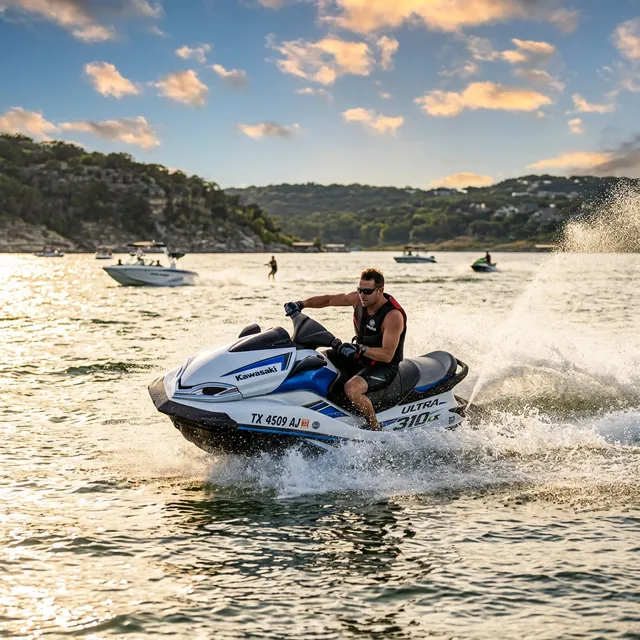
Texas PWC Laws Overview
Personal watercraft (PWC) — commonly called jet skis, WaveRunners, or Sea-Doos — are subject to stricter regulations in Texas than conventional motorboats. The Texas Water Safety Act (Chapter 31, Parks and Wildlife Code) and TPWD regulations impose specific age limits, operational restrictions, and mandatory safety equipment requirements unique to PWC.
Texas defines a personal watercraft as a vessel less than 13 feet in length that uses an inboard motor powering a water jet pump as its primary source of propulsion and is designed to be operated by a person sitting, standing, or kneeling on the vessel rather than in a conventional hull.
This guide covers every PWC-specific rule, from registration requirements to the key operational restrictions that differ from standard boating.
Registration and Title Requirements
All PWC operated on Texas public waters must be registered and titled with TPWD. There are no exceptions for PWC — they are motorized vessels by definition.
| Requirement | Details |
|---|---|
| Registration | Required; PWD 143 application |
| Title | Required for the vessel |
| Registration Fee (2-year) | $32 (under 16 ft — applies to all PWC) |
| Title Fee | $27 |
| Sales Tax | 6.25% on purchase price |
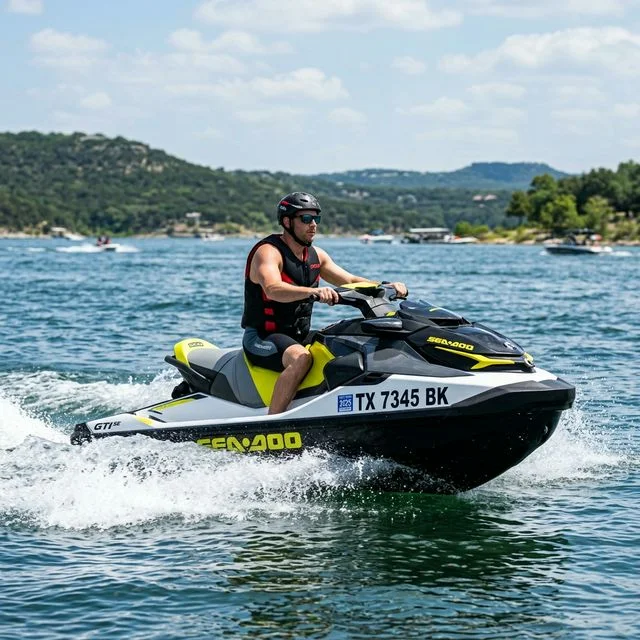
| Registration Numbers | Displayed on both sides in block letters ≥ 3 in. |
| Registration Certificate | Must be on board at all times |
For full details on the registration process, see the Texas Boat Registration page or estimate your total costs with our fee calculator.
Age Restrictions for PWC Operators
Texas enforces strict age-based restrictions for PWC operation — more restrictive than for standard motorboats:
| Operator Situation | Texas Rule | What to Carry |
|---|---|---|
| Under 13 | May not operate a PWC unless accompanied on board by a person at least 18 who can lawfully operate it | Adult operator proof and required safety gear |
| Age 13 or older | May operate if the Texas boater-education rule is satisfied, or if supervised as allowed by TPWD rules | Boater education card when required, plus photo ID |
| Born on or after September 1, 1993 | Boater education is required to operate a PWC | NASBLA-approved boater education card |
| Out-of-state visitor | Texas accepts NASBLA-approved out-of-state boater education courses | Course completion proof from the other state |
The useful shortcut is this: a child under 13 cannot operate alone, and a person born on or after September 1, 1993 should expect to need proof of boater education before operating a PWC in Texas.
The Sunset-to-Sunrise Ban
Texas law prohibits operating a PWC between sunset and sunrise. This is one of the most distinctive Texas PWC rules and applies regardless of whether the PWC has navigation lights, the operator's experience level, or the body of water.
The rationale is safety: PWC are small, low-profile, fast, and operated differently from conventional vessels. Check the official sunset time for the water body you are using before planning an evening ride.
Practical tip: Check the exact sunset time for your location before heading out. Being on the water "around sunset" can result in a citation if a Game Warden determines you were operating after the official sunset time.
The 50-Foot Headway Speed Rule
PWC operators must maintain headway speed (the minimum speed necessary to maintain steerage) when within 50 feet of any other vessel, person, object, platform, or shore. "Headway speed" is essentially idle speed — no wake, no spray, no planing.
Common trouble spots include swimmers, docks, anchored boats, platforms, and crowded coves. If you are inside the 50-foot zone, slow to headway speed before turning, crossing wakes, or approaching shore.
Mandatory Safety Equipment
PWC have the most stringent safety equipment requirements of any recreational vessel class in Texas:
| Equipment | Requirement | Key Detail |
|---|---|---|
| PFD (Life Jacket) | Every person on board must wear one | Inflatable PFDs are not approved for PWC use |
| Engine Cut-Off Switch | Wear the lanyard or wireless device if the PWC is equipped with one | Attach it to the operator, clothing, or PFD while underway |
| Fire Extinguisher | One USCG-approved B-1 marine-grade extinguisher | Required for PWC |
| Sound-Producing Device | Required | Carry a whistle, horn, or other approved sound device |
| Registration Numbers | Displayed on the PWC | Texas title and registration requirements still apply |
| Boater Education Card | If born on/after Sep 1, 1993 | Carry proof when operating |
Critical difference from boats: On a PWC, every occupant and anyone being towed must wear a USCG-approved wearable PFD. Inflatable PFDs are not approved for PWC use.
Prohibited Operations
Beyond the general boating rules that apply to all vessels, Texas law specifically prohibits the following PWC activities:
Wake jumping recklessly or unnecessarily close to another vessel. Jumping the wake of a boat that is within safe distance is a citable offense.
Weaving through congested traffic. Zigzagging between boats, especially at speed, constitutes reckless operation.
Last-second swerves. Directing the PWC toward a person, vessel, or object and swerving at the last moment falls under reckless operation.
Disturbing wildlife. Using a PWC to chase, harass, or disturb wildlife (including birds, dolphins, and manatees) is a violation of both the Texas Water Safety Act and the federal Endangered Species Act if applicable species are involved.
Operating in restricted zones. Some Texas lakes and coastal areas designate PWC-free zones, no-wake zones, or speed-restricted areas. These are marked with buoys or signage and enforced by Game Wardens.
BUI Laws for PWC Operators
Texas treats boating while intoxicated as a serious offense, and the same .08 BAC threshold commonly associated with motor-vehicle DWI applies on the water.
For PWC riders, impairment is especially risky because balance, throttle control, steering, and reboarding all require fast judgment. If alcohol is part of the outing, use a sober operator and check current Texas BWI penalties before relying on any fixed dollar amount.
Towing Requirements (Wakeboarding, Tubing, Skiing)
Some PWC are designed with enough power and a re-boarding platform to tow skiers, tubers, or wakeboarders. Texas requires the following when towing from a PWC:
Observer or mirror requirement: A mirror is not required when an observer is on board. The observer must not be the operator, must be at least 13, and must act as the observer while the person is being towed.
PWC capacity: Texas requires a PWC to have minimum seating for two occupants when towing legally. Also check the manufacturer capacity plate before carrying an operator, observer, and returning rider.
Daylight only: Since PWC operation is banned from sunset to sunrise, towing activities from a PWC are inherently limited to daytime hours.
Neighboring State PWC Laws Comparison
| Cross-Border Rule to Check | Texas Rule | Why Visitors Should Recheck |
|---|---|---|
| Minimum operating age | Under 13 cannot operate unless accompanied by a lawful adult operator on board | Neighboring states use different age and supervision thresholds |
| Night operation | PWC operation is banned from sunset to sunrise | Do not assume navigation lights make nighttime PWC operation legal |
| PFD rule | Every PWC occupant and towed person must wear a wearable PFD | Inflatable PFDs are not approved for PWC use in Texas |
| Boater education | Born on/after Sep 1, 1993 must complete boater education for PWC | Out-of-state cards should be NASBLA-approved |
| Distance/speed rule | Headway speed within 50 feet of vessels, people, objects, platforms, or shore | Local lake zones may add stricter limits |
If you ride across a border lake or tow a PWC from another state, check the rules for the launch state and the water you will actually use. The registration sticker may travel, but operating rules change by jurisdiction.
Insurance and Liability
Texas does not legally require boat or PWC insurance. However, given the high-risk nature of PWC operation (ejections, collisions, and towing incidents are common), carrying liability insurance is strongly recommended.
Coverage and premiums vary by carrier, vessel value, horsepower, operator history, storage location, and whether towing sports are covered. Review exclusions carefully because some homeowner policies exclude PWC or limit watercraft liability.
If you are involved in an accident causing property damage or personal injury, Texas law can hold you financially responsible regardless of insurance status. Insurance is not part of TPWD registration, but it is a practical risk-management step for PWC owners.
Frequently Asked Questions
What is the minimum age to drive a jet ski in Texas?
Can you ride a jet ski at night in Texas?
Do you have to wear a life jacket on a jet ski in Texas?
How much does it cost to register a jet ski in Texas?
Do I need a boater education card to ride a PWC in Texas?
What are the penalties for violating Texas jet ski laws?
Sources
- Texas Parks and Wildlife Department — PWC Regulations (https://tpwd.texas.gov/fishboat/boat/)
- Texas Water Safety Act — Chapter 31, Parks and Wildlife Code
- Texas Penal Code — Boating While Intoxicated (BWI)
- USCG — Personal Watercraft Safety Requirements
- TPWD Boater Education Course Requirements (https://tpwd.texas.gov/fishboat/boat/safety/)
This information is provided for reference purposes only. While we strive to keep data accurate and up-to-date, registration requirements, fees, and regulations may change without notice. Always contact your state's official registration agency for the most current and authoritative information before making any decisions.