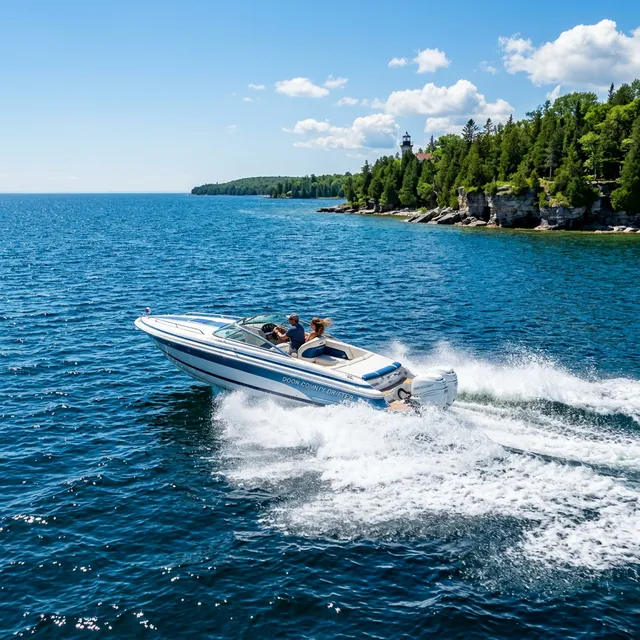
Quick Answer: Can Out-of-State Boats Use Wisconsin Waters?
Yes. A non-resident can operate a boat on Wisconsin waters for up to 60 consecutive days without Wisconsin registration if the boat has a current registration from another state or country. After that, or if the boat is kept or used in Wisconsin beyond the temporary-use exemption, Wisconsin DNR registration is required.
For the broader state-by-state comparison, see the non-resident boat registration guide.
| Non-resident situation | Wisconsin registration? | What to carry |
|---|---|---|
| Short vacation or fishing trip | No, if 60 consecutive days or less | Current home-state registration and decals |
| Seasonal stay over 60 consecutive days | Yes | Wisconsin registration or application receipt |
| Boat kept mainly in Wisconsin | Yes | Wisconsin registration documents |
| Expired home-state registration | Yes before operating | Valid registration from any state |
For a full Wisconsin registration cost estimate, use the fee calculator or review the Wisconsin boat registration guide. If you bought the boat for long-term Wisconsin use, also check the Wisconsin boat title transfer guide before submitting DNR paperwork.
Wisconsin's 60-Day Temporary Use Rule
Non-residents can operate their boat on Wisconsin waters for up to 60 consecutive days without registering in Wisconsin, provided the boat is already registered in another state or country. Treat the 60-day period as a Wisconsin DNR compliance deadline, not as a loophole that can be restarted casually during a seasonal stay.
Other boating states use different clocks: some use 30, 60, or 90 days, while others focus more heavily on where the vessel is principally used or kept. If you plan extended stays on Wisconsin waters — especially during the May-to-September boating season — keep careful track of your arrival date and confirm the rule with DNR before day 60.
After 60 consecutive days, or if the boat is kept or used in Wisconsin beyond the temporary exemption, you must register with the Wisconsin DNR before continuing to operate. For full registration details, see our Wisconsin boat registration guide.
The practical cutoff is simple: short trip, keep your valid home-state registration on board; extended seasonal use, start the Wisconsin registration process before the exemption runs out. Use the registration checklist generator if you need a document list for a newly purchased or out-of-state boat.
What Non-Residents Must Carry on Board
When operating on Wisconsin waters as a non-resident, keep the documents and equipment needed to show lawful operation if DNR wardens or law enforcement inspect the boat:
| Item to have ready | Details |
|---|---|
| Home State Registration Certificate | Keep current proof of registration available while using the temporary-use exemption. |
| Current Registration Decals | Display validation stickers according to the issuing state's requirements. |
| Boater Safety Certificate | Carry proof if Wisconsin's age rule applies; confirm acceptance if the card is not clearly NASBLA-approved. |
| Photo Identification | A driver's license or valid government ID helps resolve ownership and operator questions. |
| Required Safety Equipment | Carry the equipment required for your vessel type, length, passengers, and operating water. |
Wisconsin law enforcement patrols major lakes and waterways, especially during summer weekends and holiday periods. Missing registration proof or safety equipment can lead to citations.
Boater Education Reciprocity
Wisconsin requires boater safety education for anyone born on or after January 1, 1989. For non-residents, the safest assumption is to carry a valid NASBLA-approved boater education certificate from your home state when Wisconsin's age rule applies.
Wisconsin generally recognizes comparable boater education credentials, but your certificate still needs to be available for inspection. If your card is old, missing, or not clearly NASBLA-approved, confirm acceptance before operating.
Special note for personal watercraft (PWC/jet ski) operators: Regardless of birthdate, all PWC operators aged 12-15 must hold a boater safety certificate. No one under 12 may operate a PWC at all. For complete PWC regulations, see our Wisconsin jet ski & PWC laws guide.
Great Lakes Cross-Border Boating
Wisconsin shares borders with Michigan across Lake Michigan and Lake Superior, so Great Lakes crossings can raise jurisdiction and registration questions:
Lake Michigan: Wisconsin and Michigan share Lake Michigan. A short crossing is different from keeping or principally using the boat in another state, so verify the host-state rule before repeated or seasonal Great Lakes use.
Mississippi River: Wisconsin shares the Mississippi River with Iowa and Minnesota. For boundary waters, carry valid registration and check the state where the boat is launched, kept, or principally used before an extended stay.
Practical advice: If you are a non-resident regularly boating on Wisconsin's Great Lakes waters — particularly for seasonal fishing or vacation home use — track your days carefully. Exceeding the temporary-use window without registration can create enforcement risk. For boaters crossing between Wisconsin and Michigan frequently, see our Michigan non-resident boating guide.
When Non-Residents Must Register in Wisconsin
You must register your boat with the Wisconsin DNR if any of the following apply:
- You exceed 60 consecutive days on Wisconsin waters
- The boat is kept or used in Wisconsin beyond temporary use — confirm DNR registration timing
- You purchase a boat for Wisconsin use — check DNR paperwork before operating on Wisconsin waters
- You establish Wisconsin residency or keep the boat in Wisconsin — confirm the local registration deadline with DNR
- Your home state registration expires — an expired out-of-state registration is not valid in WI
Registration can be completed online through GoWild, by mail, or in person at a DNR service center. Some eligible transactions may provide a temporary operating receipt; verify that your application qualifies before relying on the receipt to operate.
Wisconsin 3-year registrations range from $22 (motorized boats under 16 ft) to $100 (boats 40 ft and over). For a detailed fee breakdown, visit our Wisconsin boat registration guide or compare Wisconsin with other states on the boat registration cost table.
Non-Resident Comparison: Wisconsin vs. Neighboring States
If you boat across multiple Great Lakes states, understanding each state's non-resident rules is essential:
| Feature | Wisconsin | Michigan | Minnesota | Iowa |
|---|---|---|---|---|
| Temporary-use trigger | 60 consecutive days | Check principal-use rule | Check DNR rule | 60-day rule |
| What to verify | DNR registration status | SOS/DNR current guidance | DNR current guidance | DNR current guidance |
| Online paperwork | GoWild for eligible transactions | Check SOS channel | Check DNR channel | Check DNR channel |
| Sales/use tax | May apply if registering | May apply if registering | May apply if registering | May apply if registering |
The point is not to memorize a neighbor-state shortcut. If your trip crosses state lines or your boat stays near a border for the season, check the current agency page for the state where the boat is launched, kept, stored, or used.
Tips for Non-Residents Boating in Wisconsin
Practical advice for out-of-state boaters visiting Wisconsin's 15,000+ lakes and hundreds of miles of Great Lakes shoreline:
- Track your days — Keep a log of when you first launch on Wisconsin waters. If the trip becomes seasonal or repeated, confirm the registration rule with DNR instead of relying on an informal reset theory.
- Keep registration current — An expired home state registration can make the temporary-use exemption unavailable. Renew before your Wisconsin trip.
- Carry your boater safety card — If born on or after January 1, 1989, carry your home state's boater safety certificate or confirm what Wisconsin accepts before operating.
- Obey local no-wake zones — Wisconsin lakes, especially in the Northwoods, have extensive no-wake zones that may differ from your home state. Follow posted signs.
- Follow invasive species rules — Clean off aquatic plants, drain water as required, and follow posted launch instructions before moving between waters.
- PWC rental age limit — No one under 16 can rent a PWC in Wisconsin, regardless of their home state's laws.
For more on Wisconsin's boater safety requirements, see our boater education requirements guide. To compare registration costs across all 50 states, visit our fee comparison page.
Frequently Asked Questions
How long can a non-resident boat on Wisconsin waters without registering?
Does Wisconsin accept out-of-state boater safety certificates?
Do I need to register my boat if I'm just crossing Lake Michigan from Michigan?
What happens if I exceed the 60-day limit as a non-resident?
Can non-residents rent boats or jet skis in Wisconsin?
Sources
- Wisconsin DNR — Boat Registration Requirements (https://dnr.wisconsin.gov/topic/Boat/registration.html)
- Wisconsin DNR — Boating Regulations Handbook (https://dnr.wisconsin.gov/topic/Boat/regulations.html)
- National Association of State Boating Law Administrators — NASBLA (https://www.nasbla.org)
This information is provided for reference purposes only. While we strive to keep data accurate and up-to-date, registration requirements, fees, and regulations may change without notice. Always contact your state's official registration agency for the most current and authoritative information before making any decisions.