
Michigan Boat Sales Tax: 6% State Rate at Registration
Michigan Secretary of State lists 6% sales tax due at registration unless you provide proof that tax was already paid. Dealers generally handle the title and registration application and collect the tax for dealer sales.
Private-party and out-of-state purchases are usually treated as a Michigan sales/use tax documentation issue when you title or register the watercraft. Keep the bill of sale, invoice, prior-state tax receipt, and any exemption paperwork together before visiting SOS.
Registration fees are separate from tax and are usually based on the watercraft type and length. For the fee chart and title rules, see our Michigan boat registration guide.
How Michigan Boat Sales Tax Is Calculated
Use this simple estimate: taxable purchase price x 0.06, then add the current Secretary of State registration fee and any title service fee that applies. The title fee is listed separately from the registration fee.
| Purchase situation | What to verify before SOS |
|---|---|
| Michigan dealer sale | Dealer invoice should show tax collected and title/registration handling. |
| Michigan private sale | Bring the signed ownership document or bill of sale and expect tax unless proof or exemption applies. |
| Out-of-state purchase | Bring proof of any tax paid to another state so Michigan can apply the appropriate credit. |
| Family, inheritance, or exempt buyer | Bring relationship, estate, or exemption documentation; do not rely on a verbal explanation. |
If the sale price is unusually low, keep condition notes, photos, valuation records, and repair documentation. That evidence can help explain why the purchase price differs from a typical market listing.
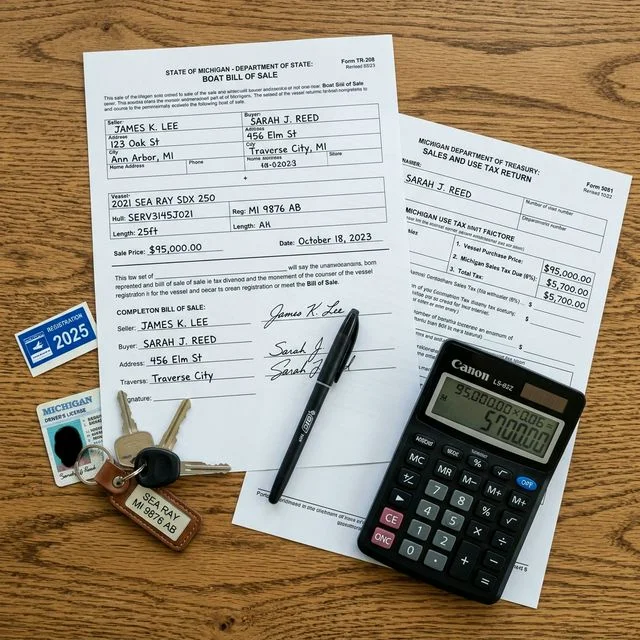
Sales Tax vs. Use Tax: What's the Difference?
Michigan distinguishes between sales tax and use tax, though the rate for both is 6%:
Sales tax is collected by Michigan-based dealers and retailers at the point of sale. When you buy a boat from a licensed Michigan dealer, the sales tax is automatically included in the final invoice and remitted to the state by the dealer.
Use tax applies when taxable property is bought outside Michigan and brought into Michigan for use, storage, or consumption. Michigan Treasury lists a 6% use tax rate and says credit is given for tax paid to another state.
For a boat purchase, the practical point is documentation: bring receipts showing tax collected elsewhere. If no acceptable proof is available, plan for Michigan to collect the tax due when the boat is registered or titled.
Tax Exemptions and Special Situations
Several situations may reduce, credit, or eliminate the amount collected at registration. Treat each one as a documentation question, not an automatic result:
| Situation | Safer documentation approach |
|---|---|
| Tax already paid | Bring the dealer invoice, out-of-state receipt, or other proof showing the tax amount paid. |
| Qualifying family transfer | Bring relationship documentation and confirm the transaction fits the current Michigan exemption rule. |
| Inheritance or estate transfer | Bring estate paperwork, death certificate, court documents, or other proof requested by SOS. |
| Business, government, nonprofit, or special-use claim | Check Michigan Treasury exemption documentation before the transaction; SOS counter staff may need proof, not just entity status. |
If an exemption or credit matters to the purchase, confirm it before closing the sale. A missing receipt or unsupported exemption claim can turn into a full 6% tax bill at registration.
Registration Costs After the Purchase
After the purchase tax issue is handled, the recurring Secretary of State item most buyers should expect is the watercraft registration cycle. Michigan registrations are issued for three years and expire March 31 of the third year.
| Cost item | What Michigan SOS lists |
|---|---|
| Registration or renewal | Usually based on watercraft type and length, with a three-year term. |
| Watercraft title | $5 when a Michigan watercraft title is required. |
| Instant title service | $5 additional service fee when requested and available. |
| Sales or use tax | 6% due unless proof that tax was already paid or an exemption applies. |
If the boat is used commercially, carries passengers or freight, is USCG documented, or is part of a business purchase, recheck the current SOS and Treasury instructions before assuming the normal recreational path applies.
Buying a Boat Out of State: Use Tax Rules
Cross-border boat purchases in the Great Lakes region are common, especially at dealerships near state lines. Here's what Michigan buyers need to know about use tax on out-of-state purchases:
If you buy from an out-of-state dealer: The dealer may collect tax, may provide tax-paid documentation, or may leave Michigan tax to be handled when you register. Confirm this on the invoice before you leave the dealership.
If you buy from a private seller in another state: Bring the signed ownership document and bill of sale. If no tax was collected and no exemption applies, expect Michigan use tax to be part of the registration transaction.
If tax was paid elsewhere: Michigan Treasury says credit is given for tax paid to another state. Bring the receipt or invoice that shows the amount and jurisdiction.
Save all receipts and documentation of sales tax paid in other states. You may need to present this at the SOS office to support the credit. Use our fee calculator only as an estimate, then verify the final amount with SOS.
Michigan vs. Neighboring States: What to Recheck
Neighboring-state comparisons get stale quickly because local tax rules, registration classes, caps, and use-tax credits are handled differently. For a Michigan buyer, the more reliable question is what evidence you need at registration:
| Comparison question | Why it matters in Michigan |
|---|---|
| Did another state collect tax? | Michigan may credit tax paid to another state, but you need proof. |
| Is the boat now principally used in Michigan? | Registration and title questions depend on where the boat is based and operated. |
| Does the boat require a Michigan title? | Watercraft 20 feet or longer, or with a permanently affixed engine, need a Michigan title unless USCG documentation applies. |
| Are there business or special-use facts? | Commercial, passenger, documented, or entity-owned vessels should be checked against current SOS and Treasury instructions. |
For a broader planning view, use our cost-by-state comparison page, then verify any purchase-specific tax result with the relevant state agency before closing.
How to Pay Your Boat Sales or Use Tax
Dealer purchases: Sales tax is collected and remitted by the dealer at the point of sale. You do not need to do anything additional — the dealer handles all tax paperwork.
Private-party purchases: Sales or use tax is handled when you title and register at a Michigan Secretary of State office, unless proof of tax paid or an accepted exemption applies.
Out-of-state purchases: Present your out-of-state sales tax receipt at the SOS office to support a credit. If you cannot prove tax was paid, expect Michigan to calculate the tax due from the purchase paperwork. For more details on the title transfer process, see our Michigan title transfer guide.
Common Tax Mistakes Michigan Boat Buyers Make
Avoid these costly errors when handling Michigan boat sales tax:
- Under-documenting a low purchase price: Keep condition records and sale paperwork when the price is lower than comparable listings.
- Losing out-of-state tax receipts: Without proof of tax paid elsewhere, it is harder to support a Michigan credit.
- Assuming used boats are automatically tax-free: A private sale can still create a Michigan sales/use tax obligation unless proof or exemption applies.
- Confusing sales tax with registration fees: The 6% tax, three-year registration fee, and title service fee are separate items.
- Forgetting the title fee: Boats requiring titles have a $5 watercraft title fee, with a separate $5 instant title service fee if requested and available.
Taking the time to understand Michigan's tax structure before your purchase can save you money and avoid surprises at the SOS office. Use our nationwide sales tax guide for broader context.
Frequently Asked Questions
What is the sales tax rate on boats in Michigan?
What recurring Michigan registration cost should I expect?
Do I owe Michigan use tax if I bought my boat in another state?
Are family boat transfers exempt from sales tax in Michigan?
How does Michigan boat tax compare to Ohio and Indiana?
Sources
- Michigan Secretary of State — Recreational vehicles and watercraft (https://www.michigan.gov/sos/vehicle/recreational-vehicles-watercraft)
- Michigan Department of Treasury — Sales and Use Taxes (https://www.michigan.gov/taxes/business-taxes/sales-use-tax)
This information is provided for reference purposes only. While we strive to keep data accurate and up-to-date, registration requirements, fees, and regulations may change without notice. Always contact your state's official registration agency for the most current and authoritative information before making any decisions.