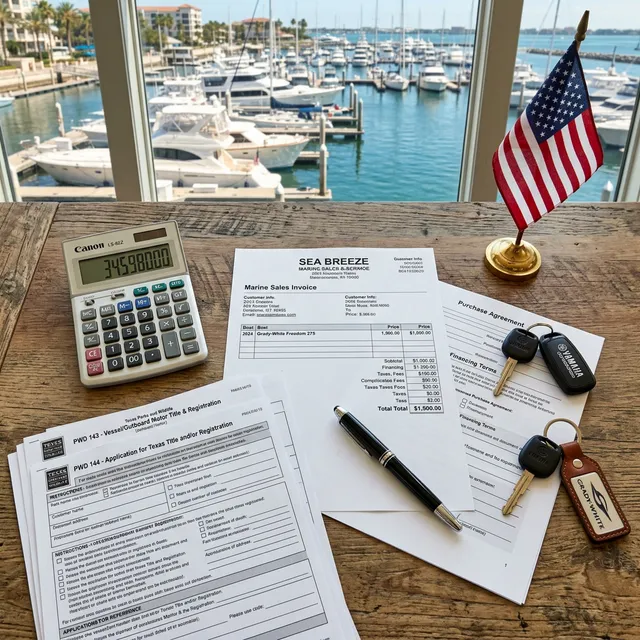
Understanding Texas Boat Sales Tax
Texas levies a 6.25 percent state sales tax on the purchase of boats and outboard motors. This rate applies whether you buy new from a dealer, used from a private seller, or bring a boat into Texas from another state. For many boat buyers, the sales tax is the single largest additional cost beyond the purchase price.
Unlike most retail purchases where sales tax is collected by the Texas Comptroller, boat sales tax is collected directly by the Texas Parks and Wildlife Department (TPWD) for vessels 115 feet or less in length. This distinction matters because it changes where, when, and how you pay — and which penalties apply if you are late.
This guide covers everything Texas boat buyers need to know about sales tax: the rate structure, payment process, key deadlines, exemptions, and strategies for calculating your total cost accurately.
Texas Boat Sales Tax Rate Structure
The Texas boat sales tax structure has two components:
| Tax Type | Rate | Details |
|---|---|---|
| State Sales Tax | 6.25% | Collected by TPWD on the vessel purchase price |
| Local Sales Tax | 0% – 2% | City + county + special district taxes (varies by location) |
| Maximum Combined Rate | 8.25% | State 6.25% + maximum local 2% |
Important distinction for boats: TPWD collects only the 6.25 percent state sales tax on vessels. Local sales taxes (city, county, transit, and special district taxes) that apply to most retail purchases generally do not apply to boat sales processed through TPWD. The 6.25 percent rate is what you will pay on your boat. Local taxes may still apply to the boat trailer, which is taxed separately through the County Tax Assessor-Collector.
There is no sales tax cap on boats in Texas, unlike states such as Florida ($18,000 cap) or South Carolina ($500 cap). On a $100,000 boat, you will owe $6,250 in state sales tax. On a $500,000 yacht, that figure reaches $31,250.
How to Calculate Your Boat Sales Tax
Here is a quick reference for estimating your Texas boat sales tax at the 6.25 percent state rate:
| Boat Purchase Price | State Sales Tax (6.25%) | Title Fee | Registration (2 yr) | Estimated Total |
|---|---|---|---|---|
| $5,000 | $312.50 | $28.00 | $32.00 | $372.50 |
| $15,000 | $937.50 | $28.00 | $53.00 | $1,018.50 |
| $30,000 | $1,875.00 | $28.00 | $53.00 | $1,956.00 |
| $50,000 | $3,125.00 | $28.00 | $110.00 | $3,263.00 |
| $100,000 | $6,250.00 | $28.00 | $150.00 | $6,428.00 |
| $250,000 | $15,625.00 | $28.00 | $150.00 | $15,803.00 |
Registration fees are based on vessel length: $32 (under 16 ft), $53 (16–25 ft), $110 (26–39 ft), and $150 (40 ft and over) for a 2-year period. Use our boat registration fee calculator for a personalized estimate.
When and How to Pay
The process for paying sales tax depends on how you acquire your boat:
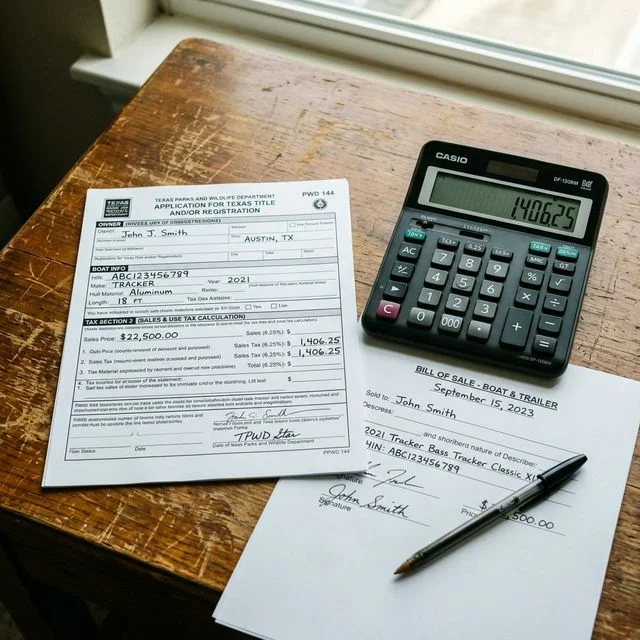
Buying from a Texas dealer: The dealer collects the 6.25 percent sales tax at the point of sale and remits it to TPWD on your behalf. You do not need to take any separate action — the dealer handles everything through Form PWD 143.
Buying from a private seller: You are responsible for paying sales tax directly to TPWD when you submit your title transfer application (Form PWD 143). Payment is due within 45 working days of the purchase date.
Buying from an out-of-state source: You owe Texas use tax (equal to the 6.25 percent sales tax rate) when you bring the boat into Texas for use. Credit is given for sales tax paid in the originating state. For example, if you paid 4 percent sales tax in Oklahoma, you owe only the 2.25 percent difference to Texas.
The Sales Tax Payment Decision Tree
Use this visual guide to determine who collects your tax and what you need to do:
The 45-Day Payment Deadline and Penalties
Texas requires all boat sales tax to be paid within 45 working days of the date of sale (for in-state purchases) or the date the vessel is brought into Texas (for out-of-state purchases). Missing this deadline triggers automatic penalties:
| Days Past Deadline | Penalty Rate | On $3,125 Tax (50K Boat) |
|---|---|---|
| 1 – 30 days | 5% of tax due | $156.25 |
| 31 – 60 days | 10% of tax due | $312.50 |
| 61 – 90 days | 15% of tax due | $468.75 |
| 91 – 120 days | 20% of tax due | $625.00 |
| 121+ days | 25% of tax due (maximum) | $781.25 |
In addition to penalties, interest accrues at 1 percent per month on unpaid tax from the due date. On a $50,000 boat, a 6-month delay could cost over $900 in combined penalties and interest — money entirely avoidable by paying on time.
Use Tax: Buying a Boat Outside Texas
If you purchase a boat in another state and bring it to Texas for use, you owe Texas use tax at the same 6.25 percent rate. This is not double taxation — Texas gives you credit for sales tax already paid in the originating state.
The formula is straightforward: Texas use tax = (6.25% × purchase price) – sales tax paid in other state. If the other state's rate was 6.25 percent or higher, you owe nothing additional to Texas.
Texas actively monitors out-of-state boat acquisitions through registration records. When you apply for Texas registration (Form PWD 143), you must document the original purchase price, any sales tax paid, and where the transaction occurred. Underpaying or failing to report use tax can result in penalties, interest, and potential audit by TPWD.
Temporary Tax Permit (Form PWD 1434)
Texas offers a Temporary Tax Permit (Form PWD 1434) for boat owners who qualify for a specific tax exemption and need additional time. This permit costs $150 and provides up to 90 days of legal operation in Texas without immediately paying sales or use tax.
Key restrictions on the temporary tax permit: it is non-renewable, non-transferable, and non-refundable. Only two permits can be issued for the same vessel in a calendar year, and there must be a minimum 30-day gap between the expiration of the first permit and the issuance of the second.
This permit is particularly relevant for non-residents visiting Texas with their boats or for buyers exploring tax exemption eligibility. It does not substitute for registration if the vessel will be operated on public waters beyond the initial exemption period.
Tax Exemptions for Texas Boats
Texas offers limited sales tax exemptions for boats in specific circumstances:
Commercial fishing vessels used exclusively for commercial fishing purposes may qualify for a sales tax exemption. The vessel must be actively used in a commercial fishing operation and registered as such.
Government-owned vessels operated by state, federal, or local government agencies are exempt from sales tax.
Interstate commerce vessels that primarily operate outside Texas waters may qualify, though documentation requirements are extensive.
Gifts between family members: If a boat is transferred as a bona fide gift (no consideration exchanged), the recipient may qualify for a tax exemption. TPWD requires a signed affidavit confirming the gift and may audit suspected sham transactions.
There is no general "trade-in credit" for boats in Texas the way there is for vehicles. If you trade in a current boat as part of the purchase price, you typically owe sales tax on the full purchase price of the new boat, not the net amount after trade-in.
How Texas Compares to Neighboring States
Understanding how Texas boat sales tax compares to its neighbors helps buyers who have flexibility on where to purchase and register:
| State | State Rate | Max Combined | Sales Tax Cap | Key Difference |
|---|---|---|---|---|
| Texas | 6.25% | 6.25%* | No cap | TPWD collects (boat only, no local tax on vessels) |
| Louisiana | 4.45% | 11%+ | No cap | High local parish taxes can push total above 10% |
| Oklahoma | 4.5% | 11% | $20 cap (excise tax) | Very favorable excise tax cap for boat buyers |
| Arkansas | 6.5% | 11.625% | No cap | Slightly higher base rate than Texas |
| New Mexico | 5.0% | 9.0625% | No cap | Lower base rate but local taxes can add up |
* TPWD collects only the 6.25% state rate on vessels. Local sales taxes generally do not apply to boats processed through TPWD.
For a comprehensive comparison across all 50 states, see our state-by-state cost comparison or use the registration fee calculator to estimate your total costs.
Common Sales Tax Mistakes to Avoid
Underreporting the purchase price. TPWD has access to valuation databases (NADA marine guides, recent comparable sales). If the declared purchase price is significantly below fair market value, TPWD may assess tax based on the higher fair market value and require you to prove the actual sale price with documentation.
Forgetting the trailer is taxed separately. The 6.25 percent TPWD boat tax does not cover the trailer. Trailer sales tax is handled through the County Tax Assessor-Collector at the combined state + local rate (up to 8.25 percent). Many buyers budget only for the boat tax and are surprised by a second tax bill.
Assuming out-of-state purchase avoids Texas tax. Texas use tax mirrors the sales tax rate. Buying a boat in Oklahoma at 4.5 percent still means you owe the 1.75 percent difference when you bring the boat to Texas.
Missing the 45-day deadline. Penalties start at 5 percent and escalate quickly. Set a calendar reminder on the day of purchase. If you are buying from a private seller, submit your PWD 143 paperwork as soon as the transaction is complete — do not wait.
Frequently Asked Questions
What is the sales tax rate on boats in Texas?
Is there a sales tax cap on boats in Texas?
Who collects boat sales tax in Texas - the dealer or TPWD?
Do I owe Texas sales tax if I bought my boat in another state?
What happens if I pay boat sales tax late in Texas?
Is the boat trailer included in the boat sales tax?
Sources
- Texas Parks and Wildlife Department — Boat Sales Tax (https://tpwd.texas.gov/fishboat/boat/)
- Texas Tax Code § 160.021 — Tax on Sale of Vessel or Outboard Motor
- TPWD Form PWD 143 — Vessel/Boat Application (https://tpwd.texas.gov/fishboat/boat/forms/)
- TPWD Form PWD 1434 — Temporary Tax Permit
- Texas Comptroller of Public Accounts — Sales Tax Rates (https://comptroller.texas.gov/taxes/sales/)
This information is provided for reference purposes only. While we strive to keep data accurate and up-to-date, registration requirements, fees, and regulations may change without notice. Always contact your state's official registration agency for the most current and authoritative information before making any decisions.