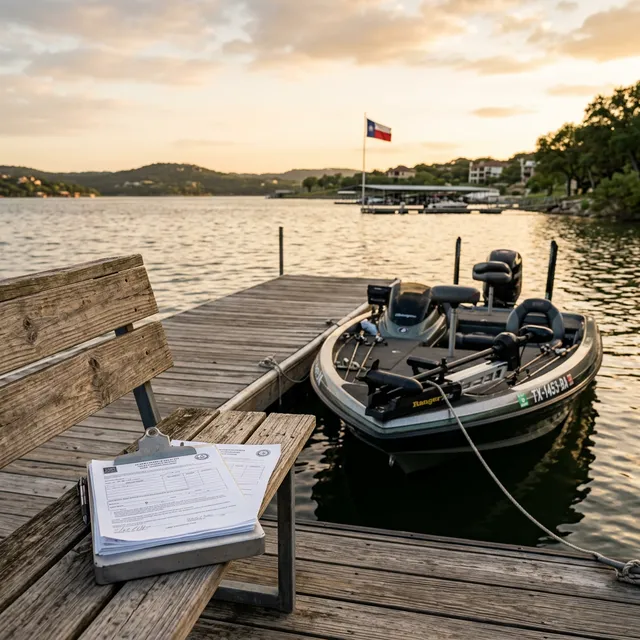
Quick Answer: Which Texas Boat Title Form Do You Need?
For most Texas boat title transfers, the buyer needs PWD 143 (Vessel/Boat Application). See our Texas PWD 143 form instructions for the document checklist. Use PWD 143 to apply for a Texas Certificate of Title, update registration, and report the taxable sale price. If an outboard motor is sold separately, add PWD 144. Sellers should also file PWD 1340 to notify TPWD that ownership changed.
| Search intent | Correct Texas form | What it does |
|---|---|---|
| Transfer a boat title | PWD 143 | Buyer applies for title, registration, and tax processing |
| Sell a boat and protect yourself | PWD 1340 | Seller reports the transfer to TPWD |
| Transfer an outboard motor | PWD 144 | Titles or reports tax for an outboard motor |
| Verify HIN or serial number | PWD 504 | Documents Hull Identification Number or motor serial verification |
Texas boat title paperwork is handled by the Texas Parks and Wildlife Department, not the Texas DMV. Boat trailers are separate and are handled through county tax assessor-collector offices.
How Texas Boat Title Transfer Works
Buying or selling a boat in Texas requires a formal title transfer through the Texas Parks and Wildlife Department (TPWD). Unlike many other states where boat titling runs through the DMV, Texas assigns this responsibility to TPWD — a distinction that catches many first-time boat buyers off guard.
The title transfer process involves a specific set of forms, fees, and deadlines. The most important is PWD 143 (Vessel/Boat Application), which serves as the universal form for titling, registration, and sales tax payment. Understanding this process protects both buyers and sellers, ensures legal ownership, and avoids penalties that accrue when deadlines are missed.
This guide walks through every step of the Texas boat title transfer process, from the forms you need to the offices that handle submissions, with real fee amounts verified against official TPWD sources.
Key Forms for Texas Boat Title Transfer
Texas boat title transfers rely on four primary TPWD forms. Here is what each one does and when you need it:
| Form | Full Name | Purpose | Who Fills It Out |
|---|---|---|---|
| PWD 143 | Vessel/Boat Application | Apply for title, registration, and pay sales tax | Buyer (main applicant) |
| PWD 144 | Outboard Motor Application | Title or sales tax for outboard motors sold separately | Buyer (if motor included) |
| PWD 504 | Verification of Serial Number | Verify Hull Identification Number (HIN) or motor serial | Buyer (with photo evidence) |
| PWD 1340 | Ownership Transfer Notification | Seller notifies TPWD that ownership changed | Seller |
All these forms are available as free PDFs on the TPWD Boating Forms page. Plan for original signatures and confirm the current form instructions before submitting copies or electronic versions.
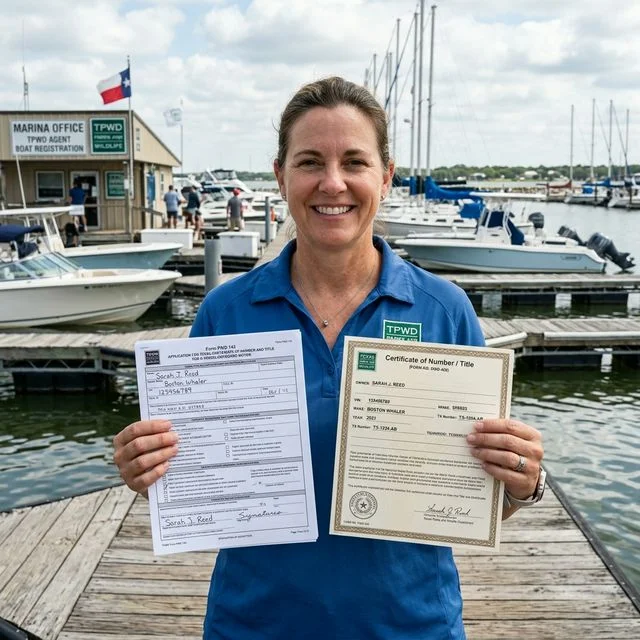
Step-by-Step: Seller Responsibilities
If you are selling a boat in Texas, you have four critical obligations to complete the transfer legally:
Step 1 — Sign the Title. On the back of your Texas Certificate of Title, fill in the buyer's full legal name and address. Sign and date the title assignment section. If there are multiple owners listed on the title, all owners must sign.
Step 2 — Complete the Tax Affidavit. Fill out the tax affidavit portion of Form PWD 143. If an outboard motor is included in the sale, also complete the tax affidavit on Form PWD 144. Sign and date both.
Step 3 — Provide a Bill of Sale. Create a written bill of sale that includes the date of sale, the agreed purchase price (excluding the trailer — TPWD does not handle trailer titles), a description of the vessel (make, model year, TX number or serial number), and signatures of all sellers and buyers.
Step 4 — Notify TPWD. File Form PWD 1340 (Ownership Transfer Notification) with TPWD after the sale. This step is critical because it documents that you sold or no longer own the vessel and helps limit future liability if the buyer fails to transfer the title promptly. TPWD lists an online notification option and a paper form.
Step-by-Step: Buyer Responsibilities
As the buyer, you bear the primary responsibility for completing the title transfer. Here is the process:
Step 1 — Collect Documents from Seller. Obtain the original Texas title (properly signed and assigned by the seller on the back), a bill of sale, and any completed tax affidavit forms. For new boats, you will receive a Manufacturer's Statement of Origin (MSO) instead of a previous title.
Step 2 — Complete Form PWD 143. Fill out the remainder of Form PWD 143 in your name as the new owner. This single form handles your title application, registration, and sales tax payment simultaneously. If an outboard motor is included, also complete Form PWD 144.
Step 3 — Verify the Hull ID Number. Complete Form PWD 504 to verify the vessel's Hull Identification Number (HIN). TPWD typically requires a clear photograph of the HIN plate on the transom of the boat as supporting evidence.
Step 4 — Submit Everything Promptly. Gather all completed forms, the assigned title, bill of sale, and payment for fees and taxes. TPWD's current fee chart says sales/use tax for vessels and outboard motors purchased in Texas on or after September 1, 2019 is due within 45 working days; late tax can trigger penalties and interest.
Where to Submit Your Title Transfer
Texas offers three submission locations for boat title transfers:
TPWD Headquarters in Austin (4200 Smith School Road, Austin, TX 78744) accepts walk-in and mail submissions. TPWD Law Enforcement field offices across the state also process title transfers — find your nearest office on the TPWD Game Warden office locator. Many County Tax Assessor-Collector offices participate in the TPWD title program and can process boat title transfers alongside vehicle titles.
Processing time varies by office, mail volume, lien status, missing documents, and whether the transaction needs additional review. Confirm the expected timing with the office or county agent before relying on a specific delivery date.
Title Transfer Fees
Here is a breakdown of the fees involved in a Texas boat title transfer. These are set by TPWD and verified as of 2026:
| Fee Type | Amount | Notes |
|---|---|---|
| New Title (first-time) | $27.00 | Applies to new boats with MSO |
| Title Transfer (used boat) | $27.00 | Change of ownership on existing title |
| Duplicate Title | $27.00 | Replacement for lost or damaged title |
| Lien Recording | $5.00 | Per lien recorded on the title |
| Sales/use tax | 6.25% | TPWD lists an $18,750 cap for vessels and outboard motors purchased in Texas on or after September 1, 2019 |
Registration fees are separate from title fees and range from $32 (under 16 ft) to $150 (40 ft and over) for a 2-year period. Visit our Texas Boat Registration page for the full fee schedule.
New Boat vs. Used Boat: Key Differences
The title transfer process differs depending on whether you are buying a new or used boat:
New Boat from a Dealer: The dealer typically handles the paperwork. They provide the Manufacturer's Statement of Origin (MSO) instead of a previous title. The dealer may collect sales tax and submit Form PWD 143 on your behalf, but confirm what the dealer is filing and what you must still sign.
Used Boat from a Private Seller: You handle the paperwork yourself. The seller provides the properly assigned previous title. You are responsible for submitting Form PWD 143, paying sales/use tax, and completing Form PWD 504 (serial number verification) if TPWD requires it. For current Texas purchases, TPWD lists a 45-working-day sales/use tax deadline.
Used Boat from a Dealer: Similar to a new boat purchase — the dealer handles most paperwork. However, the dealer provides the previous title (reassigned) rather than an MSO. Sales tax is collected at the point of sale.
TPWD vs. County Tax Assessor: Who Does What?
A common source of confusion in Texas is the split jurisdiction between TPWD and County Tax Assessor-Collector offices. Here is how responsibilities are divided:
The key takeaway: TPWD handles the boat itself; the County Tax Assessor handles the trailer. If you buy a boat-and-trailer package, you will need to process two separate title transfers — one through TPWD (boat) and one through the County Tax Assessor-Collector (trailer, handled by the Texas Department of Motor Vehicles).
The 45-Day Deadline: Penalties for Late Submission
TPWD's current fee chart says sales/use tax for vessels and outboard motors purchased in Texas on or after September 1, 2019 is due within 45 working days. Earlier purchases followed a different 20-working-day rule, so use TPWD's tax calculator or form instructions if you are dealing with an older transaction.
If tax is not paid by the due date, TPWD directs applicants to use Form PWD 930 to calculate the tax, penalties, and interest owed. The practical rule is simple: submit PWD 143, title documents, bill of sale, and tax payment as soon as the sale is complete.
Common Mistakes to Avoid
Based on TPWD guidance and common buyer experiences, here are the most frequent mistakes that delay or complicate Texas boat title transfers:
Forgetting to separate boat and trailer titles. The boat title goes through TPWD; the trailer title goes through the County Tax Assessor. Many buyers try to process both at one office and waste time.
Submitting the wrong signature format. TPWD forms commonly require original signatures. Confirm the current form instructions before relying on scanned, emailed, or photocopied signatures.
Seller not filing PWD 1340. If the seller does not file the Ownership Transfer Notification, TPWD records may still associate the seller with the vessel. Sellers: file this form to document that the boat left your ownership.
Missing the tax deadline. Penalties and interest on late sales/use tax can add up. Set a calendar reminder on the day of purchase.
Not verifying the HIN. Form PWD 504 requires physical verification of the Hull Identification Number. Take a clear photograph of the HIN plate before you submit the paperwork.
Boats Without a Texas Title
If the boat you are purchasing does not have a current Texas title — perhaps it was previously registered in another state or the title has been lost — additional steps are required.
For out-of-state boats, you will need to provide the original title from the previous state and complete a standard Form PWD 143. TPWD will issue a new Texas title based on the out-of-state documentation.
For lost titles, the seller must apply for a duplicate title ($27 fee) before the sale can proceed, or you can explore the bonded title process. See our Texas Bonded Title Guide for details on registering a boat without a title.
For boats without a clear title history, TPWD may direct you to a bonded-title review using PWD 388, or to the separate PWD 1344 process if the boat or outboard motor is actually an abandoned-property case. Do not buy a bond before TPWD reviews the file and tells you the approved path.
Frequently Asked Questions
How much does it cost to transfer a boat title in Texas?
What form do I need to transfer a boat title in Texas?
How long do I have to transfer a boat title in Texas after purchase?
Can I transfer a boat title online in Texas?
Does the seller need to do anything when selling a boat in Texas?
Who handles boat trailer titles in Texas?
Sources
- Texas Parks and Wildlife Department — Boat Titling & Registration (https://tpwd.texas.gov/fishboat/boat/)
- TPWD Form PWD 143 — Vessel/Boat Application (https://tpwd.texas.gov/fishboat/boat/forms/)
- TPWD Form PWD 1340 — Ownership Transfer Notification (https://tpwd.texas.gov/fishboat/boat/forms/)
- Texas Tax Code § 160.021 — Tax on Sale of a Vessel or Outboard Motor
- Guadalupe County Tax Assessor-Collector — Boat Title Transfer Guide (https://www.guadalupetx.gov/)
This information is provided for reference purposes only. While we strive to keep data accurate and up-to-date, registration requirements, fees, and regulations may change without notice. Always contact your state's official registration agency for the most current and authoritative information before making any decisions.