Michigan PWC Laws: Overview
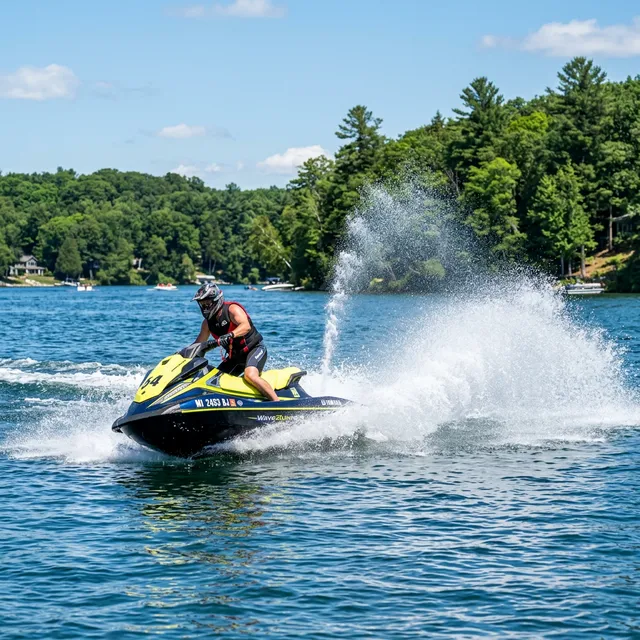
Personal Watercraft (PWC) — including Jet Skis, WaveRunners, and Sea-Doos — have their own specific set of regulations in Michigan that go beyond standard motorized vessel rules. Michigan's PWC laws are some of the most comprehensive in the Great Lakes region.
At a high level, the key rules are: minimum age 14 to operate, boater safety certificate required for operators born after December 31, 1978, no operation between sunset and 8:00 AM, and mandatory PFD and engine cut-off lanyard for all occupants.
This guide covers everything you need to know about legally operating a PWC on Michigan waters. For general boat registration information, see our Michigan boat registration guide.
Age Requirements: Who Can Operate a PWC
Michigan has strict age-based restrictions for PWC operation that differ from standard motorboat rules:
A critical detail that many people miss: the safety certificate birthdate cutoff for PWC is different than for regular motorboats. For standard motorized vessels, the cutoff is July 1, 1996. But for PWC, it's December 31, 1978 — meaning a much wider age group needs certification to ride a jet ski.
Registration Requirements for PWC
All PWCs must be registered with the Michigan Secretary of State, just like any other motorized vessel. The registration process is identical to standard boats:
| Item | Details |
|---|---|
| Registration period | 3 years (expires March 31 of the third year) |
| Registration fee | Based on vessel length — most PWCs fall in the lowest tier (~$14-$48/3 years) |
| Title required? | Yes, if PWC has a permanently affixed engine (most jet skis do) |
| Title fee | $5 (standard) or $10 (instant) |
| Sales/Use tax | 6% of purchase price |
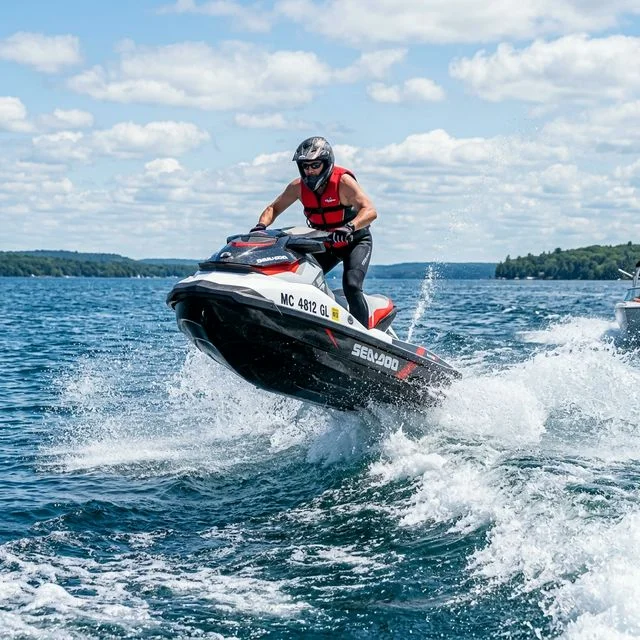
| MC numbers | Must be displayed on the hull in 3-inch block letters |
Most PWCs have permanently affixed (inboard) engines, which means they require titles regardless of their short length (typically 8-12 ft). This is a key difference from outboard-powered boats under 20 ft, which do not need titles. For more on titles, see our Michigan title transfer guide and registering without title guide.
Mandatory Safety Equipment
Michigan's PWC safety equipment requirements are more stringent than those for standard boats. Every PWC must have:
| Equipment | Requirement |
|---|---|
| PFD (Life Jacket) | USCG-approved Type I, II, or III for every person on board AND anyone being towed. Inflatable PFDs are NOT allowed for PWC use. |
| Engine cut-off lanyard | Must be attached from operator's PFD, person, or clothing to the ignition switch at all times during operation |
| Fire extinguisher | Required (most PWCs have enclosed engine compartments) |
| Sound device | Whistle or horn required |
| Visual distress signals | Required on Great Lakes waters only |
Important PFD note: Unlike standard boats where inflatable PFDs are generally acceptable, Michigan explicitly prohibits inflatable PFDs on PWC. This applies to all occupants and anyone being towed behind the PWC. Traditional foam PFDs (Type I, II, or III) are the only approved options.
Operating Hours and Speed Restrictions
Michigan imposes specific time and distance restrictions on PWC operation that do not apply to other vessel types:
The sunset-to-8 AM restriction is one of the strictest in the country for PWC. Unlike some states that allow operation until a set clock time, Michigan ties the restriction to actual sunset — which means operating hours change throughout the summer season.
The distance restrictions mean PWC operators must maintain a slow, no-wake speed within 150 ft of other vessels (when crossing behind them), within 200 ft of Great Lakes shoreline (when traveling parallel), and within 100 ft of docks, moored vessels, rafts, or swimming areas.
BUI (Boating Under the Influence)
Operating a PWC under the influence of alcohol or drugs is illegal in Michigan and carries the same penalties as drunk driving on land. Michigan's legal BAC limit for boaters is 0.08% for adults (same as motor vehicles) and zero tolerance for those under 21.
Penalties for BUI can include fines, jail time, mandatory boating safety courses, and loss of boating privileges. Law enforcement officers can administer field sobriety tests and breathalyzer tests on the water.
Given the physical demands of PWC operation — balance, reaction time, spatial awareness — alcohol impairment is particularly dangerous on a jet ski. Studies show that the combined effects of sun, wind, noise, and vibration can amplify the effects of alcohol consumption while boating.
Towing Behind a PWC
Michigan allows towing activities (water skiing, tubing, wakeboarding) behind PWC that are designed for three or more persons. Key rules for towing behind a PWC:
- PWC capacity: Must be rated for at least 3 persons (operator + observer + one more seat)
- Observer required: An observer (in addition to the driver) must be on the PWC watching the person being towed
- PFD for towed person: The person being towed must wear a USCG-approved non-inflatable PFD
- Operating hours: Towing is only allowed during legal PWC operating hours (8 AM to sunset)
- No towing after dark: Since PWC cannot operate after sunset, nighttime towing is never permitted
Two-person PWC models cannot be used for towing because there is no room for the required observer. Always check your PWC's capacity plate before attempting any towing activities.
PWC Rental Operations
Michigan has specific rules for PWC rental businesses, which are relevant if you're renting a jet ski while visiting the state:
- Pre-ride instruction: Rental operators must provide instruction on safe operation before renting a PWC
- Age verification: Rental operators must verify the renter meets age requirements
- Safety equipment: Rental operators must provide all required safety equipment including proper PFDs and engine cut-off lanyards
- Safety certificate: Renters born after December 31, 1978 must still have a valid boating safety certificate — rental operators should verify this
As a renter, you are responsible for following all Michigan PWC laws during your rental period. Violations are issued to the operator, not the rental company.
Michigan vs. Neighboring States: PWC Laws Comparison
If you ride your jet ski across state lines on the Great Lakes, be aware that PWC rules vary by state:
| Rule | Michigan | Ohio | Wisconsin | Indiana |
|---|---|---|---|---|
| Minimum age | 14 | 12 (with cert) | 12 (with adult) | 15 (or 14 with cert) |
| Nighttime ops | Sunset-8 AM banned | Sunset-sunrise | Sunset-sunrise | Sunset-sunrise |
| Safety cert required | Born after 12/31/78 | Born after 1/1/82 | Born after 1/1/89 | All operators |
| Inflatable PFD | Not allowed | Not allowed | Not allowed | Not allowed |
Michigan's 8 AM start time is notably later than neighboring states that allow operation at sunrise. If you're an early-morning rider, be aware of this restriction when visiting Michigan waters. For complete registration details in neighboring states, visit our state comparison page.
Common Violations and Penalties
Michigan DNR Conservation Officers actively enforce PWC regulations, especially during summer weekends and holidays. The most common violations include:
- Operating during restricted hours — before 8 AM or after sunset
- No boater safety certificate — particularly for operators born after 12/31/1978
- Underage operator without supervision — minors 14-15 without an adult on board or nearby
- Missing or improper PFD — wearing an inflatable PFD or not wearing one at all
- No engine cut-off lanyard attached — lanyard must be connected during operation
- Reckless operation — excessive speed near shore, jumping wakes too close to other boats
- Operating under the influence — BAC ≥ 0.08% or any controlled substance
Fines for PWC violations in Michigan range from civil infraction fines to misdemeanor charges for serious offenses like BUI or reckless operation causing injury. Multiple violations can result in loss of boating privileges.
Frequently Asked Questions
What is the minimum age to ride a jet ski in Michigan?
Do I need a boater safety certificate for a jet ski in Michigan?
What hours can I ride a jet ski in Michigan?
Can I use an inflatable life jacket on a jet ski in Michigan?
Can I tow a tuber behind my jet ski in Michigan?
Sources
- Michigan Department of Natural Resources — PWC Operating Rules (https://www.michigan.gov/dnr/things-to-do/boating)
- Michigan Legislature — Natural Resources and Environmental Protection Act, Part 801
- Michigan Secretary of State — Watercraft Registration (https://www.michigan.gov/sos/vehicle/boat)
- USCG Boating Safety — PFD Requirements (https://www.uscgboating.org/recreational-boaters/equipment-requirements.php)
This information is provided for reference purposes only. While we strive to keep data accurate and up-to-date, registration requirements, fees, and regulations may change without notice. Always contact your state's official registration agency for the most current and authoritative information before making any decisions.